
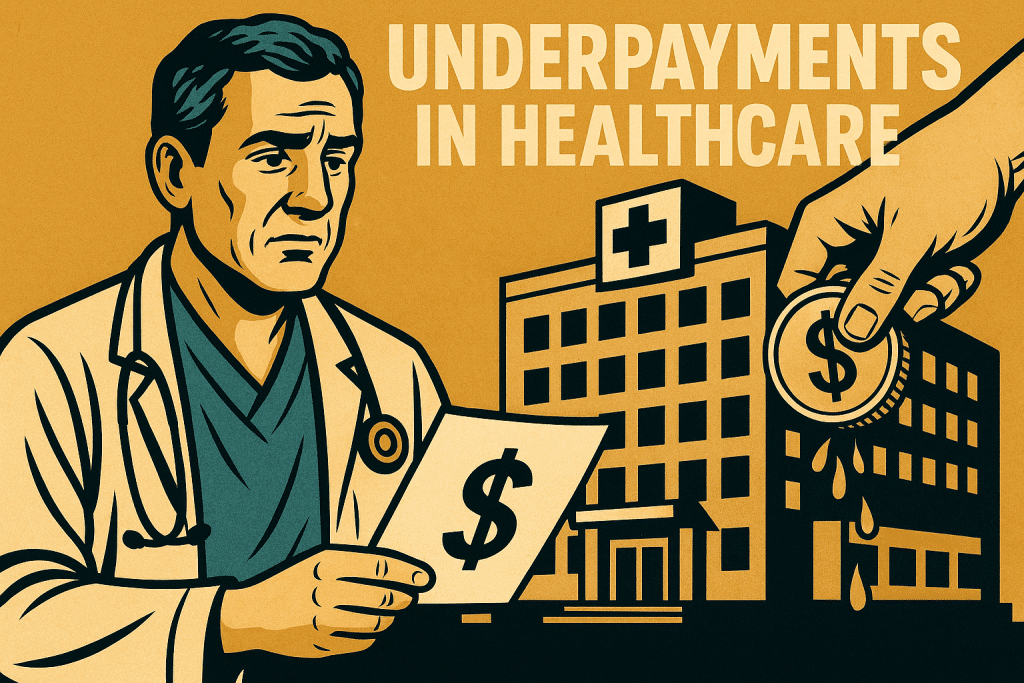
What are underpayments in healthcare? Underpayments in healthcare occur when insurance companies, such as Medicare or Medicaid, pay less money than they should for medical services. These payment shortfalls cost healthcare providers billions of dollars annually and can compromise the quality of patient care.
Understanding Healthcare Underpayments and Their Impact
Healthcare underpayments occur when medical providers receive less money than the agreed-upon contract rates or established fee schedules. This problem affects hospitals, clinics, doctor offices, and other healthcare facilities across the country. Insurance companies may underpay due to processing errors, contract disputes, or incorrect claim information. Medicare and Medicaid also contribute to underpayments through complex reimbursement rules and rate adjustments.
The financial impact of underpayments in healthcare is enormous. Studies show that healthcare providers lose an average of 1% to 3% of their total revenue due to underpayments. For a hospital with $100 million in annual revenue, this represents a loss of $1 million to $3 million in income each year. These losses compel healthcare organizations to reduce staff, postpone equipment purchases, or curtail patient services to maintain financial stability.

Common Types of Healthcare Underpayments
Several types of underpayments plague the healthcare industry, each with different causes and solutions. Contract underpayments happen when insurance companies pay less than the negotiated rates in provider contracts. These errors often result from outdated fee schedules, incorrect contract terms in payment systems, or deliberate attempts to reduce payments. Providers must carefully review each payment against their contracts to identify these discrepancies.
Coding and billing underpayments occur when claims are processed incorrectly due to medical coding errors or incomplete documentation. Insurance companies may downcode procedures to lower-paying codes or deny portions of claims due to missing information. Administrative underpayments result from system errors, duplicate payment deductions, or incorrect patient eligibility determinations. Each type requires different identification and recovery strategies.
Why Healthcare Underpayments Occur
Healthcare underpayments stem from the complex nature of medical billing and insurance processing. Insurance companies process millions of claims each month using automated systems that may contain errors or outdated information. Contract terms between providers and payers often include complicated fee schedules, modifier rules, and payment adjustments that create confusion during processing. When systems cannot properly interpret these complex rules, underpayments frequently result.
Human error also contributes significantly to underpayments in healthcare. Medical coders may select incorrect procedure codes, billing staff might enter wrong patient information, and insurance processors could misinterpret contract terms. Additionally, some insurance companies may intentionally underpay claims, knowing that many providers lack the resources to identify and appeal every discrepancy. This practice, sometimes referred to as “claims leakage,” results in billions of dollars in lost revenue across the healthcare industry.
Technology and System Integration Challenges
The healthcare industry utilizes numerous software systems that often fail to communicate effectively with one another. Electronic health records, billing systems, and insurance processing platforms may utilize different data formats or update schedules, leading to inconsistencies in claim processing. When provider systems contain different contract terms than payer systems, underpayments become inevitable. These technology gaps require constant monitoring and correction to prevent revenue loss.
Legacy systems in healthcare organizations often lack the sophisticated analytics necessary to identify underpayments quickly. Many providers still rely on manual processes to review payments, making it difficult to identify errors before claims become too old to be appealed. Modern healthcare revenue cycle management requires integrated systems that can automatically flag potential underpayments for review.

Identifying Healthcare Underpayments
Detecting underpayments in healthcare requires systematic review processes and analytical tools. Healthcare providers should conduct regular contract compliance audits to compare actual payments with contracted rates. These audits help identify patterns of underpayment from specific insurance companies or for particular types of services. Many providers use specialized software that automatically compares payments to contracts and flags discrepancies for further investigation.
Payment variance analysis is another effective method for identifying underpayments. This process involves comparing payments for similar services across different patients and insurance plans to identify unusually low payments. Providers should also monitor their key performance indicators, such as days in accounts receivable and collection rates, to identify trends that might indicate systematic underpayment issues.
Advanced Analytics and Reporting Tools
Modern healthcare organizations use sophisticated analytics platforms to identify underpayments more efficiently. These tools can analyze thousands of claims simultaneously, comparing payments against contract terms and historical patterns. Machine learning algorithms can identify subtle patterns in underpayments that human reviewers might miss, such as specific procedure codes that consistently receive lower payments than expected.
Predictive analytics help healthcare providers anticipate which claims are most likely to be underpaid before they are processed. By identifying high-risk claims early, providers can take proactive steps to ensure proper documentation and coding, reducing the likelihood of underpayments. These advanced tools represent the future of healthcare revenue cycle management and underpayment prevention.
The Cost of Healthcare Underpayments
Healthcare underpayments create a significant financial strain on medical providers and ultimately affect the quality of patient care. The direct cost includes the lost revenue from underpaid claims; however, the indirect costs are often significantly higher. Providers must invest in staff time to identify, appeal, and collect underpayments, which can cost $25 to $50 per claim to resolve. For large healthcare systems processing hundreds of thousands of claims annually, these administrative costs can reach millions of dollars.
The opportunity cost of healthcare underpayments is equally important to consider. Money lost to underpayments could have been invested in new medical equipment, additional staff, or facility improvements that directly benefit patients. When healthcare providers cannot collect their full contracted payments, they may delay necessary upgrades or reduce services, ultimately impacting the quality of care they can provide to their communities.
| Healthcare Setting | Average Underpayment % | Annual Revenue Loss | Recovery Potential |
|---|---|---|---|
| Large Hospitals | 2% – 4% | $2M – $8M | $1.5M – $6M |
| Physician Groups | 1% – 3% | $100K – $900K | $75K – $675K |
| Specialty Clinics | 2% – 5% | $200K – $1.5M | $150K – $1.2M |
| Outpatient Surgery Centers | 3% – 6% | $300K – $1.8M | $225K – $1.4M |
Preventing Healthcare Underpayments
Preventing healthcare underpayments requires a comprehensive approach that addresses the root causes of payment errors. Healthcare providers should implement robust contract management systems that ensure all fee schedules and payment terms are accurately loaded into their billing systems to ensure accurate and timely billing. Regular contract audits help identify discrepancies between negotiated rates and system settings before they result in underpayments. Staff training programs should emphasize the importance of accurate coding and documentation to minimize claim processing errors.
Technology solutions play a crucial role in preventing underpayments in healthcare. Automated contract modeling software can flag potential payment discrepancies before claims are submitted, allowing providers to correct errors proactively. Real-time eligibility verification systems help ensure that claims are submitted to the correct insurance companies with accurate patient information. These preventive measures are much more cost-effective than trying to recover underpayments after they occur.
Best Practices for Healthcare Revenue Cycle Management
Successful healthcare organizations implement comprehensive revenue cycle management programs that focus on preventing underpayments from the start. These programs include regular staff training on coding and billing best practices, monthly contract compliance reviews, and automated payment variance monitoring. Leading healthcare providers also establish dedicated teams to manage payer relationships and resolve payment disputes quickly.
Benchmarking against industry standards helps healthcare providers identify areas where their underpayment rates may be higher than average. Organizations should track key metrics such as clean claim rates, first-pass resolution rates, and average payment turnaround times to identify opportunities for improvement. Regular performance reviews with insurance companies can help address systemic issues that contribute to underpayments.
Recovering Healthcare Underpayments
When underpayments in healthcare occur, providers must act quickly to recover lost revenue. Most insurance contracts include specific timeframes for filing appeals, typically 90 to 180 days from the original payment date. Healthcare providers should maintain detailed documentation of all contracted rates and payment terms to support their underpayment claims. Organized appeals process with clear workflows help ensure that recovery efforts are efficient and effective.
The appeals process for healthcare underpayments typically involves submitting formal requests for payment review along with supporting documentation. Providers must demonstrate that the original payment was incorrect by referencing specific contract terms or fee schedules. Many successful appeals include detailed explanations of the services provided and why the higher payment amount is justified. Persistence is often required, as initial appeals may be denied and require further review.
Working with Professional Recovery Services
Many healthcare providers collaborate with specialized underpayment recovery companies that possess expertise in identifying and recovering lost revenue. These firms typically work on a contingency basis, collecting a percentage of recovered funds in exchange for their services. Professional recovery services often have better success rates than internal staff because they specialize in payer contract analysis and appeals processes.
The decision to use external recovery services depends on the provider’s internal capabilities and the complexity of their underpayment issues. Large healthcare systems may have dedicated teams for underpayment recovery, while smaller practices might benefit from outsourcing this function. Regardless of the approach, successful underpayment recovery requires systematic processes and detailed documentation to maximize collection rates.
The Future of Healthcare Underpayments
The healthcare industry is evolving toward more transparent and automated payment processes that should reduce underpayments over time. Value-based care contracts are becoming more common, which may simplify payment structures and reduce the complexity that leads to underpayments. Electronic prior authorization systems and real-time claim adjudication are also helping to identify and resolve payment issues before they become underpayments.
Artificial intelligence and machine learning technologies are being integrated into healthcare revenue cycle management systems to predict and prevent underpayments. These advanced technologies can analyze vast amounts of data to identify patterns and anomalies that human reviewers might miss. As these technologies become more sophisticated and widely adopted, the prevalence of healthcare underpayments is expected to decrease significantly.
Conclusion
Healthcare underpayments represent a significant financial challenge that affects providers across all segments of the healthcare industry. Understanding what underpayments are, why they occur, and how to prevent and recover them is essential for maintaining healthy revenue cycles. Healthcare providers must implement comprehensive strategies that include prevention, detection, and recovery processes to minimize the impact of underpayments on their operations. With proper systems and processes in place, healthcare organizations can recover millions of dollars in lost revenue while improving their overall financial performance.
What Are Underpayments in Healthcare FAQs
How common are underpayments in healthcare?
How common are underpayments in healthcare? Underpayments in healthcare are very common, affecting virtually all healthcare providers and resulting in annual revenue losses of 1% to 6%. Studies show that most healthcare organizations experience underpayments on 10% to 30% of their claims.
What is the average time to recover healthcare underpayments?
What is the average time to recover healthcare underpayments? The average time to recover healthcare underpayments ranges from 30 to 120 days, depending on the type of underpayment and the complexity of the appeal process. Simple contract underpayments typically resolve faster than complex coding disputes.
Can healthcare providers prevent all underpayments?
Can healthcare providers prevent all underpayments? Healthcare providers cannot prevent all underpayments due to the complexity of medical billing and insurance processing, but they can significantly reduce them through proper systems and processes. Most organizations can prevent 60% to 80% of underpayments with effective prevention strategies.

Paul Kohn MBA is a seasoned business consultant known for helping businesses maximize tax credits and incentives to fuel growth and profitability. He holds a Master’s in Business Administration and has helped numerous companies secure millions in tax credits and implement effective business strategies. He is regarded as a trusted authority for business owners seeking to optimize their savings and growth.