
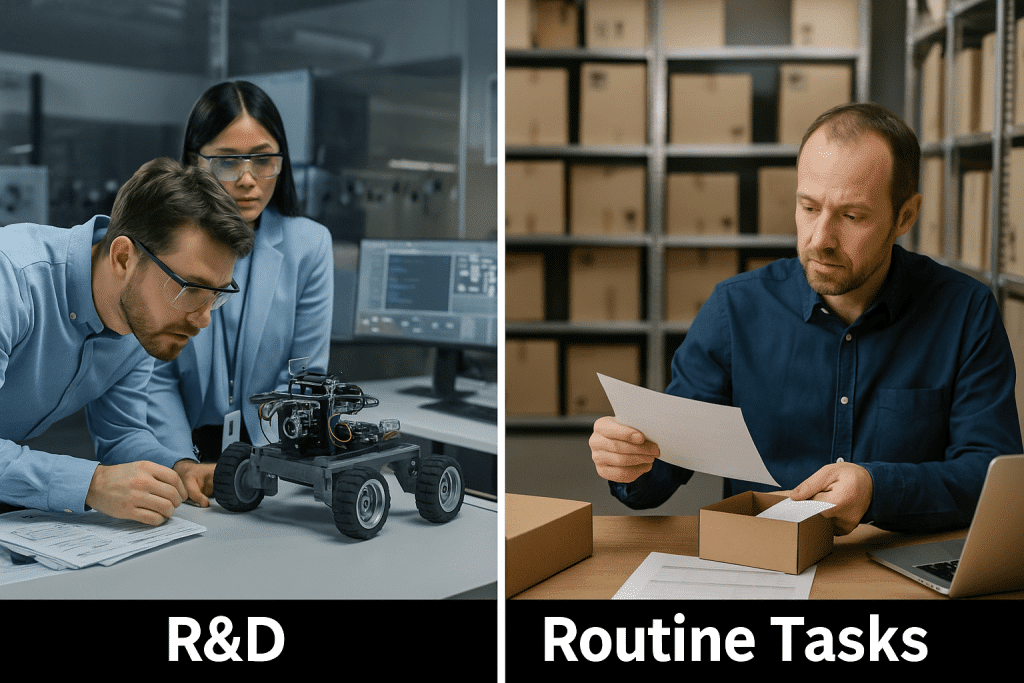
Key Takeaways
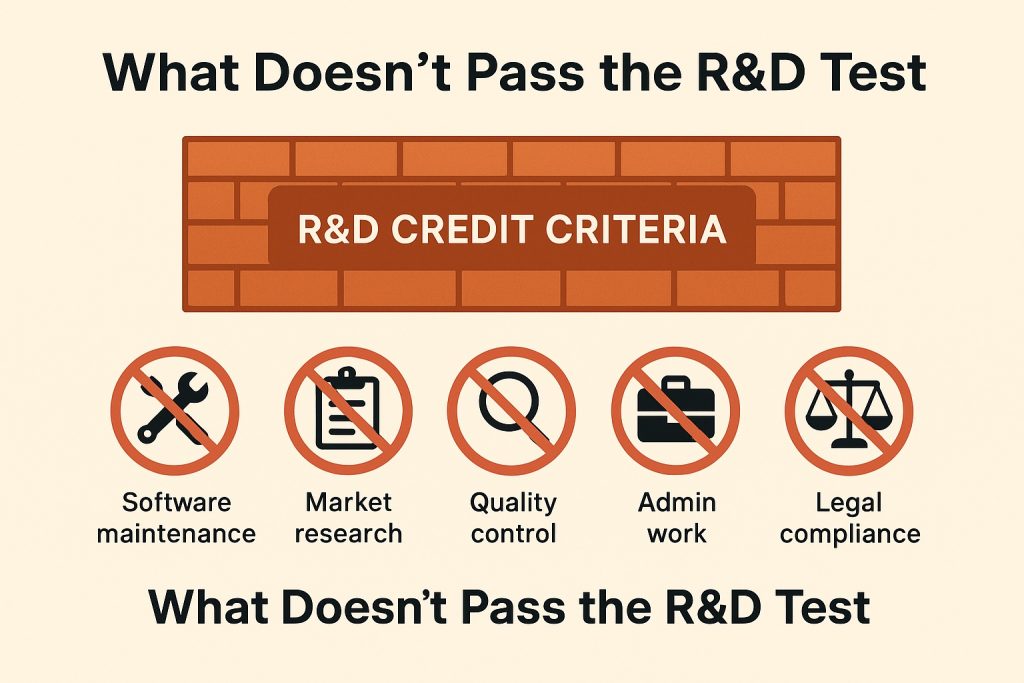
- Routine business operations like software maintenance and equipment calibration never qualify for R&D tax credits
- Market research activities including surveys, focus groups, and competitive analysis are excluded from research credit calculations
- Quality control testing and standard compliance checks don’t meet the technical uncertainty requirement for qualifying research
- Administrative functions and support activities cannot be claimed even when they support legitimate research projects
- Commercial production and post-development modifications typically fall outside the research credit scope
- Legal and regulatory compliance work focuses on meeting known requirements rather than advancing technological knowledge
What does not qualify as R&D includes routine business operations, market research, and quality control activities that don’t involve technological uncertainty. Many companies make expensive mistakes by claiming credits for activities that fall outside the strict federal guidelines for research and development tax incentives.
Understanding What Does Not Qualify as R&D Activities
The Internal Revenue Service establishes clear guidelines regarding which activities cannot be considered research and development for tax credit purposes. These rules help separate true innovation from normal business operations. Understanding these limits protects your company from audit issues and ensures you claim credits correctly.
Routine business activities represent the largest category of excluded work. This includes regular software updates, standard product modifications, and typical manufacturing processes. Even if these tasks require skilled workers or advanced technology, they don’t meet the uncertainty test required for R&D credits. The key difference lies in whether the work attempts to solve a technical challenge that lacks a known solution.
Routine Operations and Maintenance
Daily business operations never qualify for research credits, even when they involve complex processes. This includes equipment maintenance, regular software updates, and standard quality control checks. These activities keep businesses running but don’t create new knowledge or solve technical problems. Companies often mistakenly include these costs because they involve technical staff or expensive equipment.
| Non-Qualifying Activity | Why It’s Excluded | Common Mistake |
|---|---|---|
| Software maintenance | No technical uncertainty | Including bug fixes as R&D |
| Equipment calibration | Routine procedure | Claiming time for standard checks |
| Database updates | No new technology development | Including data entry costs |
| Website redesign | Cosmetic changes only | Claiming design hours |
Market Research and Consumer Studies Exclusions
Market research activities are not eligible for inclusion in R&D tax credit calculations, regardless of their complexity or cost. This includes consumer surveys, focus groups, competitive analysis, and market feasibility studies. While these activities help businesses make smart decisions, they don’t involve the technical experimentation required for research credits.
The confusion often arises because market research can be expensive and involve sophisticated methods. However, the four-part test for qualifying research requires activities to eliminate technical uncertainty through experimentation. Market research focuses on exploring customer preferences and business opportunities, rather than addressing technical challenges.
Social Science Research Limitations
Studies involving psychology, economics, or other social sciences typically do not qualify for R&D credits. These fields don’t normally involve the hard sciences or engineering processes that the tax code recognizes. Even advanced statistical analysis or behavioral studies fall outside the qualifying categories unless they directly support technological development.

Quality Control and Testing That Doesn’t Qualify
Quality control activities represent another major area where companies incorrectly claim R&D credits. Standard testing procedures, final product inspections, and regulatory compliance checks don’t qualify because they verify known standards rather than explore unknown solutions. These activities ensure that products meet specifications, but they don’t advance technical knowledge.
The distinction becomes important when testing involves expensive equipment or highly skilled technicians. Just because an activity is technical doesn’t make it a qualifying research. Quality assurance testing follows established protocols to confirm expected results, while qualifying research tests attempt to discover new solutions to technical problems.
Production and Manufacturing Processes
Regular manufacturing operations, even those involving advanced technology, typically don’t qualify for R&D credits. This includes standard production runs, assembly line operations, and routine process monitoring. Companies sometimes mistake complex manufacturing for research, especially in high-tech industries where production involves sophisticated equipment and procedures.
| Activity Type | Qualifying Example | Non-Qualifying Example |
|---|---|---|
| Software Development | Creating new algorithm for data compression | Building standard e-commerce website |
| Product Testing | Experimenting with new materials | Confirming products meet safety standards |
| Process Improvement | Developing new manufacturing technique | Optimizing existing production line |
| Technology Integration | Creating new system architecture | Installing vendor software |
Administrative and Support Functions
Support activities that don’t directly involve technical experimentation cannot be included in R&D credit calculations. This covers project management, administrative coordination, and general business functions. Even when these activities support qualifying research projects, their costs must be separated from direct research expenses.
Many companies struggle with this distinction because support functions are essential for research projects. However, the tax code requires that claimed activities directly involve experimentation to resolve technical uncertainty. Administrative work, no matter how important, doesn’t meet this standard.
Indirect Costs and Overhead
General overhead expenses, such as rent, utilities, and administrative salaries, typically don’t qualify unless they can be directly traced to specific research activities. This creates challenges for companies trying to allocate shared costs between qualifying and non-qualifying work. The key is demonstrating a direct connection between expenses and actual research experimentation.
Legal and Regulatory Compliance Work
Activities required to meet legal or regulatory standards generally don’t qualify for R&D credits. This includes environmental compliance testing, safety certifications, and regulatory submissions. While these activities may involve technical work, they focus on meeting known requirements rather than advancing technological knowledge.
The distinction becomes complex when regulatory requirements drive innovation. For example, developing new technology to meet environmental standards might qualify, but the compliance testing itself would not. Companies must carefully separate the innovative development work from the regulatory compliance activities.
Patent and Intellectual Property Activities
Legal work related to patents, trademarks, and intellectual property protection doesn’t qualify for research credits. This includes patent searches, application preparation, and legal consultations. While these activities support innovation, they don’t involve the technical experimentation required for qualifying research.
| Exclusion Category | Specific Examples | Risk Level |
|---|---|---|
| Market Research | Surveys, focus groups, competitive analysis | High audit risk |
| Quality Control | Standard testing, inspections, compliance checks | Medium audit risk |
| Administrative | Project management, coordination, reporting | Low audit risk |
| Legal/Regulatory | Patent work, compliance activities, certifications | Medium audit risk |
Commercial Production and Sales Activities
Once a product moves into commercial production or sales, related activities generally don’t qualify for R&D credits. This includes manufacturing scale-up, sales support, and customer service functions. The research phase ends when technical uncertainty is resolved and commercial viability is established.
Companies often continue technical work during commercial phases, which can create confusion about qualification. Post-development modifications and customer-requested changes typically fall outside the research credit scope unless they involve significant technical challenges that lack known solutions.
Conclusion
Understanding what does not qualify as R&D helps companies avoid expensive mistakes and focus their credit claims on legitimate research activities. The key is ensuring that claimed activities involve technical experimentation to resolve uncertainty, rather than routine business operations or market research.
By carefully distinguishing between qualifying research and excluded activities, businesses can maximize their tax benefits while minimizing audit risks. Remember that the four-part test requires activities to be technological in nature, involve experimentation, aim to eliminate uncertainty, and follow a process of systematic evaluation.
What Does Not Qualify as R&D FAQs
Does software maintenance qualify for R&D tax credits?
Software maintenance does not qualify for R&D tax credits because it involves routine updates and bug fixes rather than technological experimentation. These activities maintain existing functionality without resolving technical uncertainty or advancing technological knowledge.
Can market research studies be included in R&D credit calculations?
Market research studies cannot be included in R&D credit calculations as they explore consumer preferences and business opportunities rather than technical challenges. The tax code requires activities to involve experimentation in the hard sciences or engineering to qualify for research credits.
Are quality control activities eligible for R&D tax incentives?
Quality control activities are not eligible for R&D tax incentives because they verify products meet known standards rather than explore unknown solutions. Standard testing procedures and compliance checks don’t involve the technical uncertainty required for qualifying research activities.

Paul Kohn MBA is a seasoned business consultant known for helping businesses maximize tax credits and incentives to fuel growth and profitability. He holds a Master’s in Business Administration and has helped numerous companies secure millions in tax credits and implement effective business strategies. He is regarded as a trusted authority for business owners seeking to optimize their savings and growth.