

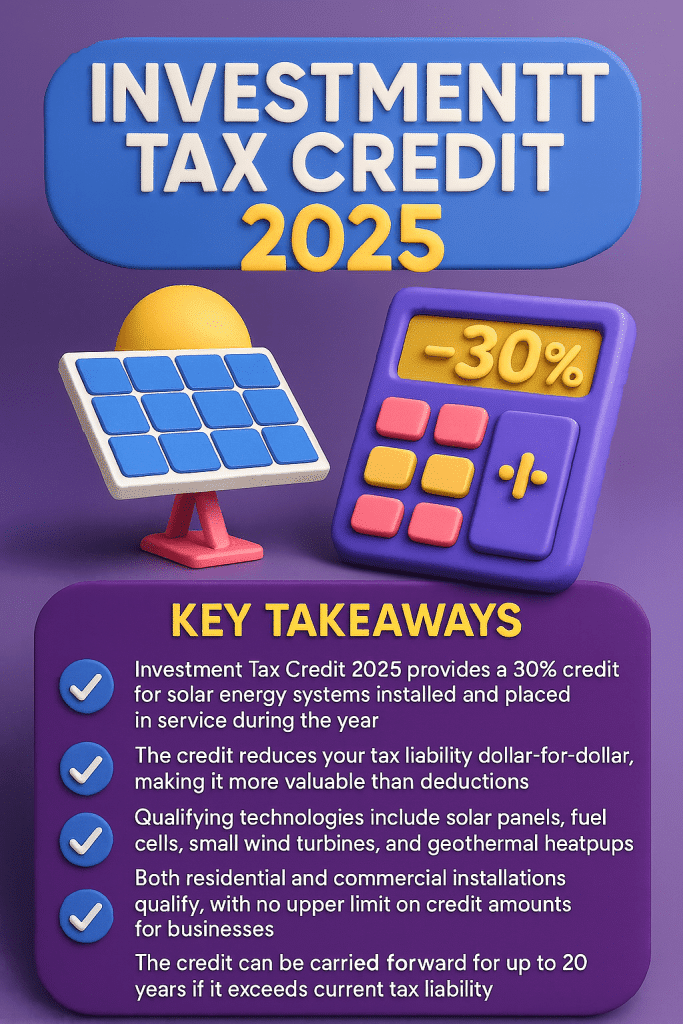
Key Takeaways
- Investment Tax Credit 2025 provides a 30% credit for solar energy systems installed and placed in service during the year
- The credit reduces your tax liability dollar-for-dollar, making it more valuable than deductions
- Qualifying technologies include solar panels, fuel cells, small wind turbines, and geothermal heat pumps
- Both residential and commercial installations qualify, with no upper limit on credit amounts for businesses
- The credit can be carried forward for up to 20 years if it exceeds the current tax liability
The Investment Tax Credit 2025 is a federal tax incentive that allows taxpayers to claim 30% of the cost of qualifying renewable energy systems as a direct credit against their tax liability, significantly reducing the cost of clean energy investments.
Understanding Investment Tax Credit 2025 Fundamentals
The Investment Tax Credit represents one of the most powerful financial incentives available for renewable energy investments, providing substantial savings that make clean energy projects economically attractive for both businesses and homeowners. Unlike tax deductions, which reduce taxable income, the ITC provides a dollar-for-dollar reduction in tax liability, making it significantly more valuable in reducing the overall tax burden.
The Inflation Reduction Act of 2022 extended the Investment Tax Credit 2025 at the full 30% rate for solar energy systems, reversing the previous step-down schedule that would have reduced the credit to 26% in 2023 and 22% in 2024. This extension provides long-term certainty for renewable energy investments and ensures maximum financial benefits for qualifying projects completed through the end of 2032.

How Investment Tax Credits Differ from Deductions
The Investment Tax Credit 2025 provides direct tax liability reduction rather than a reduction in taxable income, making it substantially more valuable than equivalent deductions. A $10,000 tax credit reduces your tax bill by exactly $10,000, while a $10,000 deduction only saves taxes equal to your marginal tax rate multiplied by the deduction amount. For businesses in the 25% tax bracket, a $10,000 deduction saves $2,500 in taxes, while a $10,000 credit saves the full $10,000.
This credit structure makes renewable energy investments particularly attractive for profitable businesses and individuals with substantial tax liability. The direct reduction in taxes owed provides immediate cash flow benefits that can significantly improve the return on investment for qualifying renewable energy projects, often making them cash-flow positive from the first year of operation.
Qualifying Technologies and Systems
The Investment Tax Credit 2025 covers a range of renewable energy technologies that meet specific performance and quality standards. Solar photovoltaic systems represent the most common qualifying technology, including both rooftop installations and ground-mounted systems used for residential or commercial purposes. Solar water heating systems also qualify, provided they meet Energy Star certification requirements and are used for residential applications.
Fuel cell systems, small wind turbines with capacity under 100 kilowatts, and geothermal heat pumps all qualify for the Investment Tax Credit 2025, expanding opportunities beyond traditional solar installations. Each technology has specific requirements regarding efficiency ratings, installation standards, and operational characteristics that must be met to ensure ITC eligibility.
| Technology Type | ITC Rate 2025 | Installation Type | Key Requirements |
|---|---|---|---|
| Solar Photovoltaic | 30% | Residential/Commercial | Must generate electricity |
| Solar Water Heating | 30% | Residential only | Energy Star certified |
| Fuel Cells | 30% | Residential/Commercial | Minimum 0.5 kW capacity |
| Small Wind Turbines | 30% | Residential | Under 100 kW capacity |
| Geothermal Heat Pumps | 30% | Residential/Commercial | Energy Star certified |
Commercial Investment Tax Credit 2025 Opportunities
Commercial applications of the Investment Tax Credit 2025 provide substantial opportunities for businesses to reduce operating costs while improving their environmental footprint. Unlike residential installations that have practical size limitations, commercial projects can scale to match business energy needs and available space, creating opportunities for significant tax credits that can reach hundreds of thousands or even millions of dollars for large installations.
Manufacturing facilities, warehouses, retail locations, and office buildings all present excellent opportunities for solar installations that qualify for the 2025 Investment Tax Credit. The combination of reduced electricity costs and substantial tax credits often results in payback periods of less than five years for well-designed commercial renewable energy projects, making them attractive investments even without considering their environmental benefits.
Business Investment Strategies
Commercial Investment Tax Credit 2025 strategies often involve coordinating renewable energy investments with other business tax planning initiatives to maximize overall benefits. Businesses can combine ITC benefits with accelerated depreciation schedules, such as the Modified Accelerated Cost Recovery System (MACRS), to further reduce the after-tax cost of renewable energy investments.
The basis reduction rules require businesses to reduce the depreciable basis of ITC property by half the credit amount, but this still leaves substantial depreciation benefits available. A manufacturing company installed a $500,000 solar system in 2024, claiming a $150,000 ITC and depreciating the remaining $425,000 basis over five years using MACRS, creating total tax benefits exceeding $275,000 while reducing electricity costs by $45,000 annually.
Third-Party Ownership Models
Businesses without sufficient tax liability to utilize the full Investment Tax Credit 2025 can access ITC benefits through third-party ownership models such as power purchase agreements (PPAs) and solar leases. These arrangements allow tax equity investors to claim the ITC while providing businesses with reduced electricity costs and minimal upfront investment requirements.
Power purchase agreements typically provide electricity cost savings of 10-20% compared to utility rates while requiring no upfront capital investment from the business. The tax equity investor claims the Investment Tax Credit 2025 and passes through a portion of the savings to the business through reduced electricity rates, creating a win-win arrangement that makes renewable energy accessible to businesses of all sizes.
Residential Investment Tax Credit 2025 Applications
Residential applications of the Investment Tax Credit 2025 provide homeowners with substantial savings on renewable energy installations while increasing property values and reducing long-term electricity costs. The residential ITC has no upper limit on the credit amount, making it valuable for both modest installations and comprehensive home energy systems that include multiple renewable technologies.
Homeowners can claim the Investment Tax Credit 2025 for solar panels, solar water heaters, fuel cells, small wind turbines, and geothermal heat pumps installed on their primary or secondary residences. The credit applies to both the equipment costs and installation expenses, including electrical work, mounting systems, and interconnection equipment required for safe and effective operation.
Home Energy System Planning
Strategic planning for residential Investment Tax Credit 2025 benefits involves coordinating renewable energy installations with home energy efficiency improvements and electrical system upgrades. Homeowners often benefit from energy audits and efficiency improvements before installing renewable energy systems, as reduced energy consumption enables smaller renewable systems to meet a greater percentage of their home’s energy needs.
Battery storage systems that are charged primarily by qualifying renewable energy sources can also qualify for the 2025 Investment Tax Credit, expanding the value proposition for comprehensive home energy solutions. The combination of solar panels, battery storage, and backup power capabilities creates energy independence while maximizing available tax credits for the complete integrated system.
Financing and Cash Flow Considerations
Homeowners can claim the Investment Tax Credit 2025 regardless of how the renewable energy system is financed, including cash purchases, solar loans, and home equity financing. This flexibility enables homeowners to select financing options that best align with their cash flow preferences, while still receiving the full tax credit benefits.
Solar loan programs specifically designed for ITC benefits often provide attractive terms that account for the tax credit cash flow, allowing homeowners to maximize their investment returns while minimizing upfront costs. These specialized financing options recognize that the Investment Tax Credit 2025 provides substantial cash flow in the year following installation, enabling loan structures that optimize both immediate affordability and long-term financial benefits.
Investment Tax Credit 2025 Calculation and Claiming Process
Calculating the Investment Tax Credit (ITC) for 2025 requires careful documentation of all qualifying costs associated with the acquisition and installation of a renewable energy system. The credit applies to the total cost basis of the qualifying system, including equipment, installation labor, permitting fees, and interconnection costs necessary for the system to operate safely and effectively.
The credit calculation process begins by determining the total qualifying cost basis and then applying the appropriate credit percentage based on the technology type and installation date. For solar installations placed in service in 2025, the calculation multiplies the total system cost by 30% to determine the available credit amount, which directly reduces tax liability dollar for dollar.
Documentation Requirements
Proper documentation for Investment Tax Credit 2025 claims requires maintaining comprehensive records of all system costs, installation dates, and equipment specifications. Required documentation includes purchase agreements, installation contracts, equipment specifications, interconnection agreements, and evidence of the date the equipment was placed in service, which determines credit eligibility.
The IRS requires specific forms for claiming the Investment Tax Credit 2025, with Form 5695 used for residential credits and Form 3468 for business installations. These forms require detailed information about system specifications, costs, and installation dates, making accurate record-keeping essential for successful credit claims and potential audit defense.
Timing and Carryforward Provisions
The Investment Tax Credit 2025 must be claimed in the tax year when the qualifying system is placed in service, which occurs when the system is installed and capable of producing energy. For systems installed near year-end, the placed-in-service date determines whether the credit applies to the current tax year or the following year’s return.
Taxpayers unable to use the full Investment Tax Credit 2025 in the year of installation can carry the unused credit forward for up to 20 years, ensuring that the full benefit can be realized over time even for taxpayers with limited current tax liability. This carryforward provision makes renewable energy investments viable for individuals and businesses with variable income or tax situations.
| Credit Feature | Residential ITC | Commercial ITC |
|---|---|---|
| Credit Rate | 30% | 30% |
| Maximum Credit | No limit | No limit |
| Carryforward Period | 20 years | 20 years |
| Basis Reduction | Not applicable | 50% of credit amount |
| Recapture Period | 5 years | 5 years |
Advanced Investment Tax Credit 2025 Strategies
Advanced tax planning with the Investment Tax Credit 2025 involves coordinating renewable energy investments with broader financial and business strategies to maximize overall benefits. Sophisticated planning considers the timing of installations, integration with other tax credits and deductions, and long-term cash flow optimization to achieve the best possible return on renewable energy investments.
Business owners can coordinate the timing of the Investment Tax Credit 2025 with income recognition strategies, retirement plan contributions, and equipment purchases to optimize their overall tax situation across multiple planning areas. The substantial credit amounts available from large renewable energy installations can significantly impact tax planning strategies and cash flow management for several years following installation.
State and Local Incentive Coordination
Many states and local jurisdictions offer additional incentives for renewable energy installations that can be combined with the Investment Tax Credit 2025 to further reduce system costs. These incentives may include state tax credits, rebates, property tax exemptions, and accelerated permitting processes that add value beyond the federal ITC benefits.
Successful incentive coordination requires understanding how different programs interact and ensuring compliance with all applicable requirements. Some state programs require installations to meet specific standards or use certified installers to qualify for local benefits, making program coordination an essential part of renewable energy project planning and implementation.
Business Entity Structure Considerations
The Investment Tax Credit 2025 is passed through to individual tax returns for partnerships, S corporations, and limited liability companies, allowing business owners to claim credits on their personal returns, even when renewable energy systems are owned by business entities. This pass-through treatment provides flexibility in structuring renewable energy investments to optimize tax benefits across different entity types.
Complex business structures may benefit from creating separate entities specifically for renewable energy investments, allowing optimal allocation of Investment Tax Credit 2025 benefits among different owners or investor groups. These structures can facilitate tax equity investments, enabling businesses to access capital for renewable energy projects while maintaining operational flexibility and maximizing available tax benefits.
Investment Tax Credit 2025 and Cost Segregation Synergies
Cost segregation studies can enhance the Investment Tax Credit 2025 benefits by accelerating depreciation on the non-renewable energy components of projects that include both qualifying ITC systems and traditional building improvements. When renewable energy installations involve significant electrical infrastructure, structural modifications, or site preparation work, cost segregation analysis can identify components that qualify for shorter depreciation periods while preserving ITC eligibility for the renewable energy equipment.
Commercial solar installations often require electrical panel upgrades, roof reinforcements, and site improvements that can be segregated into shorter depreciation categories using cost segregation methodologies. A warehouse solar project combined Investment Tax Credit 2025 benefits on the solar equipment with accelerated depreciation on electrical infrastructure improvements, creating total first-year tax benefits exceeding 45% of the project cost through coordinated tax planning strategies.
Combining Investment Tax Credit 2025 with Other Business Tax Credits
Strategic businesses can layer the Investment Tax Credit 2025 with other federal and state tax credits to maximize the total tax benefits from renewable energy and business improvement projects. The Research and Development Tax Credit can be applied to innovative renewable energy installations or energy management systems that involve developing new processes or technologies for business operations.
The Work Opportunity Tax Credit, Historic Preservation Tax Credit, and various state-level business tax credits can be combined with Investment Tax Credit 2025 to create comprehensive tax strategies that support multiple business objectives while maximizing available incentives. Manufacturing businesses installing solar systems while hiring from targeted groups or rehabilitating historic buildings can access multiple credit programs simultaneously, creating total tax benefits that significantly exceed the cost of individual improvements and supporting both operational efficiency and community development goals.
Future Investment Tax Credit 2025 Considerations
Long-term planning for Investment Tax Credit 2025 benefits requires understanding the current extension timeline and potential future changes to renewable energy tax policy. The Inflation Reduction Act extended the 30% ITC rate through 2032, providing substantial planning certainty for renewable energy investments over the next several years.
After 2032, the Investment Tax Credit is scheduled to decrease to 26% in 2033 and 22% in 2034, before settling at a permanent 10% rate for commercial installations. Residential credits are scheduled to expire after 2034 unless extended by future legislation. This timeline creates incentives for early adoption while providing long-term support for the development of renewable energy.
Technology Evolution and Credit Eligibility
Emerging renewable energy technologies may qualify for Investment Tax Credit 2025 benefits as they develop and meet IRS qualification requirements. Energy storage systems, advanced solar technologies, and integrated renewable energy solutions continue expanding the scope of qualifying investments while improving the performance and cost-effectiveness of clean energy systems.
Staying informed about technology developments and regulatory changes ensures that renewable energy investments can take advantage of the most current and beneficial tax treatment available. Professional guidance becomes particularly valuable for evaluating new technologies and complex installations that may involve multiple qualifying systems or innovative financing structures.
Market Trends and Investment Timing
Renewable energy technology costs continue declining while performance improves, creating ongoing opportunities for cost-effective investments that maximize Investment Tax Credit 2025 benefits. However, supply chain constraints, inflation, and regulatory changes can impact system costs and availability, making timing a crucial consideration for renewable energy project planning.
Market conditions may favor certain installation timeframes or technology choices that optimize the combination of equipment costs, installation timing, and available tax benefits. A retail chain strategically scheduled solar installations across twelve locations during the fourth quarter of 2024, optimizing both equipment pricing and the timing of the Installation Tax Credit to achieve maximum financial benefits while supporting its sustainability goals.
Harnessing the Investment Tax Credit 2025 transforms renewable energy investments from expenses into profit centers, reducing both taxes and operating costs while supporting environmental goals. Understanding the 30% credit rate, qualifying technologies, and strategic implementation approaches empowers you to make informed decisions that maximize financial benefits while promoting the adoption of clean energy. Start evaluating your renewable energy opportunities now to capitalize on these substantial tax benefits, making clean energy investments more attractive than ever before.
Investment Tax Credit 2025 FAQs
What is the Investment Tax Credit rate for 2025?
The Investment Tax Credit 2025 rate is 30% for qualifying renewable energy systems, including solar panels, fuel cells, small wind turbines, and geothermal heat pumps. This rate applies to both residential and commercial installations placed in service during 2025 and remains in effect through 2032 under current law.
Can I claim the Investment Tax Credit for used solar equipment?
No, the Investment Tax Credit 2025 only applies to new renewable energy equipment that is being used for the first time. Used equipment, even if new to your property, does not qualify for ITC benefits under current regulations.
How do I claim the Investment Tax Credit on my taxes?
You claim the Investment Tax Credit 2025 using Form 5695 for residential installations or Form 3468 for business installations, depending on how the system is owned. The credit reduces your tax liability dollar-for-dollar and can be carried forward for up to 20 years if it exceeds your current tax obligation.
Does the Investment Tax Credit apply to battery storage systems?
Yes, battery storage systems can qualify for the Investment Tax Credit 2025 if they are charged primarily by qualifying renewable energy systems like solar panels. The storage system must be installed at the same location and designed to work with the renewable energy system to be eligible.
Can renters or tenants claim the Investment Tax Credit?
Renters and tenants generally cannot claim the Investment Tax Credit 2025 because they do not own the property where the renewable energy system is installed. The credit is available to the system owner, which is typically the property owner, unless specific lease arrangements transfer ownership rights to the tenant.

Paul Kohn MBA is a seasoned business consultant known for helping businesses maximize tax credits and incentives to fuel growth and profitability. He holds a Master’s in Business Administration and has helped numerous companies secure millions in tax credits and implement effective business strategies. He is regarded as a trusted authority for business owners seeking to optimize their savings and growth.