

Key Takeaways
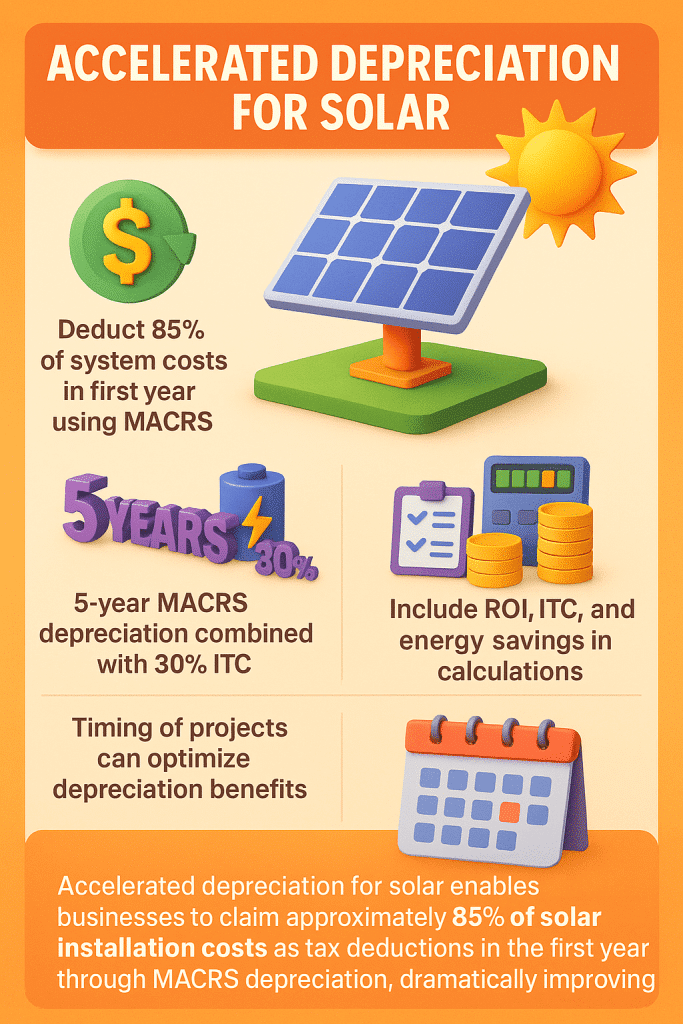
- Accelerated depreciation for solar allows businesses to deduct 85% of system costs in the first year using MACRS
- Solar installations qualify for 5-year MACRS depreciation, combined with 30% Investment Tax Credit benefits
- Building upgrades supporting solar installations can be depreciated separately using cost segregation methods
- Proper ROI calculations must include accelerated depreciation, ITC benefits, and energy savings for accurate projections
- Strategic timing of solar projects can optimize both depreciation benefits and overall building upgrade returns
Accelerated depreciation for solar enables businesses to claim approximately 85% of solar installation costs as tax deductions in the first year through MACRS depreciation, dramatically improving ROI calculations for building upgrades that include renewable energy systems.
Understanding Accelerated Depreciation for Solar Systems
Accelerated depreciation for solar installations offers one of the most significant tax advantages available for commercial renewable energy projects, enabling businesses to recover the majority of their investment costs through tax savings in the first year of operation. The Modified Accelerated Cost Recovery System (MACRS) classifies solar energy equipment as 5-year property, enabling rapid depreciation that significantly improves project economics and building upgrade returns.
The combination of accelerated depreciation for solar energy systems with the Investment Tax Credit creates extraordinary financial benefits, reducing the effective cost of solar installations by 60-70% in the first year. This dramatic cost reduction transforms solar projects from long-term investments into immediately profitable building upgrades that enhance both property value and operational efficiency while delivering substantial tax savings.

MACRS 5-Year Depreciation Schedule for Solar
Solar energy systems qualify for 5-year MACRS depreciation using the double declining balance method, which provides accelerated deductions that front-load tax benefits in the early years of system operation. The first-year depreciation rate of 20% under normal MACRS rules increases to approximately 85% when combined with bonus depreciation provisions available for qualifying solar installations.
The basis adjustment required for Investment Tax Credit recipients reduces the depreciable basis by half the credit amount, but still leaves substantial depreciation benefits available. For a $100,000 solar installation claiming a $30,000 ITC, the depreciable basis becomes $85,000, which can be largely expensed in the first year through accelerated depreciation for solar combined with bonus depreciation benefits.
Bonus Depreciation Integration
Bonus depreciation enhances accelerated depreciation for solar by allowing immediate expensing of a significant percentage of equipment costs beyond the standard MACRS first-year allowance. While bonus depreciation rates are phasing down from previous 100% levels, the remaining percentages still provide substantial additional benefits in the first year, improving solar project ROI calculations.
The combination of MACRS accelerated depreciation for solar with available bonus depreciation typically enables businesses to claim 80-85% of their solar investment as first-year tax deductions, creating immediate cash flow benefits that dramatically improve building upgrade returns. This acceleration makes solar installations particularly attractive for businesses with sufficient tax liability to absorb the concentrated deductions.
| Solar System Component | MACRS Classification | Recovery Period | First Year Rate (with Bonus) |
|---|---|---|---|
| Solar Panels | 5-year property | 5 years | ~85% |
| Inverters | 5-year property | 5 years | ~85% |
| Mounting Systems | 5-year property | 5 years | ~85% |
| Electrical Components | 5-year property | 5 years | ~85% |
Calculating ROI for Solar Building Upgrades with Accelerated Depreciation
Accurate ROI calculations for solar building upgrades must integrate accelerated depreciation for solar benefits with energy savings, Investment Tax Credits, and any additional building improvements required to support the solar installation. This comprehensive analysis ensures that businesses understand the true financial impact of solar projects while properly accounting for all available tax benefits and operational improvements.
The calculation process begins by determining the total project cost, which includes solar equipment, installation, electrical upgrades, and any necessary structural modifications required for the installation. Next, calculate the Investment Tax Credit at 30% of qualifying costs, followed by the accelerated depreciation for solar benefits based on the adjusted depreciable basis and applicable depreciation rates for the installation year.
Comprehensive Cost-Benefit Analysis Framework
A comprehensive ROI analysis for solar building upgrades should encompass initial investment costs, tax credit benefits, accelerated depreciation for solar savings, annual energy cost reductions, maintenance expenses, and the present value of all cash flows over the system’s expected lifespan. This framework provides accurate projections that account for both immediate tax benefits and long-term operational savings.
Energy savings calculations should be based on current utility rates, projected rate increases, and the solar system’s expected energy production over its 25-30 year operating life. A manufacturing facility installed a 500kW solar system for $625,000, claimed $187,500 in ITC benefits and $372,500 in first-year accelerated depreciation deductions, creating immediate tax savings of $205,000 while reducing annual electricity costs by $78,000, achieving a payback period of less than three years.
Building Infrastructure Upgrade Considerations
Solar installations often require building infrastructure upgrades such as electrical panel enhancements, roof reinforcements, or structural modifications that can be depreciated separately from the solar equipment using cost segregation methodologies. These upgrades may qualify for different depreciation schedules that optimize overall tax benefits while supporting the solar installation.
Electrical infrastructure improvements typically qualify for 7-year MACRS treatment, while structural modifications may fall under 15-year or building depreciation schedules, depending on their specific nature and integration with the building systems. Proper classification of these upgrade components through cost segregation analysis can significantly enhance the overall ROI of solar building upgrade projects by accelerating depreciation on qualifying infrastructure improvements.
Strategic Timing for Accelerated Depreciation for Solar Projects
Strategic timing of solar installations can maximize accelerated depreciation for solar benefits while coordinating with other business tax planning initiatives and building upgrade schedules. The placed-in-service date determines eligibility for current-year tax benefits, making timing a critical factor in optimizing the financial returns from solar building upgrades.
Businesses should consider their annual income patterns, other planned capital expenditures, and available tax capacity when scheduling solar installations to ensure maximum utilization of accelerated depreciation for solar benefits. Companies with seasonal income variations may benefit from timing installations to coincide with periods of high income that can absorb the concentrated first-year deductions.
Coordination with Other Building Improvements
Solar installations often coordinate well with other building improvement projects, such as roof replacements, HVAC upgrades, or facility expansions, that can be planned together to optimize overall project costs and tax benefits. This coordination can create economies of scale while ensuring that all building upgrades work together to enhance property value and operational efficiency.
Roof replacement projects offer ideal opportunities for integrating solar installations, as the combined project can qualify for different depreciation treatments for various components while minimizing installation costs through coordinated construction activities. The roof replacement typically qualifies for building depreciation over 39 years, while the solar components receive accelerated depreciation for solar treatment, optimizing the overall tax benefits from the combined building upgrade project.
Multi-Year Project Planning
Large solar installations can be phased across multiple tax years to optimize accelerated depreciation for solar benefits, taking into account changing income levels, tax rates, or available depreciation capacity. This phased approach enables businesses to align depreciation benefits with their ability to utilize the deductions, while also maintaining progress toward renewable energy and building upgrade objectives.
Phased solar installations enable businesses to optimize accelerated depreciation for solar timing while spreading construction impacts and managing cash flow requirements across multiple budget cycles. This approach works particularly well for large commercial or industrial facilities with extensive roof space or multiple buildings that can accommodate staged solar development over several years.
Cost Segregation and Component Analysis for Solar Building Upgrades
Cost segregation analysis for solar building upgrades can identify additional depreciation opportunities by properly classifying different project components according to their specific tax treatment under accelerated depreciation for solar rules and general building improvement regulations. This detailed analysis often reveals significant additional tax benefits beyond the basic depreciation of solar equipment.
Solar installation projects typically involve multiple components that may qualify for different depreciation treatments, including the solar equipment itself, electrical infrastructure improvements, structural modifications, and site preparation work. Proper segregation of these costs can optimize overall depreciation benefits while ensuring compliance with applicable tax regulations for each component category.
Electrical Infrastructure Segregation
Electrical infrastructure improvements required for solar installations often qualify for accelerated depreciation separate from both the solar equipment and building components, creating additional opportunities for enhanced tax benefits. These improvements may include panel upgrades, conduit installation, meter modifications, and interconnection equipment that support the operation of the solar system.
Electrical components directly related to solar energy production typically qualify for the same 5-year MACRS treatment as the solar equipment. In contrast, general electrical improvements may qualify for 7-year depreciation as business equipment. Proper classification through cost segregation analysis ensures that each component receives optimal depreciation treatment while maintaining compliance with accelerated depreciation for solar regulations.
Structural and Site Improvement Analysis
Structural modifications and site improvements that support solar installations may qualify for various depreciation treatments, depending on their specific nature and integration with building systems. Ground-mounted solar installations often require site preparation, foundation work, and access improvements that can be segregated into shorter depreciation categories than standard building improvements.
Rooftop solar installations may require structural reinforcements, penetration sealing, and access improvements that qualify for different depreciation treatments based on their classification as building improvements versus equipment support structures. A warehouse solar project utilized cost segregation to identify $85,000 in electrical and structural improvements that qualified for accelerated depreciation separate from the building, resulting in additional first-year deductions of $15,000 beyond the standard accelerated depreciation for solar benefits.
| Component Type | Depreciation Classification | Recovery Period | Strategic Benefit |
|---|---|---|---|
| Solar Equipment | 5-year MACRS + Bonus | Mostly first year | Maximum acceleration |
| Electrical Infrastructure | 7-year MACRS | 7 years accelerated | Enhanced building value |
| Structural Improvements | 15-year or building | 15-39 years | Long-term depreciation |
| Site Preparation | Land improvement | 15 years | Accelerated vs building |
Financing Integration with Accelerated Depreciation for Solar
Solar project financing can be structured to maximize accelerated depreciation for solar benefits while optimizing cash flow and maintaining access to all available tax incentives. Different financing approaches affect the ability to claim depreciation benefits, making financing structure an important consideration in overall project planning and ROI optimization.
Traditional equipment financing and capital leases typically preserve the ability to claim accelerated depreciation for solar benefits, while operating leases transfer these benefits to the lessor in exchange for potentially lower lease payments. Power purchase agreements and third-party ownership models provide access to solar benefits without requiring capital investment, but eliminate direct depreciation benefits for the host business.
Tax Equity and Partnership Structures
Tax equity partnerships can provide access to accelerated depreciation for solar benefits, allowing businesses without sufficient tax capacity to fully utilize the value of available deductions and credits. These structures allow tax equity investors to provide capital in exchange for the tax benefits, while the host business receives reduced energy costs and other operational benefits from the solar installation.
Partnership structures must be carefully designed to ensure that accelerated depreciation for solar benefits flow to the partners with the greatest ability to utilize the deductions while maintaining appropriate allocation of risks, rewards, and operational control. These arrangements can make solar building upgrades feasible for businesses that otherwise lack the tax capacity to maximize available incentives.
Loan and Lease Optimization
Solar equipment loans and capital leases can be structured to optimize the relationship between financing costs and accelerated depreciation for solar benefits, creating overall returns that exceed either financing savings or tax benefits alone. This optimization often involves timing loan payments to coincide with tax savings from depreciation benefits, improving overall project cash flow and returns.
Solar equipment financing structured to account for accelerated depreciation of solar cash flows can often provide terms that exceed those of traditional equipment financing, as lenders recognize the reduced risk associated with substantial first-year tax benefits. This recognition can result in lower interest rates, reduced down payment requirements, or extended repayment terms that further improve project economics and building upgrade returns.
Long-Term Building Value and Performance Optimization
Solar building upgrades with accelerated depreciation for solar benefits create long-term value enhancement that extends beyond immediate tax savings to include property value increases, operational cost reductions, and improved building performance characteristics. These long-term benefits should be factored into comprehensive ROI calculations to capture the full value proposition of solar building upgrades.
The property value increase from solar installations typically ranges from 3-6% of the property value, depending on local market conditions, energy costs, and the size of the solar installation relative to the building’s energy needs. These increases often persist throughout the building ownership period and can be realized through sale, refinancing, or improved operational cash flows from reduced energy expenses.
Energy Performance and Efficiency Gains
Solar installations often coincide with other energy efficiency improvements that compound the benefits of accelerated depreciation for solar while creating comprehensive building performance upgrades. LED lighting, HVAC improvements, and building automation systems can be coordinated with solar projects to maximize overall energy savings and tax benefits from the combined improvements.
The interaction between solar energy production and building energy efficiency creates synergistic benefits, where efficiency improvements reduce the required solar system size, while solar production offsets the remaining energy needs. This optimization can improve overall project economics while ensuring that accelerated depreciation for solar benefits applies to a right-sized system that maximizes both tax savings and operational benefits.
Maintenance and Performance Monitoring
Solar systems require minimal maintenance but benefit from performance monitoring systems that ensure optimal energy production and early identification of any issues that might affect system performance or accelerated depreciation for solar benefits. These monitoring systems can often be integrated with building management systems to provide comprehensive oversight and optimization of energy usage.
Preventive maintenance programs help ensure that solar installations continue to deliver expected energy savings throughout their 25-30 year operating life, protecting the long-term returns that justify the initial investment and accelerated depreciation for solar benefits. A retail chain with solar installations across fifteen locations implemented centralized monitoring that identified underperforming systems early, maintaining average system performance above 95% of design expectations while protecting their substantial tax benefit investments.
Maximizing your solar building upgrade returns through accelerated depreciation for solar requires comprehensive planning that integrates tax benefits, financing structures, and long-term building performance objectives. Understanding MACRS depreciation, cost segregation opportunities, and strategic timing enables you to achieve immediate tax savings while creating lasting value through the integration of renewable energy. Start evaluating your building upgrade opportunities now to identify solar projects that can deliver both substantial tax benefits and long-term operational improvements, enhancing your property value and business performance.
Accelerated Depreciation for Solar FAQs
How much can I depreciate in the first year with accelerated depreciation for solar?
Accelerated depreciation for solar typically allows businesses to deduct approximately 85% of solar system costs in the first year through the combination of MACRS 5-year depreciation and available bonus depreciation. The exact percentage depends on the year of installation and current bonus depreciation rates, but first-year benefits are substantial for qualifying solar installations.
Does the Investment Tax Credit affect my solar depreciation benefits?
Yes, the Investment Tax Credit reduces your depreciable basis for accelerated depreciation for solar by half the credit amount, but you still retain significant depreciation benefits. For example, a $100,000 system with a $30,000 ITC would have an $85,000 depreciable basis, which can still be largely depreciated in the first year.
Can building improvements for solar installation be depreciated separately?
Yes, building improvements required for solar installations can often be depreciated separately using cost segregation methods. Electrical improvements typically qualify for 7-year MACRS treatment, while structural modifications may qualify for 15-year depreciation. This separate treatment can enhance overall tax benefits beyond the accelerated depreciation for solar equipment.
What happens to solar depreciation if I sell the building?
When you sell a building with solar installations, you may need to recapture some of the accelerated depreciation for solar as ordinary income rather than capital gains, depending on the sale price and accumulated depreciation. The recapture amount is limited to the depreciation claimed and the gain realized on the solar equipment portion of the sale.
Can leased solar systems qualify for accelerated depreciation benefits?
Only capital leases, where you are considered the owner for tax purposes, allow you to claim accelerated depreciation for solar benefits, while operating leases transfer these benefits to the lessor. Power purchase agreements and third-party ownership models do not provide depreciation benefits to the host business, though they may offer other financial advantages through reduced energy costs.

Paul Kohn MBA is a seasoned business consultant known for helping businesses maximize tax credits and incentives to fuel growth and profitability. He holds a Master’s in Business Administration and has helped numerous companies secure millions in tax credits and implement effective business strategies. He is regarded as a trusted authority for business owners seeking to optimize their savings and growth.