

What is a WOTC form refers to the official federal documents required to apply for Work Opportunity Tax Credits, primarily IRS Form 8850 and ETA Forms 9061/9062. These forms determine eligibility and capture the necessary signatures and documentation required for state certification and eventual tax credit claims, which range from $1,200 to $9,600 per qualifying employee.
Key Takeaways
- Three Core Forms: IRS Form 8850, ETA Form 9061, and ETA Form 9062 handle different aspects of WOTC eligibility and certification
- Signature Requirements: Both applicant and employer signatures are mandatory for valid form submission and processing
- 28-Day Deadline: Form 8850 must be completed before job offer and submitted within 28 days of employee start date
- Target Group Documentation: Forms capture specific information proving membership in one of ten eligible target groups
- Federal Compliance Foundation: Proper form completion serves as the legal basis for claiming tax credits and surviving audits
What Is a WOTC Form and Why It Matters
Think of WOTC forms as your golden ticket to tax credits. But here’s what most employers get wrong—they treat these forms like annoying paperwork instead of valuable business tools. Each properly completed form represents potential thousands in tax savings sitting right there on your desk.
The Core Purpose and Federal Requirements
The IRS and Department of Labor created these forms to prevent fraud while making tax credits accessible to legitimate employers. They’re not trying to make your life difficult—they’re protecting a program that saves businesses millions annually while helping people who face employment barriers.
The pre-screening notice requirement exists because the government learned early on that retroactive applications create too many compliance issues. By requiring upfront screening, they ensure only genuine hiring decisions benefit from credits, not paper shuffling designed to game the system.
WOTC forms serve as both screening tools and legal documentation, creating an audit trail that protects your credits while ensuring program integrity. Miss the forms, miss the credits. Get them wrong, face potential audits. Get them right, enjoy years of tax savings.
Inside the WOTC Form Ecosystem
Most people think there’s just one WOTC form. Wrong. There’s actually a whole family of related documents that work together like pieces of a puzzle. Understanding how they connect saves time and prevents costly mistakes.
IRS Form 8850: The Foundation Document
Form 8850 acts as the main application for WOTC consideration. It’s deceptively simple—just one page—but it carries enormous weight. This form officially requests state workforce agency review of your new hire’s eligibility for tax credits.
The timing requirements for Form 8850 trip up more employers than any other WOTC mistake. You must complete this form on or before the day you make a job offer, never after employment begins. The 28-day submission clock starts ticking on the employee’s first day of work, not when you remember to deal with paperwork.
Every line on Form 8850 matters for different reasons. Employee information must match exactly with other documentation. Target group selection determines which additional forms you’ll need. Employer information links the application to your business for credit processing. Signatures make it legally binding.
| Form Type | Primary Purpose | Completion Timeline | Key Requirements |
|---|---|---|---|
| IRS Form 8850 | Initial eligibility request | Before job offer, submit within 28 days | Both signatures, target group selection |
| ETA Form 9061 | Individual characteristics verification | With Form 8850 submission | Detailed eligibility documentation |
| ETA Form 9062 | Conditional certification cases | When pre-certification exists | Special circumstances documentation |
ETA Form 9061: The Detail Collector
Form 9061 digs into the specifics of why your employee qualifies for WOTC. While Form 8850 says “this person might be eligible,” Form 9061 says “here’s exactly why they qualify and here’s the proof.”
Different target groups require different sections of Form 9061. Veterans need military service documentation. SNAP recipients need benefit verification. Ex-felons need conviction or release information. The form adapts to capture exactly what state agencies need for accurate eligibility determination.
State workforce agencies use Form 9061 information to verify eligibility claims before issuing certifications. Incomplete or inaccurate information here leads to delays, denials, or requests for additional documentation that slow down the entire process.
ETA Form 9062: The Special Situations Handler
Form 9062 comes into play when you’re dealing with conditional certifications or pre-approved candidates from certain programs. It’s less common than Forms 8850 and 9061, but critical when applicable.
Conditional certifications happen when state agencies can determine eligibility based on program participation without individual review. Summer youth programs, certain veteran initiatives, and some workforce development partnerships create these streamlined pathways.
The key with Form 9062 is understanding when to use it instead of the standard forms. Using the wrong form for your situation can delay processing and create confusion with state agencies.
How WOTC Forms Work in Real Business Situations
Here’s where theory meets reality. You’ve got real employees, real deadlines, and real money on the line. Understanding how these forms flow through your hiring process determines whether you capture credits or lose them to administrative oversights.
The Complete Workflow for Employers
Smart employers build WOTC forms into their hiring process like oil changes into vehicle maintenance—routine, systematic, never optional. The moment you identify a potentially eligible candidate, forms become part of your standard procedure, not an afterthought.
Pre-screening happens during interviews or application review. You ask targeted questions about military service, government benefits, unemployment duration, and other target group indicators. This isn’t invasive—it’s strategic. Frame it positively: “Certain backgrounds may qualify our company for tax credits that fund additional training and benefits.”
The biggest workflow mistake employers make is waiting until after hiring decisions to think about WOTC forms, which violates federal requirements and forfeits eligibility. Build form completion into your job offer process. Make it as routine as background checks or reference verification.
Document management becomes crucial once forms are completed. You need systems that track submission dates, follow up on state processing, and maintain records for audit purposes. A small food company lost $40,000 in credits last year after missing Form 8850’s 28-day deadline—automation fixed the problem and unlocked future savings.
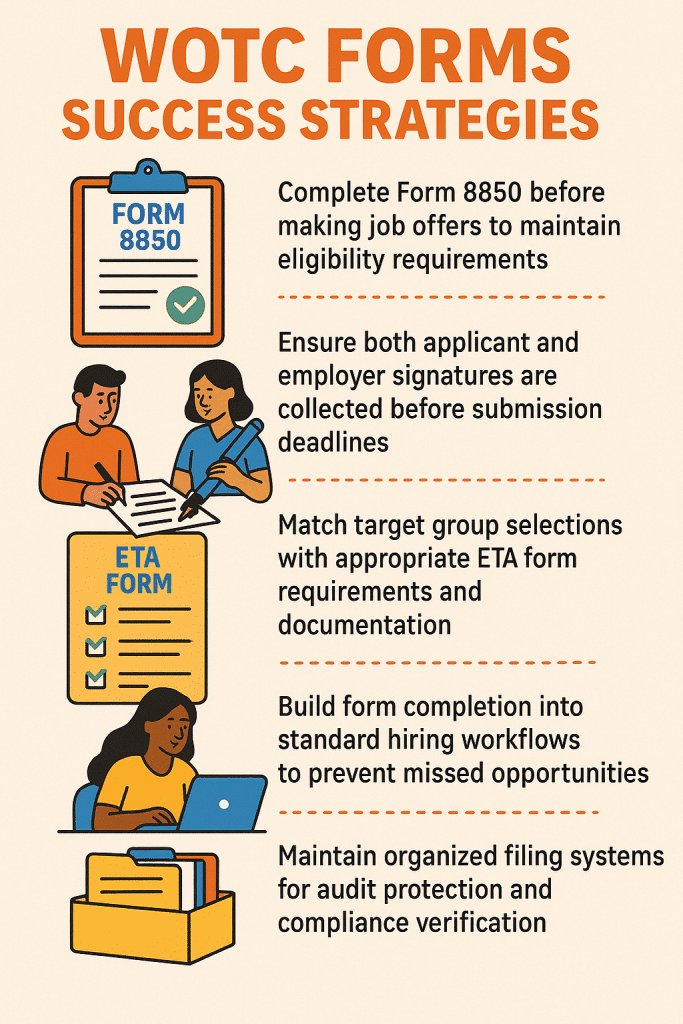
WOTC Forms Success Strategies
- Complete Form 8850 before making job offers to maintain eligibility requirements
- Ensure both applicant and employer signatures are collected before submission deadlines
- Match target group selections with appropriate ETA form requirements and documentation
- Build form completion into standard hiring workflows to prevent missed opportunities
- Maintain organized filing systems for audit protection and compliance verification
Signature Requirements and Legal Compliance
Signatures aren’t just formalities—they’re legal acknowledgments that create binding obligations for both parties. Employee signatures confirm target group membership and authorize information sharing with state agencies. Employer signatures certify that provided information is accurate and complete.
Electronic signatures work fine if your systems maintain proper authentication and audit trails. Many modern HR platforms handle this automatically, but verify that your electronic signature process meets IRS requirements before relying on it exclusively.
Missing signatures void form submissions entirely. State agencies won’t process incomplete applications, and there’s no appeal process once the 28-day deadline passes. This isn’t bureaucratic nitpicking—it’s legal protection for a program worth billions in tax credits annually.
Target Group Documentation Strategy
Each target group requires specific documentation approaches that go beyond basic form completion. Veterans need DD-214s or similar military discharge papers. SNAP recipients need benefit award letters or case numbers. Long-term unemployed individuals need unemployment office verification.
The documentation strategy you choose affects both approval rates and processing times. Complete documentation packages get faster approvals. Incomplete submissions create delays and additional correspondence that can push processing beyond useful timelines.
State-specific requirements add another layer of complexity. California handles documentation differently than Texas or New York. Understanding your state’s preferences can significantly improve your success rates and processing speed.
Advanced Form Management Techniques
Technology has revolutionized WOTC form management, but only for businesses that understand how to leverage it properly. Manual processes miss opportunities, create errors, and waste administrative time that could be spent on growth activities.
Integration with HR systems eliminates duplicate data entry while ensuring consistency across all hiring documentation. When your applicant tracking system communicates directly with WOTC platforms, form completion becomes automatic rather than optional.
Automated deadline tracking prevents the most expensive WOTC mistakes. Software can flag approaching submission deadlines, incomplete applications, and missing signatures before they become problems. The cost of automation typically pays for itself within the first few saved credits.
| Management Approach | Error Rate | Processing Time | Credit Capture Rate |
|---|---|---|---|
| Manual Paper Forms | 25-40% | 15-30 minutes per form | 30-50% of eligible hires |
| Digital Forms (Manual) | 15-25% | 8-15 minutes per form | 50-70% of eligible hires |
| Automated Integration | 5-10% | 3-8 minutes per form | 70-90% of eligible hires |
Beyond Basic Forms: The Bigger WOTC Picture
WOTC forms connect to a broader ecosystem of tax credit documentation that most employers never fully understand. Form 5884 claims your credits on business tax returns. Form 3800 handles credit limitations and carryforwards. Understanding these connections helps optimize your overall tax strategy.
State-specific variations in form processing create opportunities for businesses operating in multiple jurisdictions. Some states offer expedited processing for high-volume employers. Others provide online portals with real-time status updates. Knowing these differences can significantly improve your results.
Record retention requirements extend far beyond initial form submission. IRS audits can occur years after credit claims, making organized documentation essential for protecting your savings. Digital storage with proper backup and security measures has become the standard for serious WOTC programs.
As tax compliance specialist Michael Chen notes, “Businesses that master WOTC forms as part of a comprehensive tax credit strategy typically see 200-300% better results than those treating forms as isolated paperwork exercises.”
Common Form Mistakes and Prevention Strategies
The most expensive WOTC form mistakes stem from misunderstanding timing requirements. Forms completed after employment begins violate federal requirements and forfeit all credit eligibility. There’s no appeal process, no extensions, no exceptions.
Target group misidentification represents another costly error category. Selecting the wrong group on forms can lead to denials, even when employees are legitimately qualified under different categories. Understanding the nuances of each target group prevents these avoidable mistakes.
Incomplete employer information causes processing delays that can extend beyond useful business timelines. State agencies require complete and accurate employer details to process applications efficiently. Rushing through employer sections creates problems that take weeks to resolve.
Documentation coordination failures occur when forms don’t match supporting materials. Employee names, dates, and other details must align perfectly across all submitted materials. Inconsistencies trigger additional review that slows processing and may lead to denials.
Technology Integration Best Practices
Modern WOTC platforms offer API connections that integrate seamlessly with popular HR systems like BambooHR, Workday, and ADP. These connections eliminate manual data entry while ensuring the accurate flow of information between systems.
Mobile-friendly form completion accommodates today’s hiring practices where candidates often complete paperwork on smartphones. Clunky desktop-only systems create barriers that reduce completion rates and miss opportunities.
Real-time validation features catch common errors before form submission, preventing delays and rejections. These systems check for missing signatures, invalid dates, incomplete sections, and other issues that cause processing problems.
Reporting dashboards help track form completion rates, processing times, and success rates across different locations or hiring managers. Data-driven insights identify opportunities for improvement and optimize overall program performance.
Conclusion
WOTC forms represent the gateway to substantial tax savings, but only when completed properly and on time. Understanding the purpose and requirements of Form 8850, ETA Forms 9061 and 9062, and their place in the broader tax credit ecosystem transforms routine hiring into strategic financial planning. Master these forms through systematic processes, technology integration, and proper compliance procedures to unlock the full potential of the Work Opportunity Tax Credit program while supporting individuals who face employment barriers.
What Is a WOTC Form FAQs
What is a WOTC form and when must it be completed?
What is a WOTC form refers to IRS Form 8850 and related ETA forms required for Work Opportunity Tax Credit applications, and they must be completed before making job offers. Form 8850 must be submitted to state workforce agencies within 28 days of the employee’s start date to maintain eligibility.
Is filling out a WOTC form mandatory for all new hires?
Filling out WOTC forms is not mandatory for all new hires; however, it’s required only when employers wish to claim tax credits for eligible employees. What is a WOTC form becomes relevant only when new hires belong to one of the ten qualifying target groups and employers choose to pursue credits.
What happens if WOTC forms are submitted late or incomplete?
Late or incomplete WOTC forms result in permanent loss of tax credit eligibility with no appeal process available. The 28-day deadline for submitting Form 8850 is absolute, and missing signatures or incorrect information can result in application denials.
How do Form 8850 and ETA Form 9061 work together?
Form 8850 serves as the initial eligibility request, while ETA Form 9061 provides detailed verification of individual characteristics for target group membership. Both forms must be submitted together to state workforce agencies for complete eligibility determination and processing.
Can WOTC forms be completed electronically or do they require paper submission?
WOTC forms can be completed electronically through approved platforms that maintain proper signature authentication and audit trails. Most states accept digital submissions through online portals, which typically offer faster processing times than paper forms mailed to agencies.
Citations
- Thomson Reuters. Work Opportunity Tax Credit: Overview & FAQs
- Paychex. Work Opportunity Tax Credit (WOTC) Explained
- Walton Management. When is form 8850 due for the WOTC program
- Rockerbox. How Can an Employer Be Eligible for the WOTC
- Experian. Work Opportunity Tax Credit: Everything You Need to Know
- Delaware Department of Labor. WOTC Forms

Paul Kohn MBA is a seasoned business consultant known for helping businesses maximize tax credits and incentives to fuel growth and profitability. He holds a Master’s in Business Administration and has helped numerous companies secure millions in tax credits and implement effective business strategies. He is regarded as a trusted authority for business owners seeking to optimize their savings and growth.