
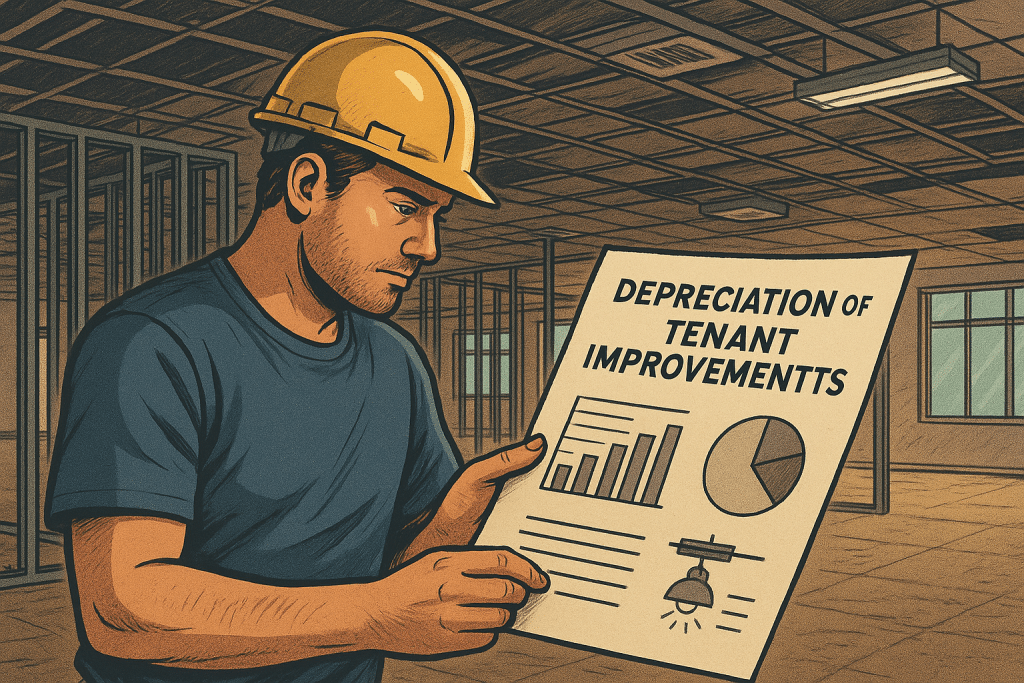
Depreciation of tenant improvements lets you write off the cost of interior upgrades to your commercial space faster than the standard 39-year schedule, with qualified improvement property eligible for a 15-year recovery period and potentially 100% bonus depreciation in 2025. Who pays for these upgrades determines who gets the tax break.
Key Takeaways
- Standard commercial improvements depreciate over 39 years, but qualified interior work can use a 15-year schedule
- The party who pays for improvements gets the depreciation deduction—not always who you’d expect
- Bonus depreciation returned to 100% for property placed in service after January 19, 2025
- State laws vary wildly on conformity—California and Massachusetts don’t follow federal bonus rules
- Cost segregation studies can uncover hidden 5-year and 7-year assets within your tenant improvements
What the IRS Really Means by Tenant Improvements
Here’s something most business owners miss. You sign a lease. You build out your dream office with custom lighting and gorgeous millwork. Then tax season hits and your CPA tells you it’s going to take 39 years to write off those costs.
Sounds brutal, right?
The thing is, it doesn’t have to work that way. Tenant improvements are modifications made to leased commercial space—things like new flooring, upgraded HVAC systems, interior walls, and built-in cabinetry. These aren’t repairs you can write off immediately. They’re capital expenditures.
But here’s where it gets interesting. Not all improvements follow the same depreciation schedule. Some take 39 years. Others qualify for 15 years. And with the right planning, certain components can be written off in just 5 or 7 years.
The key is understanding which category your improvements fall into. A restaurant owner in Portland spent $300,000 on a buildout last year. His contractor gave him one lump-sum invoice. His accountant booked everything as 39-year property. That’s $7,692 in annual depreciation. But when he hired a cost segregation firm, they found $180,000 worth of 5-year and 15-year assets hiding in that invoice. His first-year deduction jumped to over $150,000.
That’s real money. And it happened because he knew what questions to ask.
The Two Depreciation Tracks You Need to Know
Let’s cut through the jargon. Commercial property improvements typically follow one of two paths: the 39-year straight-line method or the 15-year recovery period for qualified improvement property.
The 39-year track is the default. It’s what happens when you don’t plan ahead. You divide your total cost by 39 and deduct that amount each year. No acceleration. No bonus. Just slow, methodical depreciation that barely moves the needle on your tax bill.
The 15-year track is different. It applies to something called Qualified Improvement Property—or QIP for short. To qualify, your improvements must meet three tests. They must be interior improvements. They must be made after the building was originally placed in service. And they can’t include elevators, escalators, or structural framework.
Think new lighting. Updated floor coverings. Interior partitions. Conference room upgrades. These are the improvements that get the faster write-off.
When 15 Years Becomes One Year
Here’s where the tax code gets truly powerful. Thanks to the One Big Beautiful Bill Act signed in July 2025, qualified improvement property placed in service after January 19, 2025 now qualifies for 100% bonus depreciation. That means the entire cost can be deducted in year one.
Let me say that again because it’s worth repeating. The entire cost. In year one.
This is a massive shift from where we were. In 2024, bonus depreciation was only 60%. In early 2025, it dropped to 40%. Business owners were watching their tax savings evaporate year after year. But the new legislation changed everything for improvements placed in service after mid-January 2025.
A medical office in Austin completed a $650,000 renovation. Custom cabinetry in exam rooms. Medical-grade vinyl flooring throughout. Updated lighting and electrical. With proper classification and the restored 100% bonus, they could deduct over $300,000 in year one—compared to under $17,000 using the standard 39-year method.
| Method | Recovery Period | First-Year Deduction on $200K | Best For |
|---|---|---|---|
| Standard Depreciation | 39 years | $5,128 | No planning, structural work |
| QIP Without Bonus | 15 years | $13,333 | States that don’t allow bonus |
| QIP With 100% Bonus (2025+) | N/A | $200,000 | Maximum cash flow, high-income years |
| Cost Seg with Bonus | 5/7/15 years | $130,000+ | Properties with detailed invoices |
Who Gets to Take the Deduction
This is where lease negotiations get messy. And expensive if you don’t understand the rules.
The depreciation deduction follows the money, not the title. Whoever pays for the improvements gets to depreciate them. Sounds simple, but there are traps everywhere.
When the Landlord Pays
If your landlord funds the improvements directly, they own them. They depreciate them. You get no tax benefit. This is clean and simple, but it’s not always the best structure.
The landlord gets to write off the improvements over their useful life. If the improvements are tenant-specific and won’t be used by future tenants, the landlord can claim an abandonment loss when you leave—deducting any remaining basis all at once.
When the Tenant Pays
If you pay for improvements yourself and your lease doesn’t treat them as rent substitute, you own them for tax purposes. You get the depreciation deduction. When your lease ends and you walk away, you can claim a loss for any remaining undepreciated basis.
This structure works great for tenants in high tax brackets who need deductions now.
The Improvement Allowance Trap
Many landlords offer tenant improvement allowances—a fixed dollar amount you can spend on buildouts. Here’s what most tenants don’t realize: that allowance is taxable income to you when you receive it. You report it as income, then you depreciate the improvements you build with it.
There’s an exception. If your lease qualifies as a short-term retail lease under Section 110 of the tax code (15 years or less, including renewal options, and for retail space), the allowance isn’t taxable. But you also can’t depreciate the improvements—the landlord does.
Five Things Most Businesses Never Consider
- State laws can kill your federal savings. California, Massachusetts, and Connecticut don’t conform to federal bonus depreciation. You get the deduction on your federal return but have to add it back on your state return. In California, that means you’re paying 13.3% tax on “income” you never received.
- Section 179 might beat bonus depreciation. For 2025, you can expense up to $2.5 million under Section 179 for qualifying property. Unlike bonus, Section 179 doesn’t require the property to be acquired after a specific date—just placed in service in 2025. This can help you write off improvements bought in 2024.
- Not everything inside your building is QIP. Elevators, escalators, and internal structural framework don’t qualify. Neither do improvements that expand the building’s footprint. A cost segregation study can identify what qualifies and what doesn’t.
- You can go back and fix mistakes. If you placed improvements in service in 2023 or 2024 and missed out on proper classification, you can file Form 3115 (Application for Change in Accounting Method) to claim missed depreciation as a one-time catch-up deduction.
- Documentation is everything in an audit. The IRS will ask for detailed invoices, lease agreements, and proof of who paid for what. Lump-sum contractor invoices that just say “buildout” won’t cut it. Get itemized billing.
The Hidden Gold in Your Improvement Costs
Most CPAs will book your entire improvement as one asset with one depreciation schedule. They’re busy. They don’t have time to dig through contractor invoices and separate out every component.
That’s where cost segregation comes in. A proper engineering-based study can identify personal property and land improvements hiding within your “building” costs. Things like removable cabinetry, carpet, decorative lighting, and window treatments. These assets often qualify for 5-year or 7-year depreciation instead of 15 or 39 years.
A retail buildout might include $90,000 of these shorter-life assets in a $200,000 project. With 100% bonus depreciation back in play, that difference becomes immediate cash in your pocket.
Think about parking lot resurfacing. Landscaping. Site lighting. These are 15-year land improvements, not 39-year building components. But if you don’t segregate them, they get lumped in with the building and depreciated far too slowly.
Real Numbers from Real Businesses
A tech company leased 12,000 square feet in Seattle. They spent $450,000 on improvements. Their lease was structured so they owned the improvements. Without planning, they were looking at $11,538 in annual depreciation. With a cost segregation study, they identified $270,000 in accelerated property. Using 100% bonus on that portion, their year-one deduction hit $312,051—a difference of over $300,000 in tax value.
At a 37% marginal rate, that’s $111,000 in federal tax savings. In year one. The cost segregation study cost them $12,000. Even without bonus depreciation, the study would have paid for itself in two years.
| Feature | Standard Depreciation | With Cost Segregation |
|---|---|---|
| Requires Engineering Analysis | No | Yes |
| Upfront Cost | $0 | $5,000-$15,000 |
| Assets Identified | Building only | Building, personal property, land improvements |
| Year-One Deduction | Minimal | Potentially 60-80% of total cost |
| IRS Audit Defense | Limited documentation | Detailed engineering report |
| Best For | Improvements under $100K | Improvements over $200K |
State Rules That Change Everything
Federal tax law is only half the story. Your state might not play along. Many states have their own rules about depreciation, and some outright reject federal bonus provisions.
California is the worst offender. The state froze its tax code conformity back in 2015. That means no bonus depreciation. No expanded Section 179. You have to maintain separate depreciation schedules for state and federal returns. It’s a paperwork nightmare, and it costs real money.
Massachusetts and Connecticut also reject bonus depreciation. Iowa treats QIP as 39-year property, not 15-year. Tennessee conforms to the 15-year life but caps bonus at its own rates.
If you operate in multiple states, this gets exponentially more complex. You might have five different depreciation schedules for the same asset—one for federal and four for different states. This is why professional help isn’t optional. It’s essential.
The Value of Working with Professionals
Look, I get it. Hiring a cost segregation firm feels like an unnecessary expense. You’ve already spent hundreds of thousands on improvements. Now someone wants another $10,000 to tell you what you bought?
But here’s the truth. The IRS expects documentation. They expect engineering-based analysis. They expect you to prove why carpet gets a 5-year life and why that wall is removable. Your contractor’s invoice isn’t going to cut it in an audit.
A qualified cost segregation firm brings licensed engineers who understand IRS cost segregation guidelines and can defend their findings under examination. They know which components qualify for accelerated depreciation and which don’t. They understand the technical requirements for QIP. And they provide the documentation the IRS demands.
The typical study pays for itself in the first year through increased deductions. The return on investment often exceeds 2,000%. You’d be hard-pressed to find any other professional service that delivers those kinds of results.
More than that, a good firm will identify planning opportunities you didn’t know existed. They’ll catch state conformity issues before they become problems. They’ll structure your next project to maximize tax benefits from day one.
Your Next Move
If you’ve completed tenant improvements in the past three years, now is the time to review your depreciation. With 100% bonus back on the table for 2025, the opportunity cost of waiting just went through the roof.
Talk to your CPA. Ask if they’ve considered QIP classification for your improvements. Ask if a cost segregation study makes sense for your property. And if they brush you off or seem uncertain, find someone who specializes in this work.
This isn’t about gaming the system. It’s about using the tax code the way Congress intended. The deductions exist because lawmakers want to encourage business investment in facilities. But the rules are complex enough that most businesses never claim what they’re entitled to.
Don’t be one of them. The depreciation schedules you set up today will impact your tax returns for decades. Get them right the first time.
Depreciation of Tenant Improvements FAQs
What is the depreciation period for tenant improvements?
The depreciation period for tenant improvements is typically 39 years for standard commercial property improvements, but qualified improvement property can be depreciated over 15 years using the straight-line method, and may qualify for 100% bonus depreciation if placed in service after January 19, 2025.
Can tenants depreciate improvements they make to leased property?
Yes, tenants can depreciate improvements they make to leased property if they pay for the improvements directly and the improvements aren’t treated as a substitute for rent. Upon lease termination, tenants can claim a loss deduction for any remaining undepreciated basis if they abandon the improvements.
How does depreciation of tenant improvements differ from regular building depreciation?
Depreciation of tenant improvements can use a faster 15-year schedule for qualified improvement property instead of the standard 39-year schedule for commercial buildings. Tenant improvements may also qualify for bonus depreciation and Section 179 expensing, while base buildings cannot.
Who gets to depreciate tenant improvements when there’s an improvement allowance?
When a landlord provides a tenant improvement allowance, the tenant typically receives the allowance as taxable income and then depreciates the improvements they construct. The landlord amortizes the allowance payment over the lease term unless the arrangement qualifies for the Section 110 exclusion for short-term retail leases.
What improvements qualify as QIP for faster depreciation?
Qualified improvement property includes interior, non-structural improvements to nonresidential buildings made after the building was first placed in service. QIP excludes elevators, escalators, internal structural framework, and any improvements that enlarge the building.
Citations
- Internal Revenue Service. (2024). Publication 946 (2024), How To Depreciate Property. https://www.irs.gov/publications/p946
- Colliers. Current Tax Treatment For Tenant Improvements. https://www.colliers.com/en/news/houston/current-tax-treatment-for-tenant-improvements
- Plante Moran. (2025, May 14). Tax treatment of tenant improvements: Who should make them — landlord or tenant? https://www.plantemoran.com/explore-our-thinking/insight/2017/07/tax-treatment-of-tenant-improvements
- The Tax Adviser. (2021, September 1). Qualified improvement property and bonus depreciation. https://www.thetaxadviser.com/issues/2021/sep/qualified-improvement-property-bonus-depreciation/
- McGuire Sponsel. (2023, December 11). Qualified Improvement Property Definition. https://mcguiresponsel.com/qualified-improvement-property-definition/
- Grassi Advisors. (2025, July 11). Tax Reform for Real Estate: What the One Big Beautiful Bill Means for Your Business. https://www.grassiadvisors.com/blog/tax-reform-for-real-estate-what-the-one-big-beautiful-bill-means-for-your-business/
- Wolters Kluwer. (2020, October 15). States Respond to Qualified Improvement Property Depreciation Change. https://www.wolterskluwer.com/en/expert-insights/states-respond-to-qualified-improvement-property-depreciation-change
- LoopNet. (2025, May 15). Qualified Improvement Property: Rules, Depreciation Benefits, and Tax Strategies for Commercial Real Estate Investors. https://www.loopnet.com/cre-explained/investing/qualified-improvement-property/
- CSAP Cost Segregation. (2025, July 25). Cost Segregation for Renovated Properties: Maximizing Deductions Post-Improvement. https://csap.com/cost-segregation-renovated-properties/

Paul Kohn MBA is a seasoned business consultant known for helping businesses maximize tax credits and incentives to fuel growth and profitability. He holds a Master’s in Business Administration and has helped numerous companies secure millions in tax credits and implement effective business strategies. He is regarded as a trusted authority for business owners seeking to optimize their savings and growth.