
A cost segregation study is an IRS-approved strategy that reclassifies parts of your commercial property into shorter depreciation schedules, allowing you to write off 20-40% of your building’s value in the first year, rather than waiting 39 years. With The One Big Beautiful Bill making bonus depreciation permanent, this is the fastest legal way to put tens or hundreds of thousands of dollars back in your pocket right now.
What You Need to Know Before You Spend Another Dollar on Taxes
- The One Big Beautiful Bill made 100% bonus depreciation permanent. Assets placed in service after the bill qualify for full first-year deduction—no phase-downs, no sunset dates.
- A properly done cost segregation study can shift 20-40% of your commercial building’s cost from 39-year straight-line depreciation to 5-, 7-, or 15-year accelerated schedules.
- The IRS fully backs this strategy when you use engineering-based analysis with proper documentation. This isn’t a loophole—it’s tax law working exactly as written.
- Real businesses see $200,000 to $800,000+ in first-year deductions on buildings worth $2M to $8M. That’s cash you can reinvest, pay down debt, or use to grow while competitors wait decades for the same write-offs.
- You can “catch up” on older properties using IRS Form 3115—capturing missed depreciation from past years without filing amended returns.
- Most property types qualify: commercial buildings, rental properties, restaurants, medical offices, warehouses, retail spaces, self-storage, and apartment complexes.
Why Smart Business Owners Are Doing This Now
Let me tell you something most accountants won’t say out loud. The tax code is a 70,000-page instruction manual for moving money from your pocket to the government’s. Cost segregation is one of the few places where the rules actually work in your favor—if you know how to use them.
Here’s the problem most business owners face. You bought a $3 million building. Your accountant depreciates it over 39 years. That’s $76,923 per year. Feels like nothing, right? Because it is nothing compared to what you could be doing.
With a cost segregation study, you break down the building into its components. The parking lot? That’s land improvement—15-year property. The lighting fixtures? Personal property—5 years. The carpeting, cabinets, and specialty electrical? All shorter schedules. Suddenly, you’re pulling $600,000 to $1.2M into year one instead of spreading it over four decades.
The doubts creep in. Is this legal? Will the IRS audit me? What if it doesn’t work? Here’s the truth: this strategy has been around since the 1980s. The IRS published an Audit Techniques Guide specifically for cost segregation. They expect you to do this—they just want proper documentation.
If we were sitting face-to-face, I’d say: Stop leaving money on the table because you’re afraid of the IRS. Get an engineering-based study from a credentialed firm, follow the rules, and use your tax savings to actually build something. That’s what winners do.
How Cost Segregation Analysis Actually Works
Breaking Down Your Building Into Tax-Saving Components
Your building isn’t just one big asset worth $3 million. It’s hundreds of individual components that the IRS lets you classify separately. The goal is to find everything that qualifies for shorter depreciation schedules and remove it from the 39-year straightjacket.
Section 1245 property includes personal property and land improvements—things like parking lots, sidewalks, landscaping, lighting, signage, and removable fixtures. These depreciate over 5, 7, or 15 years using accelerated methods. Section 1250 property is the building structure itself—walls, roof, foundation—stuck at 27.5 or 39 years depending on whether it’s residential or commercial.
A proper study uses engineering-based analysis. Specialists review your construction documents, blueprints, architectural plans, and invoices. They conduct on-site surveys, take measurements, and classify every component according to IRS guidelines and MACRS depreciation rules. Parking lot asphalt? Land improvement. Decorative lighting? Personal property. Removable partitions? Qualified improvement property.
The magic happens when you combine asset reclassification with bonus depreciation—taking assets from 39-year schedules and deducting 100% of their value in year one. That’s not aggressive tax planning. That’s using the law exactly as Congress wrote it.
The Engineering Approach That Makes It Bulletproof
Cookie-cutter software studies will likely result in an audit. The IRS requires a detailed engineering analysis, including cost estimation methodologies, tangible asset classification, and indirect cost allocation. Your report requires an executive summary, a comprehensive fixed asset ledger, certification of the preparer’s credentials, and sufficient detail to withstand audit scrutiny.
Credentialed specialists document every assumption, every calculation, and every classification decision. They reference the IRS Audit Techniques Guide, cite relevant tax code sections, and provide supporting documentation for every dollar reclassified. When the IRS shows up—and they might—you hand them a 200-page engineering report and watch them move on to easier targets.

The One Big Beautiful Bill Changed Everything
Permanent 100% Bonus Depreciation Is a Game Changer
Before The One Big Beautiful Bill, bonus depreciation was scheduled to phase down—80% in 2023, 60% in 2024, and so on until it disappeared. Business owners had to make rushed decisions or lose the benefit. That’s over now.
The new law made 100% bonus depreciation permanent for qualifying assets. Place property in service today and take the full deduction this year. No sunset dates. No phase-outs. There is no congressional uncertainty about whether it’ll still exist next year.
This changes how you think about building purchases, renovations, and equipment. A $5 million building with $2 million in reclassified assets means a $2 million deduction in year one. That’s $400,000 to $700,000 in immediate tax savings depending on your bracket and state taxes. Use that cash to expand, hire, invest, or pay down high-interest debt while your competitors slowly depreciate their way to nowhere.
Catch-Up Depreciation for Buildings You Already Own
You don’t need to buy new property to benefit. IRS Form 3115 lets you “catch up” on buildings you’ve owned for years. The IRS treats it like you did the cost segregation study when you first placed the property in service, then takes all those missed deductions and gives them to you now—without amending old returns.
Own a building since 2020? You’ve been depreciating it wrong for five years. File Form 3115 with your next tax return, capture all that missed depreciation, and get a massive deduction this year. It’s retroactive tax planning that the IRS explicitly allows.
| Property Type | Depreciation Schedule | Examples |
|---|---|---|
| 5-Year Property | Accelerated (MACRS) | Carpets, decorative fixtures, specialty wiring |
| 7-Year Property | Accelerated (MACRS) | Furniture, equipment, signage |
| 15-Year Property | Accelerated (MACRS) | Parking lots, landscaping, sidewalks, exterior lighting |
| 27.5-Year Property | Straight-line | Residential rental buildings |
| 39-Year Property | Straight-line | Commercial building structure |
Who Benefits Most From Cost Segregation
Property Types That Deliver the Biggest Wins
Commercial real estate owners hit the jackpot with cost segregation. Office buildings, retail centers, medical facilities, and industrial warehouses all have significant components that qualify for accelerated depreciation. The bigger the building, the bigger the potential savings.
Restaurants and hospitality properties are gold mines. Specialized kitchens, bars, themed decorations, and unique finishes all classify as personal property with short depreciation lives. A $4 million restaurant buildout might have $1.5M to $2M in reclassifiable assets. That’s massive first-year deductions.
Apartment complexes and multi-family properties work great because you’re dealing with volume. Each unit has carpeting, appliances, fixtures, and improvements that add up across 50 or 100 units. The aggregate savings can fund another property purchase.
Self-storage facilities, car washes, medical offices, and retail spaces all benefit. If you spent serious money on improvements, renovations, or buildouts—especially if you customized the space for your business—you probably have huge opportunities sitting in plain sight.
Business Situations Where This Makes Perfect Sense
You just bought a building. Do the cost segregation study now and capture maximum depreciation from day one. Waiting costs you money because you’re stuck with standard depreciation schedules while missing out on bonus depreciation benefits.
You’re planning major renovations. Time the work to coincide with a study so you classify everything correctly from the start. The placed-in-service date matters—get it right and you maximize your deductions immediately.
You own property but never did a study. Use Form 3115 to catch up. This is low-hanging fruit that most business owners ignore because they don’t know it exists. You’re leaving six figures on the table every year you wait.
You’re refinancing or considering selling. A cost segregation study increases your cash flow, making the business more attractive to lenders or buyers. Better cash flow means better terms and higher valuations.
Five Critical Steps to Maximum Tax Savings
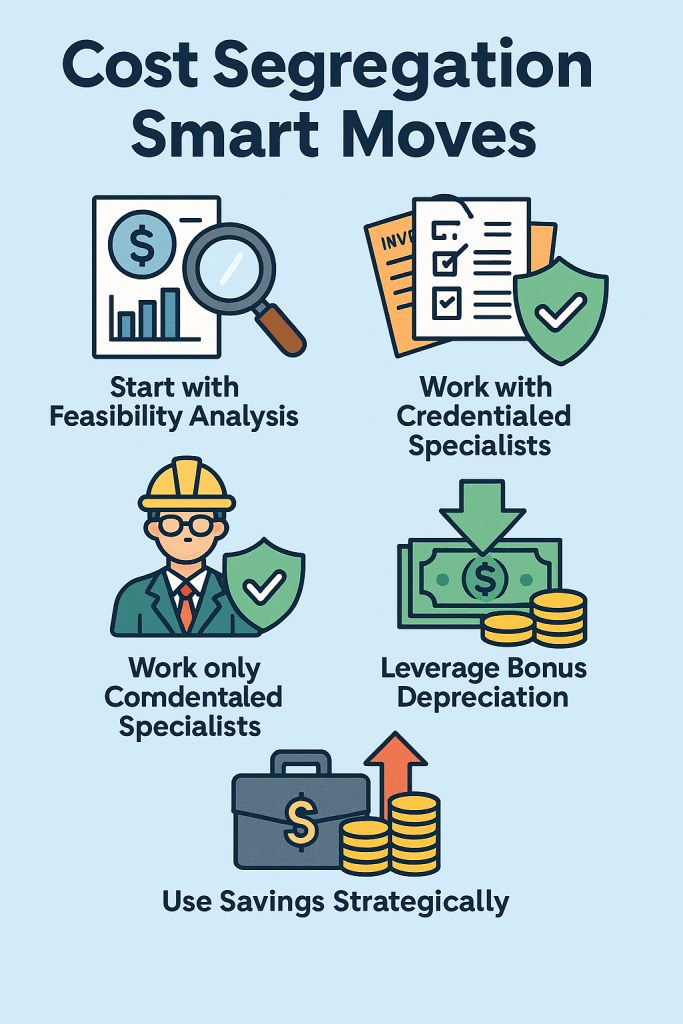
Here’s exactly what top-performing business owners do to extract every dollar from cost segregation:
- Start with a feasibility analysis: Get a free estimate from a qualified firm showing potential savings before you commit. Most properties over $500,000 make sense, but run the numbers first.
- Gather every construction document: Blueprints, invoices, change orders, architectural plans, and placed-in-service documentation. The more detail you provide, the more assets the engineers can identify and reclassify.
- Work only with credentialed specialists: Engineers with LEED credentials, licensed professionals, or certified cost segregation specialists. The IRS takes study quality seriously—don’t use software-only solutions that invite audits.
- Leverage bonus depreciation immediately: Apply 100% bonus depreciation to all reclassified assets in the year placed in service. This is where the magic happens—moving $500,000 to $2 million from future years into today.
- Use your savings strategically: Reinvest in growth, pay down expensive debt, fund new acquisitions, or build reserves. Don’t just let tax savings sit idle—put the capital to work while competitors struggle with cash flow.
Real-World Results From Actual Businesses
Houston Office Building Developer
A Houston commercial developer purchased an $8 million office building and commissioned a cost segregation study before filing their first tax return. The analysis identified $3.2 million in reclassifiable assets—parking structure, site improvements, specialized HVAC, lighting systems, and interior fixtures. With 100% bonus depreciation, they deducted $1.6 million in year one (after applying their cost basis and other factors), saving roughly $560,000 in federal and state taxes. They used the cash to close on their next acquisition six months early.
Midwest Auto Service Center
An auto service owner completed a $2.2 million retail buildout with specialized lifts, exhaust systems, and custom shop infrastructure. Their accountant was depreciating everything over 39 years. After a cost segregation analysis, they reclassified $1.8 million of the project into 5-, 7-, and 15-year property. The first-year deduction hit $640,000, slashing their tax bill by $224,000. They used the savings to pay down their construction loan early, saving another $85,000 in interest over five years.
California Apartment Complex Owner
A real estate investor bought a 48-unit apartment building for $6.5 million in 2019 but never did a cost segregation study. In 2024, they learned about catch-up depreciation. Using Form 3115, they captured $1.1 million in missed depreciation from five years of ownership, creating a $1.1 million deduction on their current return. The tax savings of $385,000 funded renovations that increased rents by 12% across the property.
| Factor | Standard Depreciation | With Cost Segregation |
|---|---|---|
| First-Year Deduction | Small (2-3% of cost) | Large (20-40% of cost) |
| Timeline for Full Deduction | 27.5 or 39 years | 5 to 15 years for reclassified assets |
| Cash Flow Impact | Minimal immediate benefit | Massive year-one cash infusion |
| IRS Audit Risk | Low (but leaving money on table) | Low (when properly documented) |
| Best For | Those unaware of alternatives | Growth-focused business owners |
Common Mistakes That Cost You Money
Using Software-Only Studies
Online tools and software programs that promise “instant cost segregation” don’t hold up under IRS scrutiny. The Audit Techniques Guide requires detailed engineering analysis, on-site inspection, and documentation of cost estimation methodologies. Software can’t provide that. If the IRS audits you and your study lacks engineering substance, they’ll disallow the deductions and hit you with penalties and interest.
Ignoring Placed-In-Service Dates
The placed-in-service date determines when you start depreciation and whether you qualify for bonus depreciation. Get this wrong and you lose timing benefits. If you substantially completed a renovation in December but didn’t occupy until February, you need to document exactly when the property was ready for use. Miss this detail and you’re pushing deductions into the next tax year unnecessarily.
Overlooking Land Improvements and Small Components
Most property owners focus on big-ticket items like HVAC and electrical systems. They miss the landscaping, sidewalks, parking lot striping, exterior lighting, and decorative elements that add up to hundreds of thousands in reclassifiable assets. A thorough engineering-based study identifies everything—including components worth $5,000 or $10,000 that most accountants overlook.
Waiting Too Long to Do the Study
Every year you wait is another year of missed depreciation. If you bought a building three years ago, you’ve already lost three years of accelerated deductions. While you can catch up using Form 3115, you’re still costing yourself time value of money—the earlier you get the tax savings, the more value you extract through investment or debt reduction.
Expert Insight on Cost Segregation Strategy
According to tax strategist and real estate investor Brandon Hall: “Cost segregation isn’t just about tax savings—it’s about cash flow velocity. The businesses that grow fastest aren’t necessarily the most profitable on paper. They’re the ones that understand how to extract capital from their assets and redeploy it before competitors even file their tax returns. This is wealth-building through legal tax engineering.”
How Federal Tax Credits ORG Makes This Easy
Most business owners know they should do cost segregation. Few actually do it because they think it’s complicated, expensive, or risky. Federal Tax Credits ORG eliminates all three concerns.
They handle the entire process from start to finish. Their team of licensed engineers and tax professionals conducts detailed, engineering-based studies that meet every IRS requirement. You get complete audit support—if the IRS questions anything, Federal Tax Credits ORG stands behind their work and handles all correspondence.
The process is simple. You provide construction documents and property details. Their engineers conduct on-site analysis, review blueprints, and classify every component according to MACRS depreciation schedules and IRS guidelines. You receive a comprehensive report with executive summary, detailed asset classification, fixed asset ledger, and certification of preparer credentials—everything you need to maximize deductions and survive any audit.
Most clients see 10-20 times ROI on their study cost through first-year tax savings alone. Federal Tax Credits ORG even provides upfront estimates so you know the potential savings before spending a dollar. If the numbers don’t make sense, they’ll tell you honestly rather than pushing a service you don’t need.
They specialize in commercial buildings, rental properties, restaurants, medical facilities, retail spaces, warehouses, and multi-family properties. If you own real estate worth over $500,000, there’s probably five or six figures in missed depreciation sitting in your building right now. Federal Tax Credits ORG finds it, documents it, and puts the cash in your pocket where it belongs.
Take Control of Your Tax Strategy Today
Cost segregation isn’t complicated once you understand what it does. You’re taking tax deductions you’re legally entitled to and moving them from decades in the future to this year. With permanent 100% bonus depreciation, the opportunity is bigger than it’s ever been.
Stop waiting for tax law to get better. It just did. Stop worrying about IRS audits when you have proper documentation. Stop leaving six or seven figures on the table because your accountant treats your building like one big depreciable asset.
Get a feasibility analysis from Federal Tax Credits ORG. See the numbers. Understand your potential savings. Then decide if you want to keep overpaying taxes or start using the law the way Congress wrote it—to help businesses grow, invest, and create value.
Your competitors are already doing this. The only question is how much longer you’re willing to wait while they use their tax savings to outgrow, outspend, and outcompete you. Make the move now. The cash flow you unlock today could fund the expansion you’ve been putting off for two years.
Cost Segregation Study FAQs
What is a cost segregation study and how does it work?
A cost segregation study is an IRS-approved tax strategy that breaks down your commercial building into individual components, reclassifying assets from 39-year straight-line depreciation into shorter 5-, 7-, or 15-year schedules. This lets you accelerate depreciation deductions and use bonus depreciation to potentially deduct 20-40% of your building’s cost in the first year instead of over decades.
How much can I save with a cost segregation study?
Typical savings range from $200,000 to $800,000+ in first-year deductions for commercial properties valued between $2 million and $8 million. The exact savings depend on your property type, cost basis, and how much can be reclassified into shorter depreciation schedules, but most properly executed studies deliver 10-20 times ROI compared to the study cost.
Is cost segregation legal and will it trigger an IRS audit?
Cost segregation is completely legal—the IRS published an Audit Techniques Guide specifically for this strategy. When you use an engineering-based study with proper documentation from credentialed specialists, audit risk is low. The IRS expects commercial property owners to use cost segregation; they just want proper support for your asset classifications and cost allocations.
Can I do a cost segregation study on a building I already own?
Yes, using IRS Form 3115 you can capture missed depreciation on buildings you’ve owned for years without amending prior tax returns. The IRS treats it as if you did the study when you first placed the property in service, then gives you all those missed deductions in one lump sum on your current return—this is called catch-up depreciation.
What types of properties benefit most from cost segregation?
Commercial buildings, rental properties, restaurants, medical offices, retail spaces, warehouses, apartment complexes, hotels, and self-storage facilities all benefit significantly. Any property over $500,000 with improvements, renovations, or specialized components typically qualifies, especially if you customized the space for your specific business operations.
Citations
- IRS, “Publication 946: How to Depreciate Property,” https://www.irs.gov/publications/p946
- CBH, “Trump’s Tax Bill: Bonus Depreciation & Cost Segregation,” https://www.cbh.com/insights/articles/trumps-tax-bill-bonus-depreciation-cost-segregation/
- Acena Consulting, “The One Big Beautiful Bill: Cost Segregation & Bonus Depreciation,” https://www.acenaconsulting.com/blog/as-it-now-stands-the-one-big-beautiful-bill-in-2025-what-it-means-for-bonus-depreciation-and-cost-segregation
- Plante Moran, “Bonus Depreciation Changes,” https://www.plantemoran.com/explore-our-thinking/insight/2022/08/the-tcja-100-percent-bonus-depreciation-starts-to-phase-out-after-2022
- ASCSP, “Cost Segregation Case Studies,” https://www.ascsp.org/cost-segregation-case-studies
- KBKG, “Cost Segregation Study Case Study,” https://www.kbkg.com/costsegregation/case-study
- CLA Connect, “Case Study: Rental Owner Finds Tax Savings With Cost Segregation Study,” https://www.claconnect.com/en/resources/articles/2022/case-study-rental-owner-finds-tax-savings-with-cost-segregation-study
- Engineered Tax Services, “Cost Segregation & 45L Case Study,” https://engineeredtaxservices.com/ets_resources/cost-segregation-45l-case-study/