

Key Takeaways
- FSA limits 2025 allow employees to contribute up to $3,300 in pre-tax dollars to health flexible spending accounts
- Dependent care FSA limits remain at $5,000 for 2025 with no increase from previous years
- Maximum carryover amount increases to $660 for unused health FSA funds from 2025 to 2026
- Understanding FSA limits helps maximize tax savings and avoid forfeiting unused contributions
- Proper planning with 2025 FSA limits can save families hundreds or thousands in taxes annually
- Employees must make new elections each year during open enrollment to participate in FSA programs
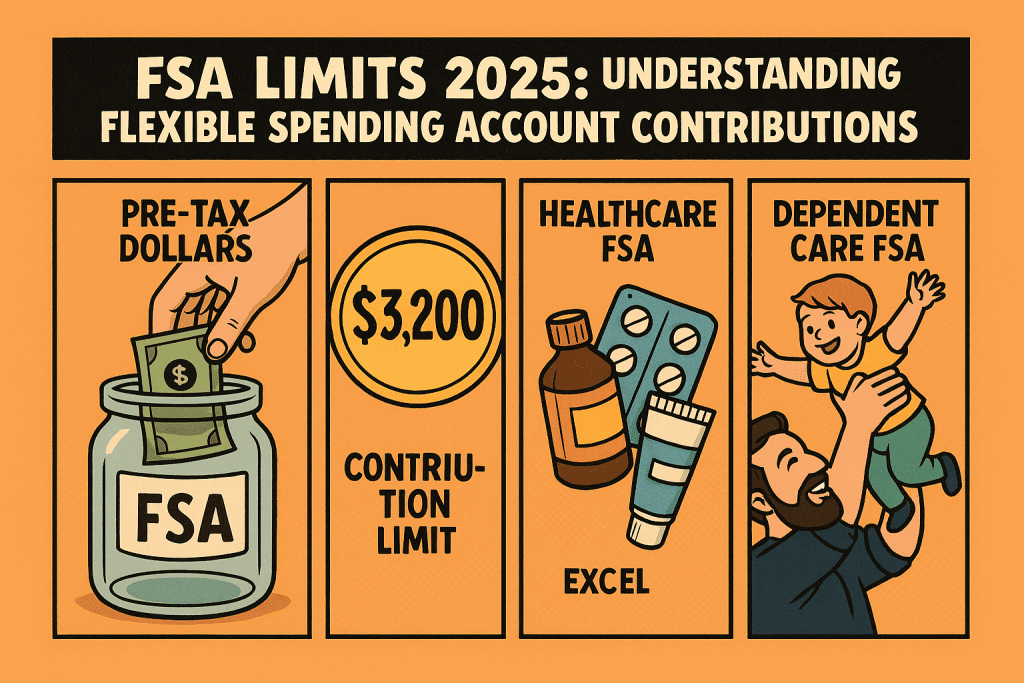
FSA limits 2025 determine the maximum amount employees can contribute to flexible spending accounts using pre-tax dollars, helping families save money on healthcare and dependent care expenses. The IRS has increased the health FSA contribution limit to $3,300 for 2025, offering participants greater tax savings opportunities.
What Is an FSA and Why FSA Limits 2025 Matter
A Flexible Spending Account (FSA) represents an employer-sponsored benefit program that allows employees to set aside pre-tax dollars from their paychecks to cover qualified medical and dependent care expenses. These contributions are not subject to federal income tax, Social Security tax or Medicare tax, creating immediate savings for participating families. Understanding FSA limits 2025 helps employees maximize their tax benefits while avoiding the potential loss of unused funds.
The basic mechanics of FSAs involve employees making contribution elections during annual open enrollment periods, with the chosen amounts being deducted from their paychecks throughout the year. Participants can then use accumulated funds to pay for eligible expenses using FSA debit cards or by submitting reimbursement claims. The traditional “use-it-or-lose-it” provision means that unused funds are typically forfeited at year-end; however, many plans now offer carryover options or grace periods to provide greater flexibility.
Types of Flexible Spending Accounts
Health FSAs represent the most common type, covering medical expenses like copayments, deductibles, prescription medications, and over-the-counter items when medically necessary. Dependent Care FSAs help working parents pay for childcare expenses with pre-tax dollars, including daycare, after-school programs, and elder care services. Limited Purpose FSAs are designed for participants enrolled in Health Savings Account plans, restricting eligible expenses to dental and vision care only to maintain HSA compatibility.
| FSA Type | 2025 Contribution Limit | Primary Use | Carryover Allowed |
|---|---|---|---|
| Health FSA | $3,300 | Medical, dental, vision expenses | Up to $660 |
| Dependent Care FSA | $5,000 | Childcare and elder care services | Varies by plan |
| Limited Purpose FSA | $3,300 | Dental and vision expenses only | Up to $660 |
Core Benefits of Maximizing FSA Limits 2025
Tax savings represent the primary advantage of participating in FSA programs, as contributions reduce taxable income dollar for dollar while eliminating payroll taxes on the contributed amounts. For employees in higher tax brackets, the combined federal, state, and payroll tax savings can reach thirty to forty percent of their FSA contributions. This means every dollar contributed to an FSA effectively costs only sixty to seventy cents in actual take-home pay reduction.
Increased purchasing power through pre-tax dollars enables families to afford better healthcare and childcare services without a proportional impact on their budgets. Pre-tax contribution benefits extend beyond simple tax savings to include improved cash flow management and predictable expense budgeting throughout the year. Many employers also contribute matching funds or provide FSA administrative benefits, further enhancing the value proposition for employees who participate.
Budgeting and Planning Advantages
FSAs encourage proactive healthcare planning by requiring employees to estimate their annual expenses during enrollment periods. This planning process often reveals opportunities to schedule routine medical procedures, replace prescription eyewear, or address deferred healthcare needs using tax-advantaged dollars. The forced budgeting aspect helps families allocate appropriate resources for healthcare expenses rather than facing unexpected out-of-pocket costs throughout the year.

FSA Limits 2025 Contribution Amounts by Account Type
For 2025, the IRS has increased the health FSA contribution limit to $3,300, representing a $100 increase from the 2024 limit of $3,200. This inflation-adjusted increase provides participants with additional tax-advantaged savings capacity to address rising healthcare costs. The contribution limit adjusts in $50 increments based on complex cost-of-living calculations tied to consumer price index increases, ensuring FSA benefits maintain purchasing power over time.
The dependent care FSA limit remains fixed at $5,000 for 2025 with no inflation adjustment, as only an act of Congress can modify this statutory limit. While this amount hasn’t increased, it still provides substantial tax savings for families with qualifying childcare expenses. The static nature of dependent care FSA limits reflects legislative requirements rather than IRS administrative adjustments, distinguishing it from health FSA limits that adjust automatically for inflation.
Employer Contribution Considerations
Employers may contribute up to $500 annually to employee health FSAs without affecting the employee contribution limit, creating a combined maximum potential of $3,800 for 2025. These employer contributions represent additional tax-free benefits that enhance the overall value of FSA participation. However, employers must be careful not to overcontribute, as excessive amounts could risk the FSA losing its status as an excepted benefit under healthcare regulations.
Historical Context and Future Projections
The 2025 FSA limit increase continues a trend of gradual adjustments that began with the Affordable Care Act’s establishment of indexed contribution limits. Previous years have seen similar modest increases reflecting inflation rates and economic conditions. Understanding these patterns helps employees anticipate future changes and plan long-term healthcare financing strategies using tax-advantaged accounts effectively.
Major Categories of FSA-Eligible Expenses Under 2025 Limits
Health FSA funds can cover a comprehensive range of medical expenses that extend far beyond basic doctor visits and prescription medications. Eligible expenses include copayments, deductibles, dental and vision care, eyeglasses, hearing aids, and various medical products and services not covered by health insurance plans. The broad eligibility criteria ensure participants can address diverse healthcare needs while maximizing their tax savings under the increased 2025 limits.
Over-the-counter medications and medical supplies represent significant opportunities for FSA utilization, particularly with expanded eligibility rules that have simplified purchase requirements. Menstrual care products, first aid supplies, diagnostic devices like blood pressure monitors, and mobility aids all qualify for FSA reimbursement. Expanded eligible expense categories enable participants to fully utilize their annual contributions, addressing both routine and unexpected healthcare needs.
Dependent Care FSA Eligible Expenses
Dependent Care FSA funds cover childcare expenses for children under the age of thirteen, including daycare centers, nursery schools, before- and after-school programs, and summer day camps. Adult dependent care services for disabled spouses or family members also qualify, providing tax advantages for families managing eldercare responsibilities. The key requirement involves care that allows the account holder to work, actively seek employment, or attend school full-time.
Limited Purpose FSA Restrictions
Limited Purpose FSAs serve participants with Health Savings Accounts by restricting eligible expenses to dental and vision care only. This design maintains HSA eligibility while still providing tax-advantaged spending for specific healthcare categories. Orthodontic treatments, routine eye exams, prescription eyewear, and dental procedures all qualify under Limited Purpose FSA rules, making these accounts valuable complements to HSA strategies.
| Expense Category | Health FSA | Dependent Care FSA | Limited Purpose FSA |
|---|---|---|---|
| Medical copayments and deductibles | Yes | No | No |
| Prescription medications | Yes | No | No |
| Dental care and orthodontics | Yes | No | Yes |
| Vision care and eyewear | Yes | No | Yes |
| Childcare and daycare | No | Yes | No |
| Elder care services | No | Yes (if qualified) | No |
FSA Rollover Rules and Use-It-or-Lose-It Provisions for 2025
The maximum carryover amount for health FSAs increases to $660 for 2025, representing 20% of the new $3,300 contribution limit. This carryover provision allows participants to roll unused funds from 2025 into 2026, providing greater flexibility in managing healthcare expenses across calendar years. The carryover feature allows participants to elect up to $3,300 in new contributions for 2025, in addition to any amounts carried over from the previous year.
Employers have discretion in plan design regarding rollover versus grace period options, though plans cannot offer both features simultaneously. Health FSA plans are permitted to offer either a grace period or a carryover feature, but not both. Grace periods typically extend spending deadlines by two and a half months into the following year, while carryover options provide longer-term flexibility by allowing unused funds to remain available throughout the subsequent plan year.
Planning Strategies to Avoid Forfeiture
Successful FSA management requires careful expense planning and monitoring throughout the year to avoid losing unused contributions. Participants should track spending regularly, estimate remaining healthcare needs, and make strategic purchases before plan year deadlines. Year-end planning strategies include stocking up on eligible over-the-counter items, scheduling routine medical procedures, and replacing prescription eyewear or contact lenses to utilize remaining balances effectively.
Employer Plan Variations
Different employers may structure their FSA plans with varying features, including carryover amounts, grace periods, and interpretations of eligible expenses. Participants should review their specific plan documents and consult human resources departments to understand their organization’s particular rules and deadlines. Some employers may choose lower contribution limits than the IRS maximums, while others may offer enhanced benefits, such as employer matching contributions or expanded eligible expense categories.
Steps for Maximizing FSA Limits 2025 Benefits
Effective FSA utilization begins with accurate expense estimation during open enrollment periods, which requires participants to review their previous year’s spending patterns and anticipate their upcoming healthcare needs. Consider scheduled medical procedures, routine checkups, prescription refills, and potential emergency expenses when calculating optimal contribution amounts. The goal involves maximizing tax savings while minimizing forfeiture risk through careful planning and realistic projections.
Regular monitoring throughout the year ensures participants stay on track with spending goals and can adjust strategies as needed. Many FSA administrators provide mobile apps, online portals, and automated alerts to help participants track balances and deadlines. Proactive account management includes setting monthly spending targets, scheduling routine healthcare services, and maintaining receipts for potential reimbursement claims or audit requirements.
Technology Tools and Management Resources
Modern FSA administration leverages technology to simplify participation and reduce administrative burdens for both employees and employers. FSA debit cards allow direct payment at qualified providers, eliminating reimbursement delays and paperwork requirements. Mobile applications enable receipt capture, balance checking, and expense tracking from smartphones, making FSA management more convenient and accessible throughout the year.
Documentation and Compliance Requirements
Proper documentation protects participants during potential audits and ensures smooth reimbursement processes for submitted claims. Save receipts for all FSA transactions, maintain records of medical necessity for over-the-counter items, and respond promptly to administrator requests for additional documentation. Understanding substantiation requirements helps avoid suspended FSA cards and ensures continued access to accumulated funds throughout the plan year.

Recent Trends and Regulatory Developments Affecting FSA Limits 2025
The 2025 FSA limit increase reflects the IRS’s ongoing efforts to maintain the purchasing power of tax-advantaged healthcare benefits in response to inflation and rising medical costs. The adjustment methodology utilizes the Chained Consumer Price Index for All Urban Consumers to determine appropriate increases, with 2025 adjustments reflecting estimated inflation rates ranging from 2.7% to 3.1%. This systematic approach ensures that FSA benefits evolve in line with economic conditions, while providing predictable planning frameworks for both employers and employees.
Employers increasingly offer enhanced FSA features including expanded eligible expense categories, digital claims processing, and integrated wellness programs that encourage preventive healthcare utilization. Many organizations have adopted more flexible plan designs that include carryover provisions, employer contributions, and streamlined administration to improve employee satisfaction and participation rates. Evolving employer offerings reflect competitive pressures to provide valuable benefits that support employee financial wellness and healthcare access.
Legislative and Regulatory Outlook
Future FSA developments may include expanded eligible expense categories, increased contribution limits, and simplified administration requirements based on ongoing discussions among policymakers and benefits professionals. Consumer advocacy groups continue pushing for greater flexibility in FSA rules, including expanded carryover amounts and reduced forfeiture risks. Understanding these trends helps participants and employers anticipate changes and plan long-term benefits strategies accordingly.
Industry Best Practices and Innovations
Leading employers implement comprehensive communication strategies to educate employees about FSA benefits and optimize participation rates. These initiatives include financial wellness seminars, personalized benefits counseling, and decision-support tools that help employees calculate optimal contribution amounts. Technology innovations continue improving the user experience through artificial intelligence-powered expense categorization, predictive analytics for spending recommendations, and integrated healthcare marketplace platforms.
Coordination with Other Tax-Advantaged Accounts
FSA participation requires careful coordination with Health Savings Accounts under Section 125 cafeteria plans as IRS rules generally prohibit simultaneous enrollment in both health FSAs and HSAs. However, Limited Purpose FSAs specifically designed for dental and vision expenses can complement HSA strategies by providing additional tax-advantaged spending capacity for non-medical expenses. Understanding these interaction rules helps participants optimize their overall benefits portfolio while maintaining compliance with complex regulatory requirements.
Dependent Care FSAs coordinate with other childcare benefits including employer-provided dependent care assistance programs and federal tax credits for childcare expenses. Participants must choose between claiming the Dependent Care FSA tax advantage or the Child and Dependent Care Tax Credit, as the same expenses cannot qualify for both benefits. Strategic benefit coordination involves comparing potential tax savings from different programs to determine the most advantageous approach for individual family situations.
HSA and FSA Integration Strategies
Families with high-deductible health plans and HSA eligibility can often benefit from Limited Purpose FSAs that cover dental and vision expenses while preserving HSA contribution capacity. This combination provides tax advantages for both current healthcare expenses and future medical costs through HSA investments. Some employers offer grace periods or carryover options that can help bridge timing differences between FSA and HSA utilization patterns.
Retirement and Estate Planning Considerations
While FSAs primarily serve current-year expense needs, they can play roles in broader financial planning strategies by reducing current tax burdens and freeing up other income for retirement savings. The tax savings from maximizing FSA contributions can be redirected to 401(k) plans, IRAs, or other long-term investment vehicles. Understanding these connections helps participants integrate FSA benefits into comprehensive financial planning approaches that support both immediate needs and future goals.
Conclusion
FSA limits 2025 provide enhanced opportunities for tax savings and healthcare cost management through increased contribution limits and improved plan features. The health FSA limit has increased to $3,300, combined with a higher carryover amount of $660, offering greater flexibility and tax advantages for participating employees. Understanding these limits and planning strategically can result in substantial savings while ensuring access to necessary healthcare and dependent care services. Success with FSA programs requires careful planning, regular monitoring, and coordination with other benefits to maximize overall value. Employees should consult with their human resources departments and benefits advisors to understand the specific features of their plan and develop optimal contribution strategies that align with their healthcare needs and financial goals.
FSA Limits 2025 FAQs
Can I have both an FSA and an HSA in 2025?
You cannot have both a health FSA and an HSA in 2025, as IRS rules prohibit simultaneous enrollment in both accounts. However, you can participate in a Limited Purpose FSA that covers only dental and vision expenses while maintaining HSA eligibility.
What happens to unused FSA funds at the end of 2025?
Unused FSA funds at the end of 2025 may be forfeited under the use-it-or-lose-it rule, though many plans offer carryover provisions allowing up to $660 to roll into 2026. Some plans offer grace periods that extend spending deadlines by 2.5 months, rather than carryover options.
Who qualifies as a dependent for Dependent Care FSA purposes?
Dependents for Dependent Care FSA purposes include children under age 13, disabled spouses, and disabled dependents of any age who cannot care for themselves. The care must be necessary to allow you to work, look for work, or attend school full-time.
Do I need receipts for all FSA purchases in 2025?
You need receipts for all FSA purchases in 2025 to substantiate expenses and comply with IRS requirements. FSA administrators may request documentation for any transaction, and maintaining proper records protects against account suspensions or audit issues.
Can my employer contribute to my FSA beyond the 2025 limits?
Your employer can contribute up to $500 to your health FSA beyond the $3,300 employee limit for 2025, creating a combined maximum of $3,800. Employer contributions don’t count toward your contribution limit but must comply with plan design requirements to maintain tax-advantaged status.