

FSA vs HSA represents a critical choice between two tax-advantaged healthcare accounts with vastly different rules and benefits. FSAs are employer-owned with use-it-or-lose-it requirements, while HSAs offer individual ownership with unlimited rollover and investment growth potential for those enrolled in high-deductible health plans.
Key Takeaways
- Ownership Structure: HSAs belong to you forever; FSAs are owned by employers and lost when you leave jobs
- Rollover Rules: HSA funds roll over indefinitely with investment growth; FSAs typically must be spent within the plan year
- Eligibility Requirements: HSAs require high-deductible health plan enrollment; FSAs need employer sponsorship only
- Contribution Limits 2025: HSAs allow up to $4,300 individual/$8,550 family; FSAs cap at $3,200 for healthcare expenses
- Tax Benefits: Both offer pre-tax contributions and tax-free qualified withdrawals, but HSAs add tax-free growth
What Are FSA and HSA Accounts Really?
Think of these accounts as your personal healthcare piggy banks, but with government-approved tax tricks that can save you serious money. The catch? They follow completely different rules that can either multiply your savings or cost you thousands if you pick wrong. They are usually attached to a Section 125 or Cafeteria Plan.
Health Savings Account Fundamentals
A Health Savings Account works like a supercharged retirement account specifically designed for medical expenses. You contribute pre-tax dollars, the money grows tax-free through investments, and qualified withdrawals never get taxed. It’s the only account in America that offers triple tax advantages.
The trade-off for these benefits is enrollment in a high-deductible health plan, which means you’ll pay more out-of-pocket before insurance kicks in. For 2025, that means deductibles of at least $1,650 for individuals or $3,300 for families. Many people see this as a barrier, but smart users turn it into an advantage.
HSAs become more valuable over time because unused funds roll over indefinitely and can be invested for long-term growth, making them excellent tools for retirement planning. After age 65, you can withdraw funds for any purpose without penalty, though non-medical withdrawals get taxed as regular income.
Flexible Spending Account Reality
Flexible Spending Accounts operate on a completely different philosophy. Your employer owns the account, sets the rules, and typically requires you to spend contributed funds within the plan year or forfeit them to the company. This “use-it-or-lose-it” rule creates pressure that many employees find stressful.
FSAs don’t require specific insurance enrollment, making them accessible to employees with traditional health plans. You can contribute to healthcare FSAs, dependent care FSAs, or both, depending on your employer’s offerings. The flexibility in plan compatibility makes FSAs attractive for employees who can’t or don’t want high-deductible coverage.
Some employers offer grace periods of up to 2.5 months or allow carryover of up to $640 into the following year, but these are optional employer benefits, not guaranteed features. The variability in employer policies makes FSA research essential during open enrollment periods.

FSA vs HSA: Complete Feature Comparison
The differences between these accounts go far beyond contribution limits and rollover rules. Understanding the nuances helps you choose the account that aligns with your financial situation, health needs, and career plans.
| Feature | HSA | FSA |
|---|---|---|
| Account Ownership | Individual (portable) | Employer (lost when leaving) |
| 2025 Contribution Limits | $4,300 individual / $8,550 family | $3,200 healthcare / $5,000 dependent care |
| Rollover Policy | Unlimited rollover | Use-it-or-lose-it (some exceptions) |
| Investment Options | Yes, after minimum balance | No investment options |
| Insurance Requirement | High-deductible health plan | Any employer-sponsored plan |
| Age 65+ Benefits | Penalty-free withdrawals for any purpose | No special age benefits |
Contribution and Withdrawal Mechanics
HSA contributions can come from employees, employers, or both, but total contributions cannot exceed annual limits. Many employers offer HSA contributions as part of benefits packages, essentially providing free money that grows tax-free. Employee contributions reduce taxable income, while employer contributions don’t count as taxable benefits.
FSA contributions typically come through payroll deduction only, though some employers contribute to employee accounts as additional benefits. The contribution timing matters because FSA elections are generally irrevocable during the plan year, while HSA contributions can be adjusted anytime up to the tax filing deadline.
Withdrawal procedures differ significantly between accounts. HSAs offer multiple access methods, including debit cards, online transfers, and reimbursement requests. Documentation requirements are less stringent because account holders bear responsibility for proving qualified expenses during potential IRS audits.
FSA withdrawals require upfront approval and documentation for most expenses. Plan administrators review requests before approving reimbursements, creating processing delays, but providing compliance protection. This administrative oversight reduces audit risk but slows access to funds.
Strategic Account Usage for Maximum Healthcare Savings
Smart account management goes beyond simply contributing pre-tax dollars and hoping for the best. Understanding how to optimize timing, maximize employer benefits, and coordinate with other financial strategies can dramatically increase your healthcare savings.
HSA Investment and Growth Strategies
Most HSA providers offer investment options once account balances reach minimum thresholds, typically $1,000-$2,000. Conservative investors often choose money market funds or CDs, while aggressive savers select mutual funds or ETFs that mirror retirement account strategies.
The key insight most people miss is treating HSAs as retirement accounts that happen to offer healthcare benefits rather than healthcare accounts with investment features. Young, healthy individuals can contribute maximum amounts, invest aggressively, and pay current medical expenses out-of-pocket to maximize long-term growth.
HSA investment growth over decades can turn modest annual contributions into substantial retirement healthcare funds, potentially worth hundreds of thousands by retirement age. A 25-year-old contributing $4,000 annually with 7% growth could accumulate over $800,000 by age 65, all available tax-free for medical expenses.
FSA Timing and Expense Optimization
FSA success requires careful expense planning and timing to avoid forfeiture. Smart users schedule elective procedures, dental work, and vision care during the plan year to maximize account utilization. The front-loading feature of FSAs allows access to full annual contributions from the start of the year, creating opportunities for large early-year expenses.
Dependent care FSAs offer unique advantages for families with childcare or eldercare expenses. These accounts can pay for daycare, preschool, after-school programs, and even elder day care for qualifying dependents. The $5,000 annual limit provides substantial tax savings for families with significant care expenses.
End-of-year FSA strategies become crucial as plan years come to a close. Stockpiling eligible items, such as bandages, pain relievers, and first aid supplies, helps utilize remaining balances. Many stores now clearly mark FSA-eligible items, making last-minute spending easier and more strategic.
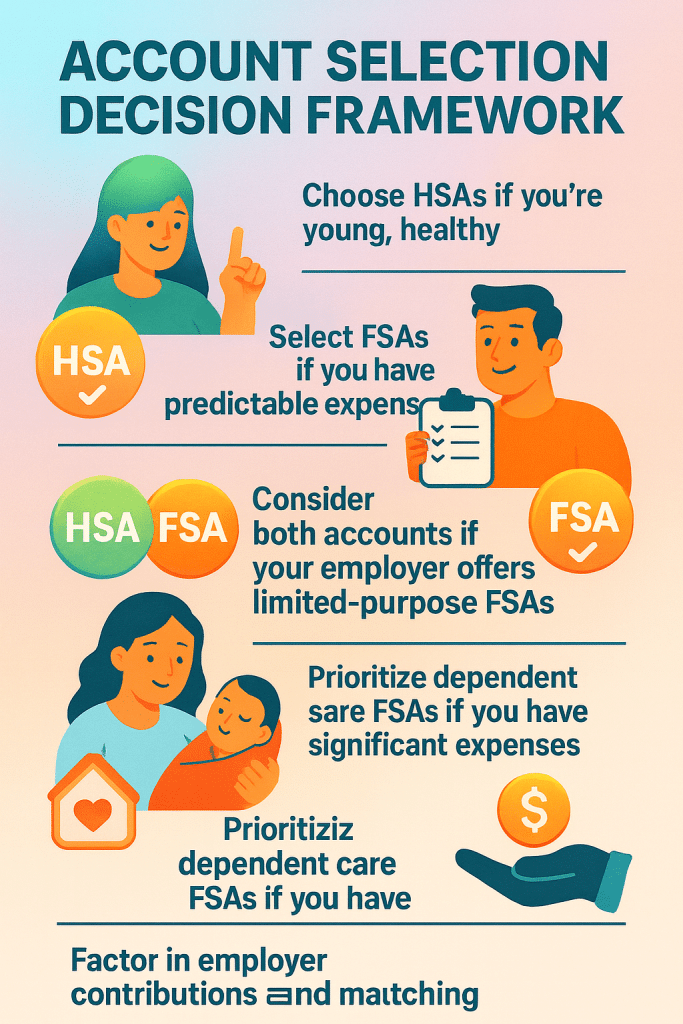
Account Selection Decision Framework
- Choose HSAs if you’re young, healthy, and want long-term investment growth with maximum flexibility
- Select FSAs if you have predictable medical expenses and want immediate tax savings without investment risk
- Consider both accounts if your employer offers limited-purpose FSAs that complement HSA eligibility
- Prioritize dependent care FSAs if you have significant childcare or eldercare expenses regardless of other choices
- Factor in employer contributions and matching when comparing account benefits and total compensation
Life Situation Analysis
Job stability significantly impacts account choice decisions. Frequent job changers benefit more from HSA portability, while long-term employees can maximize FSA benefits through consistent employer relationships. Career growth expectations also matter because higher future incomes make current tax deductions more valuable.
Family planning considerations affect account selection timing. Expecting parents often prefer FSAs for predictable pregnancy and delivery expenses, while families planning multiple children might benefit from HSA long-term growth potential.
Health status and medical history provide important decision inputs. Chronic conditions with predictable costs favor FSA front-loading benefits, while generally healthy individuals benefit more from HSA investment growth. Age becomes a factor because older workers have less time for HSA growth but more immediate medical needs.
Common Account Mistakes and Compliance Issues
The most expensive mistakes happen during account setup and annual elections. Many employees choose accounts based solely on contribution limits, without considering eligibility requirements, rollover rules, or long-term implications.
Over-contribution penalties catch many HSA users off guard, especially those receiving employer contributions. The IRS imposes 6% excess contribution penalties that continue annually until the issue is corrected. FSA over-elections create different problems because contributed funds must be spent or forfeited, leading to wasteful purchases.
Documentation failures create audit risk and potential penalties. HSA holders must maintain receipts for all medical expense withdrawals, even years after the fact. FSA users need approval before spending but face less long-term documentation burden because plan administrators handle compliance.
| Account Type | Best For | Avoid If | Key Risk |
|---|---|---|---|
| HSA | Long-term savers, job changers, investment-minded | Need traditional insurance, frequent medical expenses | High deductible exposure |
| Healthcare FSA | Predictable expenses, employer loyalty, immediate needs | Job instability, variable medical costs | Use-it-or-lose-it forfeiture |
| Dependent Care FSA | Families with childcare/eldercare costs | No qualifying dependents, irregular care needs | Contribution timing vs. expense timing |
Advanced Account Coordination Strategies
Sophisticated users often combine multiple account types to maximize tax benefits while covering different expense categories. Limited-purpose FSAs can complement HSAs by covering dental and vision expenses while preserving HSA eligibility.
Spousal account coordination creates opportunities for families where one spouse has HSA eligibility and the other has FSA access through different employers. Strategic planning can maximize total household contributions while minimizing the complexity of compliance.
Retirement planning integration becomes important for HSA holders who understand the account’s triple tax advantage. Many financial advisors recommend maximizing HSA contributions before 401(k) contributions beyond employer matching because of superior tax treatment.
A small business owner switched from FSA to HSA when she realized the long-term growth potential, contributing maximum amounts for five years and investing in low-cost index funds, growing her healthcare nest egg to over $30,000 while maintaining excellent coverage through her high-deductible plan.
As benefits consultant Sarah Williams explains, “The biggest mistake I see is people choosing accounts based on this year’s medical expenses instead of their 10-year financial and health trajectory. HSAs reward long-term thinking while FSAs optimize short-term cash flow.”
Recent Regulatory Changes and Future Considerations
IRS regulations governing both account types evolve annually, affecting contribution limits, eligible expenses, and compliance requirements. Recent changes have expanded eligible expense categories while maintaining core structural differences between account types.
Contribution limit increases typically track inflation, but vary by account type. HSA limits generally increase more substantially than FSA limits, reflecting different policy priorities around retirement healthcare savings versus immediate expense reimbursement.
Technology improvements have streamlined account management for both FSAs and HSAs. Mobile apps, receipt scanning, and automated reimbursement systems reduce administrative burden while improving compliance tracking. Integration with healthcare providers and pharmacies enables real-time verification of spending.
Future healthcare policy changes could significantly impact account utility and regulations. Understanding current rules while staying informed about potential changes helps optimize decision-making during annual enrollment periods.
Conclusion
Choosing between FSA and HSA accounts requires balancing immediate tax savings against long-term growth potential while considering your health insurance options, job stability, and financial goals. HSAs offer superior benefits for long-term planners who can handle high-deductible insurance, while FSAs provide immediate tax relief for predictable medical expenses without insurance restrictions. The key is matching account features to your specific situation rather than choosing based on contribution limits alone. Take control of your healthcare savings by carefully evaluating your insurance options, medical expense patterns, and career trajectory during your next enrollment period.
FSA vs HSA FAQs
What’s the main difference between FSA vs HSA accounts?
The main difference in FSA vs HSA accounts is ownership and rollover rules: FSAs are employer-owned with use-it-or-lose-it requirements, while HSAs are individually owned with unlimited rollover and investment growth potential. FSA vs HSA also differs in insurance requirements, with HSAs requiring high-deductible health plans.
Can you have both an FSA and HSA at the same time?
You cannot have both a general healthcare FSA and HSA simultaneously, but you can combine an HSA with a limited-purpose FSA that covers only dental and vision expenses. Dependent care FSAs can be used alongside HSAs without restrictions since they cover different expense categories.
Which account type offers better long-term value for retirement planning?
HSAs offer superior long-term value for retirement planning due to triple tax advantages, unlimited rollover, and investment growth potential that can accumulate hundreds of thousands over decades. FSAs provide immediate tax savings but lack investment options and long-term growth potential.
What happens to FSA vs HSA funds when you change jobs?
When comparing FSA vs HSA portability, HSA funds remain with you permanently regardless of job changes, while FSA funds are typically forfeited when leaving employers unless spent during grace periods. This portability difference makes HSAs more valuable for employees who change jobs frequently.
How do contribution limits compare between FSA and HSA accounts for 2025?
For 2025, HSAs allow contributions up to $4,300 for individuals and $8,550 for families, while healthcare FSAs cap at $3,200 annually. Dependent care FSAs have separate $5,000 limits, and these accounts can be combined with HSAs for maximum tax benefits.
Citations
- Truemed. HSA vs. FSA: 2025 Comparison Guide & Chart
- Aetna. HSA vs. FSA vs. HRA: What is the Difference?
- Rippling. FSA vs HSA: Which health spending account is right for you?
- PBS. FSA vs HSA Comparison Guide for Healthcare Savings
- Paychex. Health FSA vs. HSA: What’s the Difference?
- MetLife. Differences Between FSA and HSA