
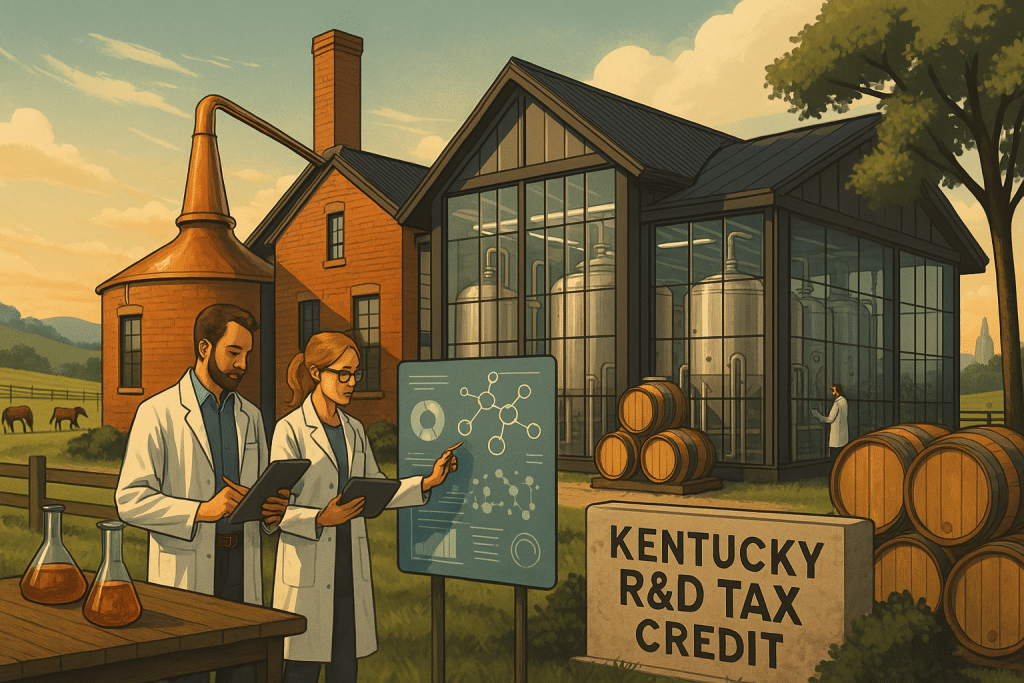
The Kentucky research and development tax credit offers businesses a 5% nonrefundable credit on qualified costs for constructing, remodeling, or equipping research facilities—with the main function being investment incentive for companies building R&D infrastructure in the Blueblooded State.
Key Takeaways
- Kentucky’s Qualified Research Facility Tax Credit equals 5% of costs for constructing, remodeling, or equipping research facilities—different from most states that credit actual research activities.
- Unused credits carry forward 10 years, giving long-term value for businesses with fluctuating tax liabilities.
- Businesses must file Schedule QR with their Kentucky return and maintain detailed property records to claim the credit.
- The Kentucky Enterprise Initiative Act provides additional sales and use tax refunds on R&D equipment purchases up to $5 million annually.
- Federal R&D tax credits remain available for actual research activities, and recent tax law changes make 2025 an exceptional year for facility investments.
What Makes Kentucky’s R&D Credit Different From Other States
Kentucky took a unique path with their research incentive. Most states reward ongoing research activities. Kentucky rewards you for building the place where innovation happens.
The Qualified Research Facility Tax Credit targets infrastructure. You’re constructing a lab in Louisville? Building a testing facility in Lexington? Equipping a clean room in Bowling Green? That’s where Kentucky wants to help.
This approach makes sense when you look at Kentucky’s industrial landscape. With over 250,000 manufacturing jobs—that’s 13% of the workforce compared to the national average of 8.5%—the state knows that research facilities drive long-term growth. Companies like Toyota, GE Appliances, and Ford didn’t just show up. They built campuses. Research centers. Testing grounds.
The credit equals 5% of your qualified costs. It’s nonrefundable, meaning it reduces your Kentucky tax liability but won’t generate a cash refund. Here’s the thing most accountants miss: you can carry unused credits forward for 10 years. That’s a decade to use every dollar.
Think about that timeline. You’re building a $10 million research facility this year. Your Kentucky state tax credit? $500,000. Even if your current tax liability is only $50,000, you’ve got ten years to use the remaining $450,000. That’s real money working for your business.
| Credit Feature | Kentucky Details | What This Means For You |
|---|---|---|
| Credit Rate | 5% of qualified facility costs | $100,000 in equipment = $5,000 credit |
| Refundability | Nonrefundable | Reduces tax owed; no cash refund |
| Carryforward Period | 10 years | Use credits across multiple tax years |
| Eligible Entities | Individuals, corporations, pass-through entities | LLCs, S-Corps, C-Corps, partnerships all qualify |
| Applicable Taxes | Individual income tax, corporate income tax, LLET | Multiple tax types can use the credit |
Who Qualifies For Kentucky’s Research Facility Credit
The good news: Kentucky casts a wide net. Individuals, corporations, S-corporations, partnerships, and LLCs can all claim this credit. If you’re a sole proprietor running R&D work through your Schedule C, you’re in. If you’re a multi-million dollar corporation, same deal.
Pass-through entities get special treatment. You can apply the credit against Kentucky’s Limited Liability Entity Tax (LLET) and pass the credit through to your members, partners, or shareholders. The credit flows through on Kentucky Schedule K-1 in proportion to each member’s distributive share of income.
What Qualifies as a Research Facility
“Construction of research facilities” has a specific meaning under Kentucky law. You’re looking at costs for constructing, remodeling, and equipping facilities or expanding existing facilities in Kentucky for qualified research.
The expenses must be for tangible, depreciable property. Raw materials don’t count. Supplies don’t count. Replacement property? Nope. The Kentucky Department of Revenue wants to see permanent infrastructure improvements.
Say you’re a biotech startup in Northern Kentucky. You lease 10,000 square feet and need to outfit it as a lab. Your buildout costs include installing specialized HVAC systems, lab benches, fume hoods, autoclave equipment, and testing machinery. Every bit of that tangible property counts toward your credit basis—as long as it’s depreciable and used for qualified research.
The Four-Part Test For Qualified Research
Kentucky ties its definition of “qualified research” to Internal Revenue Code Section 41. That means your research activities must pass the same four-part test the federal government uses:
Your research must be technological in nature. You’re relying on principles of physical science, biological science, engineering, or computer science. Marketing studies don’t qualify. Consumer surveys don’t qualify. You’re solving technical problems.
You’re eliminating uncertainty. At the start of your project, you don’t know if something will work, how to achieve a particular result, or what design will succeed. That uncertainty is what makes it research rather than routine development.
You’re using a process of experimentation. You’re testing hypotheses. Running trials. Collecting data. Refining approaches based on results. This isn’t guesswork—it’s systematic investigation.
The purpose must be creating a new or improved business component. You’re developing products, processes, techniques, formulas, inventions, or software. The goal is improving function, performance, reliability, or quality.
How To Calculate Your Kentucky Research Facility Tax Credit
The math is straightforward. Take your total qualified costs for construction, remodeling, expansion, and equipment. Multiply by 5%. That’s your credit.
Let’s work through a real scenario. You’re a manufacturing company in Jefferson County planning a $3 million research facility expansion. Here’s how your costs break down:
Building expansion: $1,200,000
Specialized manufacturing equipment: $1,400,000
Testing and measurement devices: $300,000
Laboratory furniture and fixtures: $100,000
Total qualified costs: $3,000,000
Kentucky research facility credit: $3,000,000 × 5% = $150,000
That $150,000 credit can offset your Kentucky corporate income tax or LLET. If your current year tax liability is $40,000, you use $40,000 this year and carry forward $110,000 for the next nine years.
Timing Matters: When Credits Become Available
You claim the credit in the tax year you place the property in service. Not when you sign the contract. Not when you pay for it. When it’s installed, operational, and ready for use.
This creates planning opportunities. If you’re completing a major facility buildout near year-end, consider whether accelerating or delaying the placed-in-service date makes sense for your tax situation. A conversation with your tax advisor in Q4 can save serious money.

Recent Federal Tax Changes That Supercharge Facility Investments
Here’s where 2025 gets interesting. The One Big Beautiful Bill Act, signed July 4, 2025, permanently restored 100% bonus depreciation for qualified property acquired and placed in service after January 19, 2025.
This is huge for research facility investments. You can now fully expense eligible research equipment in the year you buy it—and still claim Kentucky’s 5% facility credit on top.
Think about the cash flow impact. You’re investing $2 million in research equipment this year. Federal 100% bonus depreciation gives you a $2 million deduction immediately (assuming a 21% federal corporate rate, that’s $420,000 in federal tax savings). Kentucky’s 5% credit adds another $100,000 in state tax reduction. You’re recovering over $500,000 of your $2 million investment through tax benefits in year one.
The bill also introduced 100% depreciation for “qualified production property”—certain buildings used in manufacturing, production, or refining. For construction beginning between January 20, 2025, and December 31, 2028, and placed in service before January 1, 2031, you can fully expense qualifying building costs in addition to claiming Kentucky’s facility credit.
- Federal R&D Tax Credit: Approximately 6.5% of qualified research expenses (wages, supplies, contract research) for actual research activities—separate from facility costs
- Kentucky Facility Credit: 5% of construction, remodeling, and equipment costs for research facilities
- 100% Bonus Depreciation: Full first-year expensing of eligible research equipment and potentially qualifying buildings
- KEIA Sales Tax Refunds: Recovery of sales and use taxes paid on R&D equipment purchases through the Kentucky Enterprise Initiative Act
- Section 179 Expensing: Increased to $2.5 million under OBBBA for immediate equipment deductions
Kentucky Enterprise Initiative Act: The Hidden R&D Equipment Benefit
Most businesses miss this one. The Kentucky Enterprise Initiative Act (KEIA) provides sales and use tax refunds for research and development equipment purchases.
If your company is engaged in manufacturing, non-retail service, technology activities, agribusiness, or operating a tourism attraction in Kentucky, and you’re making at least $500,000 in eligible investment, KEIA can refund sales and use taxes paid on R&D equipment.
The program has annual caps: $20 million for building and construction materials, and $5 million for research and development equipment across all projects statewide. First come, first served. But for approved projects, you recover the 6% Kentucky sales tax on qualifying equipment purchases.
You need approval from the Kentucky Economic Development Finance Authority (KEDFA) before making purchases. There’s a $500 application fee (waived if you’re applying for multiple incentive programs). The approval process typically takes presentation to KEDFA, which meets the last Thursday of each month.
Stack this with the facility credit and federal benefits. You’re buying $1 million in R&D equipment. KEIA refunds $60,000 in sales tax. Kentucky’s facility credit gives you $50,000. Federal bonus depreciation provides approximately $210,000 in tax savings. You’re recovering $320,000 on a $1 million purchase.
Documentation Requirements: What Kentucky Wants To See
Kentucky doesn’t mess around with paperwork. You must file Schedule QR (Qualified Research Facility Tax Credit) with your income tax return every year you claim the credit.
Attach a detailed schedule listing each piece of tangible, depreciable property:
Date purchased
Date placed in service
Description of the property
Cost
For carryforward years, attach a copy of Schedule QR from the original year plus all subsequent years. Kentucky wants the paper trail showing where the credit came from and how you’ve used it.
Pass-through entities complete Schedule TCS (for corporations and pass-through entities) or Schedule ITC (for individuals) to claim their distributive share received on Schedule K-1.
Record Retention Best Practices
Keep everything for at least four years after you use the last dollar of credits. That includes invoices, contracts, engineering specifications, architectural drawings, equipment purchase orders, installation records, and placed-in-service documentation.
If you’re claiming credits on a $5 million facility buildout, those records protect $250,000 in tax benefits. Losing documentation in an audit is expensive.
| Feature | Kentucky Qualified Research Facility Credit | Federal R&D Tax Credit |
|---|---|---|
| What’s Credited | Construction, remodeling, equipping facilities | Research wages, supplies, contract research |
| Credit Rate | 5% of qualified facility costs | Approx. 6.5% of QREs using Alternative Simplified Credit method |
| Refundable? | No (but 10-year carryforward) | No for most; startups can use against payroll taxes |
| Qualifying Activities | Must meet IRC Section 41 four-part test | Must meet IRC Section 41 four-part test |
| Eligible Expenses | Tangible, depreciable property only | Wages, supplies, contract research |
| Can Be Used Together? | Yes – different expense categories | Yes – different expense categories |
Industries That Benefit Most In Kentucky
Kentucky’s economic momentum is hitting historic highs. Since 2020, the state has announced over 1,200 private-sector projects totaling roughly $40 billion in investments and 63,000 jobs.
Automotive and Advanced Manufacturing
Toyota in Georgetown. Ford in Louisville. These aren’t just assembly plants. They’re research and development campuses. When Toyota announced its EV expansion, that meant research facilities. Testing centers. Engineering labs.
Automotive suppliers benefit too. If you’re developing next-generation components, new manufacturing processes, or lighter-weight materials, you’re conducting qualified research. Building the facilities to do that work? That’s exactly what Kentucky’s credit targets.
Life Sciences and Biotech
Northern Kentucky is seeing explosive growth in life sciences. The Covington Life Science Lab opened in 2025. Employment in the sector is projected to grow 49% through 2025.
Biotech facilities are expensive. Clean rooms, specialized HVAC, safety equipment, testing infrastructure. A single lab buildout can run $500 to $1,000 per square foot. That 5% credit becomes meaningful fast.
Companies like Bexion Pharmaceuticals, Gravity Diagnostics, and Ethos Labs are already here. They needed facilities. They got credits.
Technology and Software Development
Kentucky is establishing itself as a tech hub. The state’s Small Business Innovation Research (SBIR) and Small Business Technology Transfer (STTR) matching funds programs have awarded nearly $1.5 million to 15 innovative Kentucky companies in 2025 alone.
Software companies need server rooms, testing facilities, development labs. You’re building infrastructure for cloud computing, AI development, or cybersecurity research? The facility credit applies.
Agribusiness and Agricultural Technology
The UN estimates we need to increase food supply 70% over the next 30 years. Kentucky sees this opportunity. The state is positioning itself as an agritech leader.
Agribusiness research facilities—whether you’re developing drought-resistant crops, precision agriculture equipment, or food processing technology—all qualify. Kentucky’s agricultural heritage combined with cutting-edge research creates unique opportunities.
Real Kentucky Companies That Benefited
A Lexington-based automotive component manufacturer constructed a new research facility in 2014. The company qualified for $289,100 in federal R&D tax credits for their research activities and an additional $160,000 in Kentucky state facility credits for the building and equipment costs. The facility enabled them to develop next-generation components for the automobile industry while significantly reducing their multi-year tax burden.
A Louisville aerospace company took a similar approach. Over tax years 2011-2014, they claimed $327,833 in federal R&D credits plus $210,000 in Kentucky facility credits for their research facility construction. The combined federal and state benefits helped offset the substantial capital investment required to compete in the aerospace sector.
How The Credit Interacts With Other Kentucky Incentives
Kentucky offers aggressive economic development incentives. The research facility credit is just one piece of a larger puzzle.
The Kentucky Business Investment (KBI) Program provides income tax credits and wage assessments for new and expanding manufacturing, agribusiness, headquarters operations, and technology companies creating jobs.
The Kentucky Reinvestment Act (KRA) offers credits to existing Kentucky manufacturers making at least $2.5 million in equipment investments.
These programs stack. You can claim the facility credit for your research infrastructure while also receiving KBI credits for job creation or KRA credits for manufacturing equipment. Each program has different qualifying criteria and approval processes, but they’re designed to work together.
Working With KEDFA
The Kentucky Economic Development Finance Authority approves most incentive programs. They meet the last Thursday of each month. Applications must be received by the last Friday of the month before the meeting.
If you’re planning a significant research facility investment, engaging with KEDFA early in the process makes sense. They can help you understand which incentives apply to your specific situation and how to maximize the combined benefit.
Application Deadlines and Filing Procedures
There’s no pre-approval required for the research facility credit itself. You claim it when you file your Kentucky tax return for the year you placed qualifying property in service.
File Schedule QR with your return. Corporations use Form 720 (Kentucky Corporation Income Tax and LLET Return). Individuals use Form 740 (Kentucky Individual Income Tax Return).
The credit flows through on Kentucky Schedule K-1 for pass-through entities. Partners, members, or shareholders then claim their share using Schedule TCS or Schedule ITC.
Amended Return Considerations
Discovered qualifying expenses after filing? You can amend your Kentucky return to claim the facility credit. You have four years from the original due date to file an amended return.
This happens more often than you’d think. Companies complete facility buildouts, file their taxes, then later realize certain equipment or improvements qualified. Don’t leave money on the table.
Common Mistakes That Kill Credit Claims
The biggest error? Thinking Kentucky’s credit works like other states. If you’re trying to claim it for research wages or ongoing R&D expenses, you’re filing wrong. This credit is facility-specific. Infrastructure. Equipment. Building costs.
Second mistake: including replacement property. You’re swapping out an old testing machine for a new one? That’s replacement property. Doesn’t count. You’re expanding capacity or adding new capability? That counts.
Third issue: poor documentation. Kentucky wants detailed property schedules. Date purchased, date placed in service, description, cost. “Lab equipment – $500,000” doesn’t cut it. Break it down.
Fourth problem: not understanding the placed-in-service timing. Ordered equipment in December but it wasn’t installed and operational until January? You’re claiming in the next tax year, not the purchase year.
Why Professional R&D Tax Credit Firms Matter
R&D tax credits are complex. Kentucky’s facility-specific approach adds another layer of nuance. Most general accounting firms don’t specialize in R&D credits. They file tax returns. That’s different.
Professional R&D tax credit firms employ engineers, scientists, and specialized tax attorneys who understand the technical requirements. They know which costs qualify. They understand the documentation standards. They’ve defended credits in audits.
According to tax professionals who specialize in R&D credits, “The R&D credit can substantially benefit companies recognizing its potential. These credits represent a lucrative opportunity to lower your tax burden by up to 10% for work you’re already doing.”
For Kentucky’s facility credit specifically, you need someone who understands the distinction between qualifying facility costs and non-qualifying research expenses. You need documentation that satisfies both Kentucky’s Schedule QR requirements and potential federal audit scrutiny.
A professional firm will conduct a multi-year analysis. Maybe you’ve been building research facilities for the past three years and never claimed the credit. You can amend returns and recover those credits retroactively.
The cost of working with a specialized firm is typically based on a percentage of credits identified. You’re not paying unless they find savings. For a company investing millions in research facilities, the professional fees are a rounding error compared to the credits recovered.
Taking Control of Your Kentucky R&D Tax Strategy
Kentucky’s research facility credit isn’t the biggest R&D incentive in the country. But stacked with federal credits, bonus depreciation, and KEIA sales tax refunds, it becomes part of a powerful tax strategy for companies investing in innovation infrastructure.
The permanent restoration of 100% bonus depreciation makes 2025 forward an exceptional window for facility investments. You’re getting immediate federal deductions, multi-year Kentucky credits, and potential sales tax recoveries—all for investments you were planning to make anyway.
Start with documentation. Every research facility investment you make this year needs detailed records from day one. Establish systems to track property purchases, installation dates, and costs in the format Kentucky requires.
Engage with Kentucky’s economic development resources early. The Cabinet for Economic Development can connect you with programs beyond the facility credit. KEDFA can guide you through incentive stacking strategies.
And work with advisors who specialize in R&D credits. This isn’t territory for general practitioners. You need engineers who can document technical uncertainty and tax professionals who live in IRC Section 41 regulations.
Kentucky is building its future on advanced manufacturing, technology, life sciences, and agribusiness. The state is backing that vision with real tax incentives for companies willing to invest in research infrastructure. Your facility investment isn’t just about creating space for innovation. It’s about creating tax savings that fund that innovation.
Kentucky Research and Development Tax Credit FAQs
Does Kentucky offer a traditional R&D tax credit for research activities?
No, Kentucky doesn’t offer a traditional R&D tax credit for ongoing research expenses like wages and supplies. The Kentucky research and development tax credit specifically targets facility construction, remodeling, expansion, and equipment costs for research facilities. Businesses can still claim the federal R&D tax credit for research activities conducted in Kentucky.
What is the Kentucky research and development tax credit rate?
The Kentucky research and development tax credit equals 5% of qualified costs for constructing, remodeling, or equipping research facilities in Kentucky. The credit is nonrefundable but can be carried forward for 10 years to offset future Kentucky tax liabilities.
Can startups claim the Kentucky research facility credit?
Yes, startups can claim the Kentucky research facility credit if they invest in qualifying research facilities. Startups with limited current tax liability benefit from the 10-year carryforward provision, allowing them to use credits as they become profitable and generate Kentucky tax obligations.
How does Kentucky’s R&D credit work for pass-through entities?
Pass-through entities like S-corporations, partnerships, and LLCs can claim the credit against their Limited Liability Entity Tax (LLET) and pass the credit through to members, partners, or shareholders via Kentucky Schedule K-1. Each owner receives a pro-rata share based on their distributive share of income.
What documentation does Kentucky require for the research facility tax credit?
Kentucky requires Schedule QR filed with your income tax return, plus a detailed schedule of tangible, depreciable property listing the date purchased, date placed in service, description, and cost. You must attach Schedule QR each year you claim the credit, including carryforward years.
R&D Tax Credits by State
Alaska
Arizona
Arkansas
California
Colorado
Connecticut
Delaware
Florida
Georgia
Hawaii
Idaho
Illinois
Indiana
Iowa
Kansas
Kentucky
Louisiana
Maine
Maryland
Massachusetts
Michigan
Minnesota
Missouri
Mississippi
Montana
Nebraska
Nevada
New Hampshire
New Jersey
New Mexico
New York
North Carolina
North Dakota
Ohio
Oklahoma
Oregon
Pennsylvania
Rhode Island
South Carolina
South Dakota
Tennessee
Texas
Utah
Vermont
Virginia
Washington
West Virginia
Wisconsin
Wyoming
Citations
- Kentucky Department of Revenue, Qualified Research Facility Tax Credit
- Kentucky Cabinet for Economic Development, Kentucky Financial Incentives
- Kahn Litwin Renza, Big Beautiful Bill Restores 100% Bonus Depreciation for 2025
- BDO, One Big Beautiful Bill Act Expands 100% Depreciation Expensing Opportunities
- LINK nky, A Bright Future: Kentucky Continues to Position Itself as a Hub for Innovation, High-Tech Job Growth
- Lane Report, Economic Development: Kentucky’s Economic Momentum Continues in 2025
- Strike Tax, Kentucky R&D Tax Credits
- TaxFoundation, FAQ: The One Big Beautiful Bill Act Tax Changes