
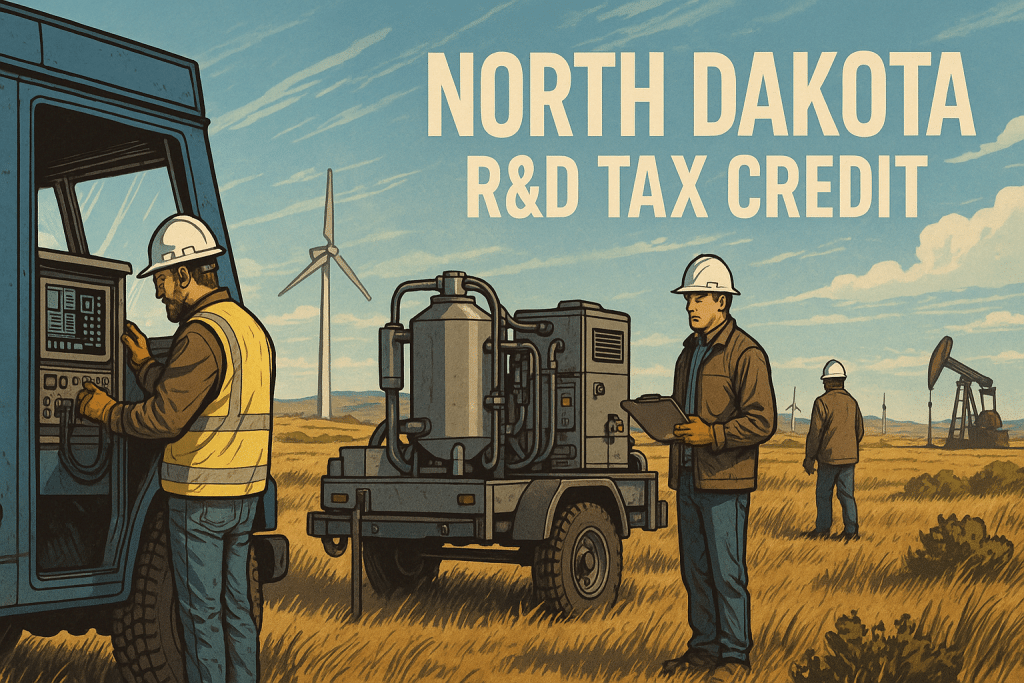
The North Dakota R&D tax credit is a state income tax incentive that rewards businesses conducting qualified research activities within the state. North Dakota’s program offers a generous 25% credit on the first $100,000 of excess research expenses, plus an additional 8% on amounts exceeding that threshold, making it one of the most competitive state-level R&D incentives in the region.
Key Takeaways
- North Dakota offers both regular and alternative simplified calculation methods for R&D tax credits, letting businesses choose the most beneficial approach annually
- Qualifying small businesses can transfer up to $100,000 in unused credits to other taxpayers, creating immediate cash flow opportunities
- The 2025 One Big Beautiful Bill Act permanently restored immediate expensing of domestic R&D costs, dramatically improving cash flow for innovative companies
- Primary sector business certification opens doors to North Dakota’s R&D credit transferability and other valuable economic development incentives
- Credits can be carried back three years or forward fifteen years, maximizing flexibility for businesses with varying tax liabilities
Why North Dakota’s R&D Credit Matters Right Now
Your engineering team just spent six months redesigning your manufacturing process. The project cost $200,000 in wages, supplies, and testing. Most business owners write that off as an expense and move on.
That’s leaving money on the table.
North Dakota wants you to innovate. The state backs up that commitment with real dollars through its R&D tax credit program. And starting in 2025, federal tax changes made this credit even more valuable.
Think about it. A Fargo manufacturing company recently recovered over $500,000 in combined federal and state R&D tax credits for software development work they were already doing. They didn’t change anything about their business. They just documented activities that qualified.
The North Dakota economy runs on innovation. Agriculture tech startups in Fargo are using AI to optimize crop yields. Energy companies are developing cleaner extraction methods. Manufacturers are automating processes that seemed impossible five years ago.
North Dakota’s R&D tax credit, codified under N.D.C.C. § 57-38-30.5, follows federal definitions for qualified research expenses while adding state-specific benefits that many businesses overlook.
Here’s what makes this credit different. Most states just copy the federal program and call it a day. North Dakota built something better. They added credit transferability for small businesses. They created multiple calculation methods. They tied it into their primary sector business program.
Understanding North Dakota’s R&D Credit Structure
North Dakota’s credit comes in two flavors. Pick the one that saves you more money.
The Regular Method
The regular method mirrors the federal approach but with North Dakota’s own percentages. You calculate your base amount using a four-year lookback at gross receipts. Then you measure your current year’s qualified research expenses against that base. The excess gets credited at 25% for the first $100,000, then 8% for everything above.
Say your base amount is $300,000 and you spent $500,000 on qualified research this year. That’s $200,000 in excess expenses. You’d get a $25,000 credit on the first $100,000, plus $8,000 on the remaining $100,000. Total credit: $33,000.
The math gets trickier if you conducted research in North Dakota before 2007. Those legacy taxpayers face a $2 million annual cap on credits. But if you started researching after 2010, no cap applies.
The Alternative Simplified Method
This method became available for tax years after 2018. It’s simpler. You take 50% of your average qualified research expenses from the prior three years. Anything you spend above that amount qualifies for the credit.
The rates work out to 17.5% on the first $100,000 of excess expenses, then 5.6% on amounts above that threshold. For many growing companies, this method produces larger credits with less paperwork.
You can switch between methods year by year. That flexibility matters when your research spending fluctuates.
| Credit Component | Regular Method | Alternative Simplified Method |
|---|---|---|
| First $100,000 excess QREs | 25% | 17.5% |
| Excess QREs over $100,000 | 8% | 5.6% |
| Base amount calculation | 4-year gross receipts average | 50% of 3-year QRE average |
| Method selection | Annual election | Annual election |
| Best for | Established research programs | Growing or new R&D activities |
What Counts as Qualified Research in North Dakota
North Dakota follows the federal four-part test. Your research activities must meet all four criteria.
First, you’re developing or improving a business component. That’s a product, process, software, technique, formula, or invention. The improvement needs to be functional. Making something prettier doesn’t count. Making it work better does.
Second, the work is technological in nature. You’re relying on engineering, computer science, physical sciences, or biological sciences. Marketing research doesn’t qualify. Neither does routine data collection.
Third, you’re eliminating uncertainty. At the start of the project, you didn’t know if the desired outcome was achievable or how to achieve it. This uncertainty must be technological, not market-based.
Fourth, you’re conducting a process of experimentation. You’re testing different approaches through modeling, simulation, trial and error, or other systematic methods.
Industries That Benefit Most
Agriculture tech companies in North Dakota are gold mines for R&D credits. Bushel developed software that now powers over 2,600 grain facilities. That kind of software development generates massive qualified research expenses. Every algorithm improvement qualifies. Every integration with new hardware qualifies.
Manufacturing companies often miss their credits. They’re improving production processes constantly but don’t think of it as research. When you’re solving problems through engineering, you’re researching.
Fargo’s growing tech sector sits on millions in unclaimed credits. Appareo Systems develops aerospace and defense electronics. Every circuit board redesign generates QREs. BWR Innovations is pioneering hydrogen fuel cell technology. That’s pure qualified research.
Software companies qualify almost by default. If you’re writing code to solve problems, you’re researching. CoSchedule built a marketing platform from scratch. Every feature they developed qualified for credits.
Energy companies developing new extraction methods or environmental controls qualify. Food processors testing new formulations qualify. Architecture firms using engineering software to solve structural challenges qualify.
Five Activities That Definitely Qualify for North Dakota R&D Credits
- Developing custom software or applications that solve technical problems, including modifications to existing platforms that improve functionality
- Creating new manufacturing processes or automation systems that reduce waste, improve efficiency, or enhance product quality through engineering methods
- Testing and prototyping new product designs where the outcome is uncertain and requires systematic experimentation to achieve desired specifications
- Engineering solutions for agricultural operations including precision farming technology, equipment modifications, or process improvements
- Developing environmental or safety systems that use scientific principles to solve technical problems in compliance with regulations
The Primary Sector Business Advantage
Here’s where North Dakota gets interesting. The state created a “primary sector business” designation that unlocks special benefits. If your company adds value to products, processes, or services in a way that creates new wealth, you qualify.
The definition matters. New wealth means revenue from outside North Dakota or revenue from products and services that weren’t previously available in the state. Manufacturing companies typically qualify. Tech companies selling to out-of-state customers qualify. Tourism businesses qualify.
Production agriculture doesn’t qualify. That’s explicitly excluded.
Why chase this certification? Because it opens doors. Primary sector businesses can access low-interest PACE loans through the Bank of North Dakota. They qualify for income tax exemptions up to five years for new operations. And most important for our purposes, they can transfer unused R&D tax credits.
Credit Transferability Creates Cash Flow
Small businesses face a problem. They generate R&D credits but don’t have enough tax liability to use them immediately. Sure, you can carry credits forward fifteen years. But startups need cash now.
North Dakota solves this. If you meet three requirements, you can sell up to $100,000 of unused credits to another taxpayer.
First requirement: You’re a primary sector business certified by the North Dakota Department of Commerce Division of Economic Development and Finance. That takes an application but isn’t difficult if you genuinely add value.
Second requirement: Your gross annual revenue stays under $750,000. This is designed for small businesses and startups.
Third requirement: You started conducting qualified research in North Dakota after December 31, 2016. Legacy researchers don’t get this benefit.
The mechanics work through Form CTS (Credit Transfer Statement). You and the buyer jointly complete and file this form within 30 days of executing the transfer agreement. The buyer claims the credit in the year of purchase and can carry it forward fifteen years.
You can’t carry back transferred credits. The buyer can’t sell them again. But that’s fine because the buyer is typically a profitable company looking to reduce their tax liability.
This creates a marketplace. Growing tech startups in Fargo are generating credits they can’t use. Established manufacturing companies have tax liability but less R&D activity. The transfer mechanism matches supply with demand.

How Recent Tax Changes Make This Better
July 4, 2025 changed everything for R&D incentives. President Trump signed the One Big Beautiful Bill Act into law. The tax provisions permanently restored several business-friendly policies that had been phasing out.
The big win: immediate expensing of domestic R&D costs. From 2022 through 2024, companies had to amortize R&D expenses over five years. That destroyed cash flow for innovative companies. You spent $500,000 on research this year but could only deduct $100,000 annually.
Now you can expense the full amount immediately. That’s permanent for tax years 2025 and forward.
Small businesses with under $31 million in annual revenue got even more. They can amend prior year returns to expense R&D costs incurred between December 31, 2021 and January 1, 2025. That’s retroactive relief creating immediate cash refunds.
The Act also permanently restored 100% bonus depreciation for qualified property acquired after January 19, 2025. Companies can immediately expense equipment, machinery, computers, and other capital investments. Combined with R&D credits, this creates powerful cash flow benefits.
“The restoration of full R&D expensing removes a major barrier to innovation,” notes tax policy experts at the Tax Foundation. “Companies can now invest in research without the artificial constraint of capitalization requirements.”
For North Dakota businesses, this means federal and state incentives work together. You expense your R&D costs federally. Then you claim credits at both levels. The state credit calculation still uses qualified research expenses, so nothing changes there. But your overall tax benefit just got significantly larger.
| Tax Treatment | Before OBBBA (2022-2024) | After OBBBA (2025+) |
|---|---|---|
| Domestic R&D expenses | Capitalized over 5 years | Immediately expensed |
| Bonus depreciation | Phasing down (40% in 2024) | 100% permanent |
| Small business retroactive relief | Not available | Can amend 2022-2024 returns |
| Cash flow impact | Severely constrained | Dramatically improved |
| State R&D credit interaction | Still available but lower benefit | Full benefit maximized |
Carryforward and Carryback Flexibility
Not every business has enough tax liability to use all their credits in the current year. North Dakota built in flexibility.
You can carry unused credits back three years. That generates immediate refunds. If you earned credits this year but paid taxes the prior three years, you’re getting money back.
Forward carryovers extend fifteen years. Most businesses with consistent profitability can use credits within that window. The extended carryforward period distinguishes North Dakota from states with shorter timelines.
Pass-through entities distribute credits to owners proportionally. If you own 40% of an S corporation that earned $50,000 in R&D credits, you claim $20,000 on your personal return. The credit passes through based on ownership interests, not profit distributions.
That creates planning opportunities. Partners and shareholders can use credits to offset their individual tax liabilities from all sources, not just income from the pass-through entity.
Documentation Requirements Matter More Than You Think
The North Dakota Office of State Tax Commissioner doesn’t require a special form for claiming R&D credits. You attach a schedule or worksheet showing your computation to your North Dakota income tax return.
But that simplicity can be dangerous. The calculation matters. If you’re audited, you need to prove every dollar of qualified research expenses.
Documentation should be contemporaneous. That means created at the time of the research, not reconstructed years later during an audit. Project plans, technical specifications, testing results, budget reports, and employee time records all matter.
Many businesses claim credits based on engineering payroll alone. That’s leaving money on the table. Supplies consumed in research qualify. Software and cloud computing costs qualify. Contract research costs qualify at 65% of amounts paid.
A manufacturing company testing new materials for product durability qualifies. The materials consumed during testing are QREs. The engineer’s wages while conducting tests are QREs. The outside lab fees for analysis are QREs at 65%.
Document the technological uncertainty. Write down what you didn’t know at the start of the project. Explain why the outcome was uncertain. Describe the alternative approaches you tested.
Keep records of your experimentation process. Meeting notes from design reviews qualify. Testing reports showing failed approaches qualify. Source code version control showing iterative improvements qualifies.
The Role of Professional R&D Tax Credit Firms
Most businesses leave money on the table. They know about the R&D credit but don’t understand how broadly it applies. They miss qualifying activities because they don’t think of routine innovation as research.
Professional R&D tax credit consultants specialize in finding credits businesses miss. They interview your technical staff. They review your projects. They identify qualifying activities you didn’t recognize.
These firms typically work on contingency. They only get paid if they find credits. That alignment of incentives ensures they maximize your benefit.
More important, they provide audit protection. When the IRS or North Dakota Tax Commissioner questions your credit, the consulting firm defends it. They have engineers and tax attorneys on staff who can substantiate every dollar claimed.
The documentation they create meets IRS standards. That’s valuable insurance. An audit can cost tens of thousands in professional fees even if you win. Having documentation prepared by specialists reduces that risk.
For North Dakota’s credit transferability program, professional firms can help navigate the certification process. Getting primary sector status requires understanding what the Department of Commerce is looking for. Consultants who work with these programs regularly know how to present your case effectively.
Real-World North Dakota R&D Credit Impact
A Fargo farming equipment manufacturer recovered $516,329 in North Dakota R&D tax credits plus $390,726 in federal credits. The three-year study with two-year lookback covered software development activities they’d been conducting but never claimed. They didn’t change their business. They just documented what they were already doing.
An agriculture tech startup in the Greater Fargo-Moorhead area generated $85,000 in combined credits for developing precision farming software. As a qualifying small business, they transferred $100,000 of unused North Dakota credits to a profitable manufacturing company, generating immediate cash flow.
How to Claim Your North Dakota R&D Tax Credit
Start by determining which calculation method benefits you most. Run the numbers both ways. The regular method often works better for mature companies with established research programs. The alternative simplified method tends to favor growing companies or those just starting R&D activities.
If you’re considering credit transferability, apply for primary sector certification first. That process takes three to four weeks. You’ll complete Form SFN 52998 (Application for Certification as a Primary Sector Business) with the Department of Commerce Division of Economic Development and Finance.
For the R&D credit itself, you’ll also need to complete Form SFN 58638 (Application for Certification as Research and Development Company) if you plan to transfer credits. Both certifications must be in place before executing a transfer.
Calculate your qualified research expenses. Include wages for employees performing, supervising, or supporting qualified research. Add supplies consumed in research. Factor in contract research at 65% of amounts paid. Include software and cloud computing costs for development activities.
Determine your base amount using either the regular method or alternative simplified method. Calculate the excess of current year QREs over the base amount. Apply the appropriate credit percentages.
Attach your calculation schedule to your North Dakota income tax return. Keep detailed supporting documentation for at least three years after filing (longer if you carry credits forward).
If you’re transferring credits, jointly complete Form CTS with the purchaser within 30 days of the transfer agreement. Report gross proceeds from the transfer as North Dakota-source income.
Common Mistakes That Cost Money
The biggest mistake is not claiming the credit at all. Many businesses assume they don’t qualify because they’re not doing “groundbreaking” research. The law doesn’t require groundbreaking innovation. It requires systematic effort to overcome technological uncertainty.
Second mistake: using only payroll in the QRE calculation. Supplies matter. Contract research matters. Companies routinely leave 20-30% of their credit on the table by ignoring these categories.
Third mistake: poor documentation. You can’t reconstruct records during an audit. Document as you go. Make it a business process, not an annual scramble.
Fourth mistake: not revisiting the calculation method annually. Your business changes. Your research activities change. The method that worked best last year might not work best this year.
Fifth mistake: ignoring the primary sector certification opportunity. If you’re a growing company with modest tax liability, credit transferability can be worth real money. But you need the certification in place before you need it.
Conclusion
The North Dakota R&D tax credit represents one of the most valuable incentives available to innovative businesses in the state. Combined with federal tax changes that permanently restored immediate expensing of R&D costs, companies can now capture significant cash benefits for activities they’re already conducting. Whether you’re a manufacturing firm improving production processes, a tech startup developing new software, or an agriculture company innovating farming techniques, these credits can fund your next phase of growth. The key is understanding what qualifies, documenting your activities properly, and working with specialists who ensure you’re capturing every dollar you’ve earned. Don’t leave money on the table when North Dakota is actively investing in your innovation.
North Dakota R&D Tax Credit FAQs
How does the North Dakota R&D tax credit differ from the federal R&D tax credit?
The North Dakota R&D tax credit follows similar qualification rules as the federal credit but offers different credit percentages and unique state benefits. North Dakota provides 25% credit on the first $100,000 of excess qualified research expenses (versus the federal 20% under regular method), and small qualifying businesses can transfer up to $100,000 in unused credits to other taxpayers, a feature not available at the federal level.
Can I claim both the North Dakota R&D tax credit and the federal R&D tax credit for the same expenses?
Yes, you can claim both the state and federal R&D tax credits for the same qualified research expenses. The credits don’t reduce each other, though you may need to reduce your federal deduction by the amount of the credit claimed, and proper allocation of expenses between North Dakota activities and those conducted elsewhere is required.
What is a primary sector business and why does it matter for the North Dakota R&D tax credit?
A primary sector business in North Dakota is an entity certified by the Department of Commerce that adds value to products, processes, or services resulting in new wealth generated from outside the state. This certification matters because only certified primary sector businesses with under $750,000 in annual revenue can transfer unused R&D tax credits to other taxpayers, creating immediate cash flow opportunities.
How long do I have to use my North Dakota R&D tax credits?
Unused North Dakota R&D tax credits can be carried back three years to generate immediate refunds or carried forward up to fifteen years to offset future tax liabilities. This extended carryforward period gives businesses significant flexibility to maximize the value of earned credits over time.
What happens to North Dakota R&D tax credits in a pass-through entity like an S corporation?
In pass-through entities such as S corporations or partnerships, the North Dakota R&D tax credit passes through to owners in proportion to their ownership interests. Each owner claims their proportional share of the credit on their individual tax return in the year the entity’s tax year ends, allowing them to offset personal tax liability from all sources.
R&D Tax Credits by State
Alaska
Arizona
Arkansas
California
Colorado
Connecticut
Delaware
Florida
Georgia
Hawaii
Idaho
Illinois
Indiana
Iowa
Kansas
Kentucky
Louisiana
Maine
Maryland
Massachusetts
Michigan
Minnesota
Missouri
Mississippi
Montana
Nebraska
Nevada
New Hampshire
New Jersey
New Mexico
New York
North Carolina
North Dakota
Ohio
Oklahoma
Oregon
Pennsylvania
Rhode Island
South Carolina
South Dakota
Tennessee
Texas
Utah
Vermont
Virginia
Washington
West Virginia
Wisconsin
Wyoming
Citations
- North Dakota Office of State Tax Commissioner. Research Expense Credit
- Every.io. Tax Credits For Startups In North Dakota
- Gusto. The North Dakota Guide to State Tax Incentives
- North Dakota Department of Commerce. Finance and Incentive Forms
- Greater Fargo Moorhead Economic Development Corp. The Importance of Primary-Sector Certification
- Nucamp. Inside Fargo’s Thriving Tech Hub: Startups and Success Stories
- The Tech Tribune. 2022 Best Tech Startups in Fargo
- North Dakota Legislature. Statutory Definitions of Primary Sector Business
- LawServer. North Dakota Code 57-38-30.5 – Income Tax Credit for Research and Experimental Expenditures