
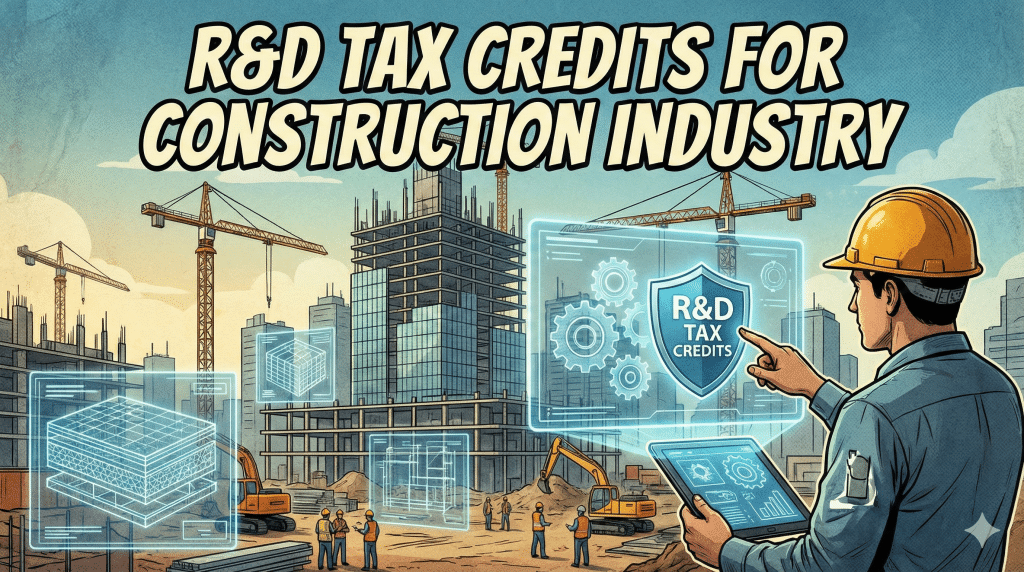
R&D tax credits for construction industry firms deliver 7-10% returns on qualified research expenses through federal Section 41 incentives, with recent 2025 legislation making these credits more accessible and valuable than ever before.
Key Takeaways
- Construction firms conducting design-build projects, value engineering, or developing innovative construction methods typically qualify for substantial R&D tax credits
- Credits now range from 7-10% of qualified research expenditures (QREs), including wages, supplies, and third-party contractor costs
- The 2025 One Big Beautiful Bill Act restored 100% bonus depreciation and increased the payroll tax offset to $500,000 annually for qualifying small businesses
- Most qualifying activities involve solving technical uncertainties through systematic experimentation—not groundbreaking industry-first innovations
- Proper documentation of the four-part test is critical, especially following recent Tax Court cases that scrutinized construction and architecture firms
Why Construction Companies Miss Out on Millions
Walk onto any major construction site today and you’ll hear the hum of innovation. Project managers studying 3D models on tablets. Engineers calculating load-bearing capacities for structures that didn’t exist five years ago. Superintendents testing new materials that promise better weather resistance.
Yet when tax season rolls around, most construction firms leave money on the table. They assume R&D tax credits are reserved for pharmaceutical companies in white lab coats or Silicon Valley tech startups writing code. The reality? Your construction firm is probably doing research every single day without realizing it qualifies for serious tax savings.
Here’s what changed the game: In July 2025, the One Big Beautiful Bill Act made these credits dramatically more valuable. Not only did it restore 100% bonus depreciation permanently for equipment acquired after January 19, 2025, but it also doubled down on incentives that reward construction innovation. For qualifying small businesses, the payroll tax offset jumped to $500,000 annually—meaning even startups burning through cash can immediately benefit.
The construction industry faces unique technical challenges every day. When architects design a building to withstand Category 5 hurricanes, that’s research. When MEP engineers figure out how to cool a data center using 40% less energy, that’s qualifying activity. When you evaluate three different foundation approaches for unstable soil conditions, you’re conducting qualified research under Section 41 of the Internal Revenue Code.
| Construction Activity | Qualification Status | Why It Matters |
|---|---|---|
| Design-build project with novel structural solutions | ✓ Qualifies | Resolves technical uncertainty through experimentation |
| Developing BIM coordination process improvements | ✓ Qualifies | New to your company counts, not new to world |
| LEED certification compliance | ✗ Doesn’t Qualify | Administrative/compliance work lacks technical uncertainty |
| Testing high-performance concrete mixes | ✓ Qualifies | Material innovation through systematic process |
| Routine code compliance work | ✗ Doesn’t Qualify | No elimination of technological uncertainty |
| Value engineering to reduce costs while improving performance | ✓ Qualifies | Systematic evaluation of alternative methods |
Understanding Section 41 and What Actually Qualifies
Let’s cut through the tax jargon. Section 41 of the Internal Revenue Code established the federal research credit to keep American companies competitive globally. The credit rewards businesses that invest in developing or improving products, processes, or techniques.
For construction firms, this translates to real money. A mid-sized contractor with $10 million in qualified research expenses could see credits worth $700,000 to $1 million. That’s not a deduction—it’s a dollar-for-dollar reduction in your tax bill.
The Four-Part Test Every Construction Project Must Pass
The IRS doesn’t care if you’re pouring concrete or writing software. Every activity claiming the R&D credit must satisfy four specific requirements. Miss even one, and your entire claim falls apart.
First: Permitted Purpose. Your work must aim to create something new or improve what already exists. In construction, this covers developing better construction techniques, improving building performance, or creating unique structural solutions. The key word here: your company doesn’t need to invent something the industry has never seen. If your firm figures out a better way to install curtain walls on high-rises, even if other companies already do it differently, you’ve met this test.
Second: Technological in Nature. The work must rely on hard sciences—engineering, computer science, or physical sciences. Construction firms live here. When your structural engineers calculate load distributions, that’s engineering science. When MEP consultants model airflow patterns, that’s applied physics. When your team uses Building Information Modeling to detect clashes before construction, you’re applying computer science to solve real problems.
Third: Elimination of Uncertainty. This is where construction companies actually shine. You must demonstrate that you didn’t know the best approach at the start and had to evaluate alternatives. Think about the last time your team faced a challenging site condition. Did you consider multiple foundation types? Test different materials? Run calculations comparing approaches? That’s eliminating uncertainty.
Fourth: Process of Experimentation. You must show systematic trial-and-error or modeling. This doesn’t mean building three different buildings to see which stands. It means your engineers ran finite element analysis, created prototypes, conducted dew point calculations, or systematically compared design alternatives using established engineering principles.
According to analysis from Cherry Bekaert’s Tax Credits and Incentives Advisory team, “construction and architecture firms naturally perform qualifying day-to-day activities, from evaluating designs to refining innovation efforts.” The challenge isn’t doing qualifying work—it’s documenting that work properly.
What Construction Activities Generate Real Credits
Stop thinking about R&D as occurring in laboratories. In construction, qualified research happens when your team solves problems. Here’s what actually counts:
Design-Build and Integrated Project Delivery
When your firm takes on design-build work, you’re constantly making technical decisions that qualify. Evaluating multiple structural systems for a warehouse? Qualified. Testing different curtain wall assemblies for thermal performance? Qualified. Coordinating MEP systems in tight ceiling spaces using BIM? Qualified.
The work happens in proposal stages too. When you respond to RFPs and develop innovative construction approaches to win competitive bids, those engineering hours count toward your qualified research expenses.
Mechanical, Electrical, and Plumbing Engineering
MEP work is goldmine territory for R&D credits. Engineers designing HVAC systems for energy efficiency must model airflow, calculate heat loads, and test different configurations. Electrical engineers sizing distribution systems for high-power equipment work through complex calculations. Plumbers designing medical gas systems or process piping follow rigorous engineering protocols.
A case from 2025 involved an MEP engineering firm that claimed credits for designing systems for a military psychiatric unit, a medical facility in Mississippi, and a university engineering building. While the Tax Court ultimately required stronger documentation, the activities themselves represented legitimate qualified research—solving technical challenges through systematic engineering processes.
Green Building and Sustainable Design Innovation
The push toward sustainability creates constant opportunities for qualifying work. When your team explores energy-efficient building envelopes, tests high-performance glazing systems, or develops water management strategies, you’re conducting qualified research.
Important distinction: pursuing LEED certification itself doesn’t qualify. That’s administrative compliance. But the technical work behind it—modeling energy performance, testing daylighting strategies, developing innovative stormwater systems—absolutely qualifies when it involves eliminating technical uncertainty.
Structural Innovation and Seismic Design
Designing structures for extreme conditions demands serious engineering. Buildings that must withstand earthquakes, hurricanes, or heavy snow loads require engineers to evaluate multiple structural systems, run advanced analysis, and often develop novel connection details.
When you’re designing a pedestrian bridge with a 200-foot span or a stadium roof that needs to support equipment loads nobody’s attempted before, you’re deep in qualifying territory.
Building Information Modeling and Process Improvements
Building Information Modeling has transformed how construction gets done. But implementing BIM isn’t automatic qualification. The qualifying work happens when your team develops new workflows, writes custom scripts to automate clash detection, or creates parametric families that solve recurring technical problems.
Similarly, when you develop better construction sequencing to reduce schedule risk, test prefabrication methods that haven’t been tried on your project types, or engineer temporary works for unusual conditions, you’re conducting process innovation that qualifies.
Key Construction Industry R&D Activities
- Alternative means and methods analysis: Evaluating multiple construction approaches for feasibility, cost, and performance before selection
- Value engineering: Systematic examination of functions to reduce costs while maintaining or improving quality and performance
- Prototype development: Creating shop drawings, mockups, or physical models to test constructability and performance
- Material testing and specification: Evaluating new materials or combinations for specific performance requirements
- Energy efficiency optimization: Modeling and testing approaches to reduce building energy consumption beyond code requirements
How Recent Tax Law Changes Transformed the Credit
The game changed dramatically on July 4, 2025, when President Trump signed the One Big Beautiful Bill Act into law. For construction companies, three provisions matter most.
First: 100% Bonus Depreciation Restored Permanently. For qualified property acquired after January 19, 2025, you can now write off the full cost immediately. Construction equipment, vehicles with gross vehicle weight under 6,000 pounds, computers, and most business assets with recovery periods under 20 years qualify. This works hand-in-glove with R&D credits. A contractor buying $5 million in equipment can now deduct the entire amount in year one while also claiming R&D credits on the engineering work that determined what equipment to buy.
Second: Qualified Production Property Gets 100% Depreciation. This new category covers nonresidential real property used in manufacturing, production, or refining. Construction must begin between January 20, 2025 and December 31, 2028, with property placed in service before January 1, 2031. For contractors building or expanding production facilities, this creates significant planning opportunities.
Third: Doubled Payroll Tax Offset for Small Businesses. Startups and young construction firms often don’t have tax liability to offset. The Inflation Reduction Act already doubled the payroll tax credit from $250,000 to $500,000 annually, effective for tax years beginning after December 31, 2022. This means qualified small businesses with less than $5 million in annual gross receipts and no more than five years of revenue can use R&D credits to offset the employer portion of Social Security and Medicare taxes.
Think about a three-year-old design-build firm with $4 million in revenue. They’re burning cash investing in people and technology. With $1 million in qualified research expenses, they could generate $70,000 to $100,000 in R&D credits and apply every dollar against their quarterly payroll taxes. That’s real money hitting the bank account.
Section 174 Amortization Changes
Starting January 1, 2022, the Tax Cuts and Jobs Act required companies to capitalize and amortize research expenses over five years (fifteen for foreign research) instead of deducting them immediately. This created a temporary cash flow headache. The One Big Beautiful Bill Act addresses this for qualified small businesses, allowing retroactive expensing elections for certain taxpayers with average annual receipts under $31 million.
For construction firms tracking costs carefully, this means R&D expenses from 2022 forward might be eligible for accelerated treatment, improving near-term cash position.
| Tax Provision | Before One Big Beautiful Bill | After July 4, 2025 |
|---|---|---|
| Bonus Depreciation (2025) | 40% phasing to 0% by 2027 | 100% permanent for property acquired after 1/19/25 |
| Payroll Tax Offset | $500,000 annually (Inflation Reduction Act) | $500,000 annually (maintained) |
| Section 179 Limits | $1M expensing / $2.5M phaseout | $2.5M expensing / $4M phaseout |
| QSB Gross Receipts Threshold | Under $5M | Under $31M (proposed increase) |
Calculating Your Qualified Research Expenses
Money talks, and qualified research expenses determine your credit size. Most construction firms can capture three main expense categories.
Wages for Qualified Services
This is typically your largest bucket. You can claim W-2 wages for employees performing, supervising, or directly supporting qualified research. This includes your engineers, project managers, superintendents running pilot projects, estimators developing innovative approaches for competitive bids, and CAD technicians creating detailed models.
The IRS doesn’t require punch-clock precision. If 80% or more of an employee’s time qualifies, you can claim all their wages under the “substantially all” test. For others, reasonable estimates work—supported by project records, testimony, or contemporaneous documentation.
A typical construction firm with 1,000 employees might find that estimators, project executives, select project managers, and superintendents working on qualifying projects generate significant wage-based QREs. One partnership-structured firm with this profile generated $566,000 in federal R&D tax credits that passed through directly to partners, offsetting their personal income taxes.
Supplies and Materials
Materials consumed during the research process count. This includes supplies used in testing, prototypes, mockups, and pilot installations. Important: materials incorporated into the final delivered project don’t qualify. But materials used to test different approaches, create samples, or validate performance absolutely do.
Think about testing three different concrete mix designs before specifying the final one. The materials for those test batches qualify. The final building concrete doesn’t.
Contract Research Expenses
When you pay third parties to conduct qualified research on your behalf, you can claim 65% of those costs (75% if paid to qualified research consortiums). This covers payments to specialty engineering consultants, testing laboratories, and research institutions.
For construction firms, this often includes geotechnical engineering for unusual soil conditions, wind tunnel testing for complex structures, commissioning agents testing performance of innovative systems, and specialty consultants solving novel technical problems.
The Documentation Challenge: Learning from Recent Court Cases
Here’s the hard truth: having qualifying activities isn’t enough. You must document them properly. Two 2024 Tax Court cases—Meyer, Borgman & Johnson and Phoenix Design Group—demonstrate exactly what happens when documentation falls short.
Meyer, Borgman & Johnson, an architecture firm in Minnesota, lost its R&D credit claim primarily on “funded research” grounds. The court ruled that because clients paid for the work under fixed-price contracts, the research was “funded” by clients and therefore didn’t qualify. The firm argued it bore financial risk if designs failed, similar to an earlier favorable case (Fairchild Industries). The court disagreed, noting MBJ’s contracts required professional standards compliance but didn’t explicitly tie payment to research success.
Phoenix Design Group, a multidisciplinary MEPF engineering firm, claimed credits for over 200 projects. The Tax Court denied credits for all sample projects examined, largely because the firm couldn’t demonstrate it engaged in a systematic “process of experimentation.” While the work was clearly technological and aimed at business improvement, documentation didn’t adequately show the engineering team evaluated alternatives and made decisions through systematic comparison.
The lesson: document your process, not just your results. When engineers evaluate three structural systems, save the analysis comparing them. When you test materials, keep the test reports and the decision matrix explaining why you chose one over another. When BIM reveals conflicts, document what alternatives you considered and why you selected the final solution.
As one tax attorney observed following these cases, “The path forward is neither wide nor easy, but it is not yet sealed shut. By aligning their practices with the guideposts discussed—crafting precise contracts, substantiating uncertainties, and embracing experimentation—firms can erect a defensible framework for the R&D credit.”
One bright spot: The December 2024 Tax Court order in Adrian Smith + Gordon Gill Architecture LLP v. Commissioner denied the IRS’s motion for summary judgment. This suggests courts will consider well-documented cases where firms demonstrate they retained intellectual property rights and bore genuine financial risk tied to research outcomes.
What Doesn’t Qualify: Common Misconceptions
Not everything labeled “innovative” qualifies for R&D credits. Knowing what doesn’t count saves time and audit risk.
Routine Design Work: Reproducing existing designs without significant improvement doesn’t qualify, even if the original design was innovative. Your standard residential floor plan repeated across a subdivision—not qualified. Adapting that plan for a hillside lot requiring custom engineering—potentially qualified.
Code Compliance and Permitting: Meeting building codes, obtaining permits, and zoning work all fail the test. These are administrative activities, not technological research. The distinction: figuring out how to meet wind loads through structural innovation qualifies. Filing the permit application doesn’t.
Management and Coordination: General project management, scheduling, and coordination don’t qualify unless they involve solving technical uncertainties. A superintendent scheduling subcontractors—not qualified. That same superintendent testing a new prefabrication sequence to reduce weather risk—potentially qualified.
Aesthetic Improvements: Design decisions driven solely by aesthetics don’t count. The facade must be green glass instead of blue because the client prefers it? Not qualified. The facade uses a novel glazing system that reduces solar heat gain by 40%? Qualified.
Post-Completion Activities: Work performed after a project is substantially complete rarely qualifies. Punch list items, warranty work, and customer-requested changes fall outside the credit’s scope.
State R&D Credits: Doubling Down on Savings
Don’t stop at federal credits. Many states offer their own R&D incentives that can significantly boost total savings. While state programs vary widely, most allow construction firms to claim credits for the same activities qualifying federally.
States like California, Massachusetts, Minnesota, and others maintain generous R&D credit programs. Some states allow credits against income tax. Others permit offsets against franchise or excise taxes. A handful even offer refundable credits, meaning you can receive cash back even without tax liability.
The key: understand state conformity rules. Some states automatically conform to federal definitions. Others require separate calculations or have different qualifying criteria. Many states cap total credits or require minimum expenditure thresholds.
Construction firms operating across multiple states should evaluate each jurisdiction’s program. A firm with projects in five states might find opportunities to claim credits in three or four, significantly multiplying federal benefits.
The Calculation Methods: Traditional vs. Alternative Simplified Credit
Once you’ve identified your QREs, you need to calculate the actual credit. The IRS offers two methods, and choosing the right one matters.
The Traditional Method (Regular Credit): This calculates your credit as 20% of your current-year QREs exceeding a base amount. The base amount uses your historical spending patterns, typically your average QREs from a four-year lookback period as a percentage of average gross receipts, multiplied by your current gross receipts. Minimum base: 50% of current-year QREs.
This method typically generates larger credits for companies with rapidly increasing R&D spending or newer companies without extensive history.
The Alternative Simplified Credit (ASC): This method calculates the credit as 14% of your current-year QREs exceeding 50% of your average QREs over the prior three years. If you have no QREs in any of those years, the credit is 6% of current-year QREs.
ASC is simpler and often favors companies with inconsistent historical R&D spending. Many construction firms prefer this method because project types vary year to year, making spending patterns irregular.
You choose your method annually on Form 6765. Most tax software or specialized R&D consultants will calculate both to determine which maximizes your credit.
Small Business Advantages: Payroll Tax Offset and Special Rules
Qualified small businesses get special treatment that makes the credit incredibly valuable, even without taxable income. To qualify as a QSB, your company must have less than $5 million in gross receipts for the credit year and have no gross receipts for any taxable year preceding the five-year period ending with the credit year.
Essentially, you’re a startup or young company not yet generating significant revenue. Many design-build firms, specialty contractors, and construction technology companies fit this profile in their early years.
The payroll tax election lets you apply up to $500,000 of your R&D credit against the employer portion of Social Security tax (6.2%) and Medicare tax (1.45%) on Form 941. This election must be made on your originally filed return—you can’t amend later to add it.
Here’s the math: A construction startup with 50 employees averaging $75,000 in annual wages pays roughly $232,500 in employer Social Security taxes annually. If they generate $500,000 in R&D credits and elect the payroll offset, they can eliminate more than two full quarters of payroll tax liability.
The election lasts up to five years. You can’t make it in a sixth year, ensuring the benefit targets truly young companies rather than becoming a permanent payroll tax reduction.
Filing Requirements and IRS Form 6765
Claiming the credit requires filing Form 6765 with your tax return. The form asks for detailed information about your qualified research expenses, calculation method choice, and specific project details.
New for recent years: The IRS added reporting requirements demanding more granular project information. Section G of Form 6765 now requires “Business Component Information” for tax years beginning after 2024, subject to guidelines still being finalized. This means identifying specific projects or activities generating your QREs, not just aggregate numbers.
The form also requires you to maintain adequate documentation to support your calculations. “Adequate” isn’t precisely defined, but based on recent cases, best practice includes:
- Project descriptions explaining technical challenges and uncertainties
- Documentation showing alternative approaches considered
- Engineering calculations, models, or test results
- Meeting minutes or emails discussing technical decisions
- Time tracking or reasonable estimates of employee time on qualified activities
- Invoices from third-party contractors performing qualified research
- Supply and material records for testing or prototyping
Real-World Construction R&D Credit Examples
Case 1: Regional Design-Build Contractor
A 500-employee design-build firm specializing in healthcare and institutional projects claimed credits for engineering work on complex MEP systems, structural innovations for expansion over occupied spaces, and development of prefabrication processes. Annual QREs: $8.2 million. Credit generated: $730,000. Key activities included developing custom air handling solutions for operating rooms, engineering seismic bracing for equipment in earthquake zones, and systematic testing of modular construction approaches.
Case 2: Heavy Civil Contractor
A bridge and highway contractor with 200 employees conducted qualifying research when designing temporary support systems for unusual site conditions, developing new equipment to accelerate pile driving in difficult soils, and engineering drainage systems for complex watersheds. Annual QREs: $3.1 million. Credit generated: $248,000. The firm successfully documented systematic evaluation of multiple foundation approaches and extensive soils testing to eliminate uncertainty about bearing capacities.
Case 3: MEP Engineering Firm
A 75-person MEP consultancy claimed credits for designing advanced HVAC systems optimizing energy efficiency, developing electrical distribution for high-density data centers, and engineering medical gas systems for surgical centers. Annual QREs: $4.5 million. Credit generated: $360,000. Documentation included energy modeling comparing multiple system types, load calculations for innovative electrical designs, and systematic evaluation of pressure controls for medical gases.
Why Professional R&D Tax Credit Firms Matter
You wouldn’t hire a plumber to design a structural foundation. Don’t try to maximize R&D credits without expertise. The stakes are too high and the rules too complex.
Professional R&D tax credit firms bring specialized knowledge of construction industry qualifying activities, IRS audit defense experience, and established documentation processes that withstand scrutiny. They’ve seen what works and what fails in audits. They understand construction terminology and can translate your technical work into tax credit compliance language.
A qualified firm will interview your engineers, review project files, analyze payroll records, and prepare comprehensive documentation that satisfies IRS requirements. They’ll calculate credits using both available methods to maximize benefits. And critically, they’ll prepare audit-ready files before the IRS ever asks questions.
The Phoenix Design Group case illustrates this perfectly. The firm clearly conducted qualifying research but couldn’t adequately document their “process of experimentation.” A specialized R&D consultant would have recognized this weakness early and helped structure documentation that captured the systematic engineering approach actually used.
Many R&D firms work on contingency, taking a percentage of credits identified. This aligns incentives—they only get paid if they deliver value. For construction firms unsure whether they qualify, this removes financial risk from exploring the opportunity.
Beyond initial credit claims, professional firms help establish ongoing documentation systems. Instead of reconstructing your research activities at tax time, you capture information contemporaneously throughout the year. This creates defensible files and dramatically reduces the work required annually.
Taking Action: Your Next Steps
R&D tax credits represent one of the most valuable incentives available to construction firms, but they require action. The credit doesn’t happen automatically. You must identify qualifying activities, calculate expenses properly, and file appropriate forms.
Start by reviewing your projects from the past three years. Which involved technical challenges? Where did your team evaluate alternatives? When did engineers spend hours solving problems that didn’t have obvious solutions? Those activities likely qualify.
Next, assess your documentation practices. Can you demonstrate what uncertainties existed and how your team resolved them? Do you have records showing alternatives considered? If not, implement systems to capture this information going forward.
Consider engaging an R&D tax credit specialist to evaluate your eligibility. A good firm will conduct a free preliminary assessment, estimating potential credit value before you commit. If the opportunity justifies the effort, they’ll guide you through the complete study, calculation, and filing process.
Remember: you can amend prior returns to claim missed credits. The statute of limitations gives you three years from the original filing date. If you’ve been conducting qualifying research but not claiming credits, you might be sitting on hundreds of thousands of dollars in refunds.
The construction industry drives American infrastructure and innovation. The federal government created R&D credits specifically to reward that innovation. Don’t leave money on the table. With the 2025 tax law changes making these credits more valuable than ever, now is the time to capture benefits your firm has earned through technical excellence and problem-solving ingenuity.
Conclusion
The construction industry stands at the intersection of engineering precision and real-world problem-solving. Every complex project your firm completes represents innovation worth rewarding. R&D tax credits for construction industry firms aren’t theoretical benefits reserved for others—they’re practical tools that put money back in your business when you’re solving technical challenges.
With 2025 tax law changes restoring 100% bonus depreciation permanently and maintaining the $500,000 payroll tax offset for qualifying small businesses, construction firms have unprecedented opportunities to reduce tax liability while continuing to innovate. But these benefits require documentation, strategic planning, and often professional guidance to capture fully.
Don’t wait until next tax season to explore your eligibility. The work you’re doing today—designing innovative solutions, testing new approaches, improving construction methods—represents qualifying research under federal law. Start documenting that work now, consult with R&D tax credit specialists who understand construction, and claim the credits your firm has earned through technical excellence. Your competitors already are.
R&D Tax Credits for Construction Industry FAQs
Can construction companies really qualify for R&D tax credits?
Yes, construction companies conducting design-build projects, value engineering, or developing innovative construction methods typically qualify for substantial R&D tax credits under Section 41 of the Internal Revenue Code. The credits reward technical problem-solving, not just laboratory research, making construction’s engineering challenges ideal candidates for the program.
What construction activities qualify for R&D tax credits?
Qualifying activities include developing alternative construction methods, designing innovative structural systems, improving MEP engineering for efficiency, creating BIM workflows, testing new materials, and engineering solutions for unique site conditions. The key is demonstrating technical uncertainty resolved through systematic experimentation or engineering analysis.
How much can construction firms save through R&D tax credits?
Most construction firms can claim credits worth 7-10% of qualified research expenditures, which typically include wages for engineers and project managers, supplies used in testing, and payments to specialty consultants. A firm with $5 million in qualifying expenses could generate $350,000 to $500,000 in annual credits.
Do small construction startups qualify for R&D tax credits without income tax liability?
Yes, qualified small businesses with less than $5 million in gross receipts and no more than five years of revenue can use up to $500,000 annually in R&D credits to offset employer-paid Social Security and Medicare payroll taxes. This payroll tax offset delivers immediate cash benefits even for unprofitable startups conducting qualifying research.
How did the 2025 One Big Beautiful Bill Act affect construction R&D tax credits?
The One Big Beautiful Bill Act signed July 4, 2025 permanently restored 100% bonus depreciation for equipment acquired after January 19, 2025, created new 100% depreciation for qualified production property, and increased Section 179 expensing limits from $1 million to $2.5 million. These provisions work alongside R&D credits to dramatically improve after-tax returns on construction innovation and capital investment.
Citations
- CliftonLarsonAllen – R&D Tax Credit: Construction, Architects, Engineers
- RevenueSafe – How to Claim R&D Tax Credits for Construction Companies in 2025
- Kowal, Meredith – Claiming R&D Tax Credits in Architecture, Engineering & Construction: Risks and Rewards, Aprio Advisory
- BDO – Inflation Reduction Act Doubles R&D Credit Payroll Tax Offset for Qualified Small Businesses
- ADP – R&D Tax Credits | IRS Form 6765 Instructions
- Stinson LLP – One Big Beautiful Bill Explained
- BDO – One Big Beautiful Bill Act Expands 100% Depreciation Expensing Opportunities
- KLR – Big Beautiful Bill Restores 100% Bonus Depreciation for 2025
- IRS – Instructions for Form 6765 (Rev. January 2025)
- IRS – Research credit
- JLK Rosenberger – R&D Section 41 Overview | New Refund Claim Requirements