

Key Takeaways
- You can be profitable on paper, but still run out of cash due to timing differences between sales and payments
- The cash conversion cycle measures how long money stays tied up in your business before becoming cash
- Tax credits and incentives can provide immediate cash infusions of $5,000-$50,000+ without taking on debt
- Invoice factoring can convert unpaid invoices to cash within 24-48 hours at 1-5% cost
- Growth can actually hurt cash flow in the short term, requiring 25-40% more working capital
- Negative working capital strategies can free up cash by using supplier financing effectively
Small business cash flow management focuses on timing the movement of money in and out of your business to ensure you always have sufficient cash to operate, even when you are profitable.
The Profitable But Cash-Poor Problem
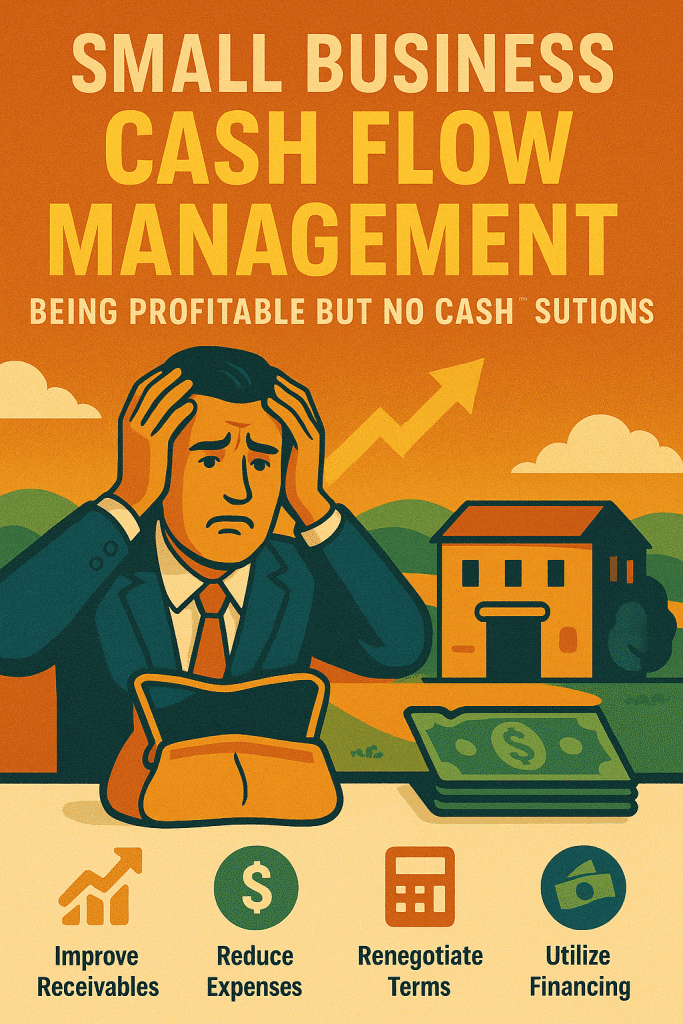
Many business owners face a confusing situation: their profit and loss statement shows they are making money, but their bank account tells a different story. This occurs because profit and cash flow are distinct concepts. Profit measures how much money you made after all expenses. Cash flow measures how much actual money you have available right now.
The problem starts with timing. When you sell something, you record the sale immediately as revenue. However, you may not receive payment for 30, 60, or even 90 days. Meanwhile, you still need to pay employees, rent, and suppliers who want their money now. This creates a cash gap that can put profitable businesses in serious trouble.

Why This Happens to Successful Businesses
The more successful your business becomes, the bigger this problem can get. Growing businesses often face the biggest cash flow challenges because growth requires more inventory, additional employees, and increased equipment before the resulting sales are converted into cash. A study by SCORE found that 82% of small businesses fail due to cash flow problems, rather than a lack of profitability.
Consider a construction company that wins a $100,000 project. They might need to spend $60,000 on materials and labor upfront, but not receive payment until the project is completed three months later. Even though they will make a $40,000 profit, they need to find $60,000 in cash to get started.
Quick Cash Flow Solutions Decision Table
| Solution Type | Speed to Cash | Cost | Best For |
|---|---|---|---|
| Tax Credits & Incentives | 30-90 days | Free | R&D, hiring, equipment purchases |
| Invoice Factoring | 24-48 hours | 1-5% per month | B2B businesses with good customers |
| Line of Credit | 1-7 days | 5-15% annually | Seasonal or temporary needs |
| Extended Payment Terms | Immediate relief | Free | Good supplier relationships |
| Cash Collection Acceleration | 7-30 days | 1-3% discount cost | Slow-paying customers |
Understanding Your Cash Conversion Cycle
The cash conversion cycle shows exactly how long your money stays tied up in your business. This number indicates the number of days that pass from when you spend money until you receive it back as cash. The shorter this cycle, the better your cash flow will be.
The Three Parts of Cash Conversion
The cash conversion cycle consists of three key components: the time inventory is held, the time it takes for customers to pay, and the time you can delay paying suppliers. Most small businesses can reduce their cycle time by 15-30 days with simple changes, which frees up thousands of dollars in working capital.
Inventory days indicate the average time products remain unsold before being sold. If you have $50,000 in inventory and sell $200,000 per year, your inventory sits for about 91 days on average. Reducing this to 60 days would free up $17,000 in cash.
Collection days measure the time it takes customers to settle their payments. If customers owe you $40,000 and you make $300,000 per year, customers take about 49 days to pay on average. Getting paid in 30 days instead would put $15,000 back in your pocket.
Payment days indicate the maximum period you can delay paying suppliers. If you owe suppliers $25,000 and buy $150,000 per year, you pay suppliers every 61 days on average. Extending this to 75 days would result in an additional $5,700 being deposited into your bank account.
Calculating Your Cycle
To find your cash conversion cycle, add inventory days plus collection days, then subtract payment days. A typical small business might have 60 + 45 – 30 = 75 days. This means that money remains tied up for 75 days before it becomes available as cash again. Cutting this to 45 days could free up 40% more working capital.
Tax Incentives for Immediate Cash Infusion
One of the most overlooked sources of cash flow relief comes from tax credits and incentives. Unlike loans, these programs give you money without creating debt. Many small businesses miss out on thousands of dollars because they are unaware of these programs.
Research and Development Tax Credits
The R&D tax credit offers cash back for developing new products, enhancing processes, or resolving technical issues. This credit is still available even if you are not yet profitable. Small businesses can use R&D credits to offset payroll taxes, putting money directly back into their bank accounts.
Software companies, manufacturers, architects, and engineers often qualify for this credit. Activities like developing new software features, improving manufacturing processes, or designing custom solutions for clients can generate credits worth 10-20% of qualifying expenses.
A small software company that spent $100,000 on developing a new app feature could claim a $10,000-$20,000 credit. Instead of waiting for profitability, they can apply this credit against their payroll taxes and get the money within 90 days.
Work Opportunity and Hiring Credits
Hiring employees from certain groups can generate immediate tax credits. The Work Opportunity Tax Credit provides up to $9,600 per employee for hiring individuals who are veterans, former felons, or those receiving government assistance. For businesses that need to hire anyway, this turns a necessary expense into a cash benefit.
The Small Business Health Care Tax Credit helps businesses with fewer than 25 employees offset health insurance costs. This credit can be worth up to 50% of health insurance premiums, providing thousands in cash savings for businesses that offer employee benefits.
Equipment and Energy Credits
Purchasing business equipment or making energy-efficient improvements can generate immediate tax benefits. Section 179 allows businesses to deduct the full cost of equipment purchases in the year they are made, rather than spreading the deduction over several years.
Energy efficiency improvements, such as LED lighting, HVAC upgrades, or solar installations, often qualify for additional credits. These programs can reduce the real cost of necessary improvements by 20-40%, freeing up cash for other business needs.
Smart Small Business Cash Flow Management Strategies
Effective cash flow management requires a systematic approach that addresses both incoming and outgoing money. The goal is to accelerate cash inflows while strategically reducing cash outflows, without damaging business relationships.
Accelerating Cash Collection
Getting paid faster is often the quickest way to improve cash flow. Start by making invoicing automatic and immediate. The longer you wait to send an invoice, the longer you wait to get paid. Set up systems that send invoices as soon as work is completed or products are delivered.
Payment terms matter more than most business owners realize. Offering a 2% discount for payment within 10 days can cut collection time in half for many businesses. Even though you give up 2% of revenue, you get your money 30-40 days faster, which often saves more in reduced financing costs.
Following up on overdue payments should be systematic, not personal. Set up automatic reminders that go out 5 days before payment is due, on the due date, and every week after that. Most customers pay late because they forget, not because they are unable to pay.
Strategic Payment Management
Managing your bill payments can dramatically improve cash flow without incurring additional costs. Many suppliers offer extended payment terms if you request them, especially if you have been a loyal customer. Switching from 30-day to 45-day payment terms provides you with two extra weeks of cash flow on every purchase.
Take advantage of payment timing by scheduling large payments immediately after receiving significant customer payments. This prevents cash from sitting idle while also ensuring you can cover major expenses when they come due.
Consider which bills must be paid immediately versus which ones can be paid later. Payroll, rent, and loan payments cannot be delayed. But supplier payments, utility bills, and equipment purchases often have some flexibility in timing.
The Growth Paradox in Cash Flow Management
Growing businesses face a unique cash flow challenge: success can actually hurt cash flow in the short term. This happens because growth requires investing cash in inventory, equipment, and employees before the additional sales generate cash.
Why Growth Hurts Cash Flow
When business grows by 50%, you typically need 25-40% more working capital to support that growth. This means you need more money tied up in inventory, more accounts receivable from additional sales, and more cash to pay additional employees. All of this happens before the growth generates additional cash.
A retail business generating $500,000 per year with 20% growth requires an additional $100,000 in sales. However, they may need an additional $30,000 in inventory, $15,000 more in accounts receivable, and $20,000 more in operating expenses before realizing the extra cash from those sales.
Managing Growth-Related Cash Needs
Smart business owners plan for growth-related cash needs before they happen. This means securing lines of credit or other financing before you need them, not after you run out of cash. Banks prefer to lend money to businesses that do not desperately need it.
Staged growth can reduce cash flow pressure by spreading the investment over time, rather than attempting to grow everything at once. Focus on growing one area of the business at a time, using the cash from initial growth to fund the next stage.
Monitor your cash conversion cycle closely during periods of growth. Growth often extends this cycle because you need more inventory and have higher accounts receivable. Keeping the cycle as short as possible reduces the amount of extra cash needed to support growth.
Alternative Financing for Cash Flow Gaps
When traditional cash flow management is not enough, alternative financing can bridge the gap between profitable operations and immediate cash needs. These solutions work differently from traditional loans and can provide cash much faster.
Invoice Factoring for Immediate Cash
Invoice factoring turns your unpaid invoices into immediate cash. Instead of waiting 30-90 days for customers to pay, you sell the invoices to a factoring company and get 80-95% of the money within 24-48 hours. When customers pay, the factoring company retains a small fee and pays you the remainder.
This solution works best for businesses with creditworthy customers who just pay slowly. The factoring company evaluates your customers’ credit, not yours, so businesses with cash flow problems can still qualify. Factoring costs typically range from 1% to 5% per month, which is expensive for long-term financing but reasonable for short-term cash flow needs.
A manufacturing company with $200,000 in outstanding invoices could receive $170,000 in cash immediately through factoring. Even at 3% monthly cost, this might be cheaper than missing payroll or losing supplier discounts due to cash shortages.
Revenue-Based Financing
Revenue-based financing provides cash in exchange for a percentage of future sales. Unlike traditional loans, payments fluctuate with your sales, making it easier to manage during slow periods. This option works well for businesses with predictable revenue patterns but temporary cash flow gaps.
These arrangements typically cost more than traditional financing but provide more flexibility. A business might receive $50,000 in exchange for 10% of its revenue until it has paid back $65,000. During slow months, payments are smaller, reducing cash flow pressure when it is needed most.
Working Capital Optimization Strategies
Optimizing working capital means maximizing the business impact with the least amount of cash tied up in day-to-day operations. This involves balancing inventory levels, payment terms, and collection processes to minimize cash requirements.
Inventory Management for Cash Flow
Inventory often represents the biggest cash drain for small businesses. Money spent on inventory cannot be used for anything else until the inventory is sold and customers have paid. The key is finding the minimum inventory level that prevents stockouts while maximizing cash availability.
Just-in-time ordering reduces inventory investment by ordering smaller quantities more frequently. Instead of buying three months of inventory at once, you might buy one month at a time. This triples your inventory turnover and frees up two-thirds of the cash for other uses.
Demand forecasting helps prevent both overstocking and stockouts. Better forecasting means you can operate with lower inventory levels without running out of products. Even improving forecast accuracy by 20% can reduce inventory requirements by 10-15%.
ABC analysis helps prioritize inventory management by focusing on the products that tie up the most cash. The 80/20 rule often applies: 20% of your products account for 80% of your inventory investment. Managing these high-impact items more carefully can free up a significant amount of cash.
Negative Working Capital Strategies
Negative working capital occurs when suppliers essentially finance your business operations by allowing you to sell products before paying for them. This strategy can eliminate cash flow problems entirely when executed properly.
Some retail businesses collect cash from customers immediately but pay suppliers 30-60 days later. This creates negative working capital because customer payments finance operations before supplier payments are due. The faster you turn inventory, the more effective this strategy becomes.
Service businesses can achieve a negative working capital position by collecting payments upfront or requiring deposits before commencing work. A consulting firm that collects 50% deposits before beginning projects has client money to finance operations instead of using its own cash.
Technology Solutions for Cash Flow Management
Modern technology can automate many cash flow management tasks and provide real-time visibility into your financial position. These tools prevent cash flow problems by alerting you to potential issues before they become critical.
Automated Cash Flow Forecasting
Cash flow forecasting software connects to your accounting system and automatically projects future cash needs based on historical patterns and current obligations. This helps you spot potential cash shortages weeks or months in advance, giving you time to take corrective action.
Advanced forecasting tools can model various scenarios, illustrating how changes in sales, payment terms, or expenses would impact future cash flow. This helps you make better decisions about growth investments, hiring, and major purchases.
Real-time dashboards provide instant visibility into key cash flow metrics, such as days sales outstanding, inventory turnover, and cash conversion cycle. When these metrics start moving in the wrong direction, you can address problems before they hurt cash flow.
Payment Processing Optimization
Accepting multiple payment methods and making payments easy for customers can significantly reduce the time it takes to collect. Credit cards offer immediate payment, while ACH transfers provide low-cost, next-day payment for larger amounts.
Automated payment reminders and recurring billing reduce the administrative cost of collections while improving payment timing. Customers who receive automatic reminders pay 15-25% faster than those who do not.
Online payment portals make it easy for customers to pay invoices immediately, eliminating the need to wait for the next check run. Even a 10% improvement in payment timing can free up thousands of dollars in working capital for growing businesses.
Cash Flow vs. Profitability: Understanding the Difference
| Aspect | Cash Flow | Profitability |
|---|---|---|
| Definition | Money actually received and spent | Revenue minus expenses on paper |
| Timing | When money moves in/out | When sales/expenses are recorded |
| Business Impact | Determines ability to operate daily | Shows long-term business viability |
| Short-term Focus | Critical for immediate survival | Less important for daily operations |
| Management | Requires active daily management | Managed through pricing and costs |
A landscaping company had $300,000 in annual profits but ran out of cash each winter because all their revenue came during growing season while expenses continued year-round. They resolved this issue by securing a seasonal line of credit and building cash reserves during peak periods.
Seasonal Cash Flow Management
Many businesses face predictable seasonal cash flow challenges that require special planning. The key is recognizing these patterns and preparing for them before they create problems.
Building Seasonal Cash Reserves
Businesses with seasonal sales need to save cash during busy periods to cover expenses during slow periods. A pool service company might make 70% of its annual revenue between April and September, but have expenses every month of the year.
The solution is treating seasonal cash flow like a business savings account. During busy months, set aside a fixed percentage of revenue to cover slow months. This prevents the need for expensive seasonal financing and provides predictable cash flow year-round.
Calculate your seasonal cash needs by comparing the difference between fixed expenses and the minimum monthly revenue during slow periods. If you have $15,000 in monthly expenses but only $5,000 in slow-season revenue, you need $10,000 per month in reserves for slow months.
Seasonal Financing Strategies
Some seasonal businesses use temporary financing during slow periods instead of building large cash reserves. A seasonal line of credit can provide cash during slow months, then be paid down during busy periods. This keeps more cash available for growth investments during the year.
Seasonal businesses can also shift some expenses to match revenue timing. Annual insurance payments, equipment purchases, and major maintenance can be scheduled during high-revenue months to reduce cash needs during slow periods.
Emergency Cash Flow Planning
Even businesses with effective cash flow management can face unexpected events that create immediate cash needs. Having an emergency plan prevents temporary problems from becoming permanent business damage.
Building Cash Reserves
Business emergency funds should cover 3-6 months of essential expenses, not total expenses. Essential expenses include payroll, rent, loan payments, and critical supplier payments. Non-essential expenses, such as marketing, training, and equipment upgrades, can be delayed during emergencies.
Start building reserves gradually by setting aside 5-10% of monthly profits until you reach your target. Even $500 per month can create a $6,000 emergency fund within a year, which can cover many temporary cash flow issues.
Keep emergency funds separate from operating cash to prevent accidentally spending them on daily operations. A separate business savings account clearly distinguishes between funds available for operations and those reserved for emergencies.
Emergency Financing Options
When cash reserves are not enough, having pre-approved emergency financing can provide immediate relief. Apply for lines of credit before you need them, when your business looks strong and profitable. Banks are much more willing to lend money to businesses that do not desperately need it.
Emergency factoring can turn accounts receivable into cash within hours if you have established relationships with factoring companies. Some factoring companies offer emergency services to businesses they have not previously worked with, although these services are typically provided at higher costs.
Asset-based lending utilizes inventory, equipment, or accounts receivable as collateral to provide quick cash. While more expensive than traditional financing, asset-based loans can provide cash when other options are not available.
Conclusion
Small business cash flow management is about timing, not just profitability. You can have a profitable business that fails due to poor cash flow, or you can experience temporary losses but maintain strong cash flow, which keeps you operating. The key is understanding the difference and managing both.
Success comes from shortening your cash conversion cycle, leveraging tax incentives for cash infusions, and having backup plans in place for when cash flow problems arise. Start by measuring your current cash conversion cycle, then focus on the areas that will provide the biggest improvement with the least effort.
Remember that cash flow management is an ongoing process, not a one-time fix. Markets change, businesses grow, and unexpected events happen. The businesses that survive and thrive are those that actively manage cash flow as a core business function, not just an afterthought in accounting.
Small Business Cash Flow Management FAQs
Why can my business be profitable but still run out of cash?
Small business cash flow management issues occur when there is a timing difference between recording sales and receiving payment, or between incurring expenses and paying them. You can have profits on paper while waiting 30-90 days for customer payments, but still need cash today to pay employees and suppliers.
What is the cash conversion cycle and why does it matter for small businesses?
The cash conversion cycle measures the time it takes for money to be tied up in business operations before it is converted back into cash. It includes time for inventory to sell, customers to pay, and the length of time you can delay paying suppliers. A shorter cycle means better cash flow and requires less working capital.
How can tax incentives help with immediate cash flow problems?
Tax credits like R&D credits, hiring incentives, and equipment purchase benefits can provide cash back to your business within 30-90 days without creating debt. Small businesses can often claim $5,000-$50,000+ in credits they didn’t know existed, providing immediate cash infusion for operations.
When should a small business consider invoice factoring for cash flow?
Invoice factoring works best when you have creditworthy customers who pay slowly but reliably, and you need cash within 24-48 hours. The 1-5% monthly cost makes sense for short-term cash flow gaps but becomes expensive for long-term financing needs.
How much cash reserve should a small business maintain for emergencies?
Small businesses should maintain 3-6 months of essential expenses (such as payroll, rent, and critical supplier payments) in emergency reserves, not total expenses. This typically equals 15-25% of annual revenue for most businesses, built gradually by setting aside 5-10% of monthly profits.

Paul Kohn MBA is a seasoned business consultant known for helping businesses maximize tax credits and incentives to fuel growth and profitability. He holds a Master’s in Business Administration and has helped numerous companies secure millions in tax credits and implement effective business strategies. He is regarded as a trusted authority for business owners seeking to optimize their savings and growth.