

What is Form 8850 is the IRS Pre-Screening Notice and Certification Request that employers must complete to verify new hire eligibility for Work Opportunity Tax Credits. Form 8850 serves as the official application that triggers state workforce agency review and potential tax credits ranging from $1,200 to $9,600 per qualifying employee.
Key Takeaways
- Critical Timing: Form 8850 must be completed before or on job offer date and submitted within 28 days of employee start date
- Dual Signatures Required: Both applicant and employer signatures are mandatory for valid processing by state agencies
- Gateway Document: Form 8850 initiates the entire WOTC process and connects to ETA Forms 9061 and 9062 for complete applications
- No Extensions Available: Missing the 28-day deadline permanently forfeits all credit eligibility with no appeal process
- Federal Compliance Foundation: Proper Form 8850 completion establishes the legal basis for claiming tax credits and surviving audits
What Is IRS Form 8850 and Why It Exists
Picture walking into a room full of money. That’s what Form 8850 represents for smart employers. But here’s the catch—most business owners treat it like junk mail instead of the treasure map it actually is.
Purpose and Federal Mandate
The IRS created Form 8850 to prevent WOTC fraud while keeping the program accessible to legitimate employers. They learned early on that retroactive applications create too many compliance headaches and opportunities for manipulation. By requiring upfront screening, they ensure only genuine hiring decisions benefit from credits.
Form 8850 works as both a screening tool and a legal contract. Your signature certifies that the information is accurate and complete. The employee’s signature confirms their target group membership and authorizes information sharing with state agencies. These aren’t just formalities—they’re legal commitments that protect billions in annual tax credit distributions.
Form 8850 acts as the official trigger that starts state workforce agency review, making it the most critical document in the entire WOTC process. Without this single page, properly completed and submitted in a timely manner, no other WOTC activities matter. You can have perfect payroll records, detailed employee files, and expert tax preparation, but missing Form 8850 eliminates all credit eligibility.
How Form 8850 Works in Real Business Situations
Most employers think Form 8850 is a complicated bureaucracy. Wrong. It’s actually straightforward once you understand the system. The complexity comes from not knowing the rules, not from the rules themselves.
Pre-Screening and Target Group Identification
The pre-screening notice section of Form 8850 captures basic employee information that determines eligibility for one of ten target groups. Veterans, SNAP recipients, ex-felons, long-term unemployed, and six other categories each have specific qualification criteria that the form helps identify.
Target group selection drives everything else in the WOTC process. Choose the wrong group, and your application gets denied even if the employee legitimately qualifies under a different category. Understanding the nuances of each group prevents these costly mistakes that forfeit otherwise valid credits.
Here’s a story that changed how I think about Form 8850. A small manufacturer in Ohio hired a veteran who mentioned his military service casually during orientation. The HR manager almost skipped the WOTC paperwork because it seemed like “extra work.” That single Form 8850 generated a $5,400 tax credit. The veteran stayed three years and became a team leader. Sometimes the biggest wins come from the simplest actions.
| Form Section | Required Information | Common Mistakes | Success Tips |
|---|---|---|---|
| Employee Information | Name, address, SSN, start date | Typos, wrong dates | Double-check everything |
| Target Group Selection | Specific category qualification | Wrong group selection | Ask detailed questions |
| Employer Information | Business details, EIN, contact info | Outdated information | Keep templates current |
| Signatures | Both parties must sign | Missing signatures | Check before submission |
Submission Deadlines and Compliance Requirements
The 28-day submission rule creates the single most expensive mistake in WOTC programs. This deadline is absolute. No extensions. No exceptions. No appeals. Miss it by one day, and you permanently forfeit all credit eligibility for that employee.
The clock starts ticking on the employee’s first day of work, not when you remember to handle paperwork or when you get around to processing applications. Smart employers build Form 8850 completion into their hiring workflow so it becomes automatic rather than optional.
Best practices for deadline management involve creating systems that automatically track critical dates. Many businesses use HR software with built-in WOTC modules that flag approaching deadlines and generate reminders. The investment in automation typically pays for itself within the first few months, as evidenced by the saved credits.
Missing the Form 8850 deadline represents one of the most expensive administrative mistakes businesses can make, often costing thousands per employee in forfeited tax credits. A company that hires 50 employees annually and loses half their WOTC opportunities to deadline failures might forfeit $60,000 in annual tax savings. That’s real money that could fund equipment, training, or additional hiring.
Supporting Documentation and Related Forms
Form 8850 doesn’t work in isolation. It connects to other forms that complete the WOTC application package. Understanding these relationships prevents submission errors and processing delays.
ETA Forms 9061 and 9062 Integration
ETA Form 9061 provides detailed individual characteristics that support the eligibility claims made on Form 8850. While Form 8850 says “this person might qualify,” Form 9061 says “here’s exactly why they qualify and here’s the documentation that proves it.”
ETA Form 9062 handles special situations involving conditional certifications or pre-approved candidates from specific programs. It’s less common than Forms 8850 and 9061, but critical when applicable. Using the wrong form for your situation can delay processing and create confusion with state agencies.
The key relationship to understand is that Form 8850 always comes first in the WOTC workflow. It initiates state agency review and determines which additional forms are required. ETA forms provide supporting details, but they can’t substitute for properly completed Form 8850.
Connection to Tax Filing Forms
Form 8850 data eventually flows into Forms 5884 and 3800 when you claim credits on business tax returns. Form 5884 calculates your specific credit amounts based on wages paid and hours worked. Form 3800 handles credit limitations and carryforward provisions for businesses with complex tax situations.
Understanding these downstream connections helps optimize your overall tax strategy. Credits claimed on Form 5884 must match employees certified through Form 8850 applications. Discrepancies trigger audits that can delay processing and create additional compliance burdens.
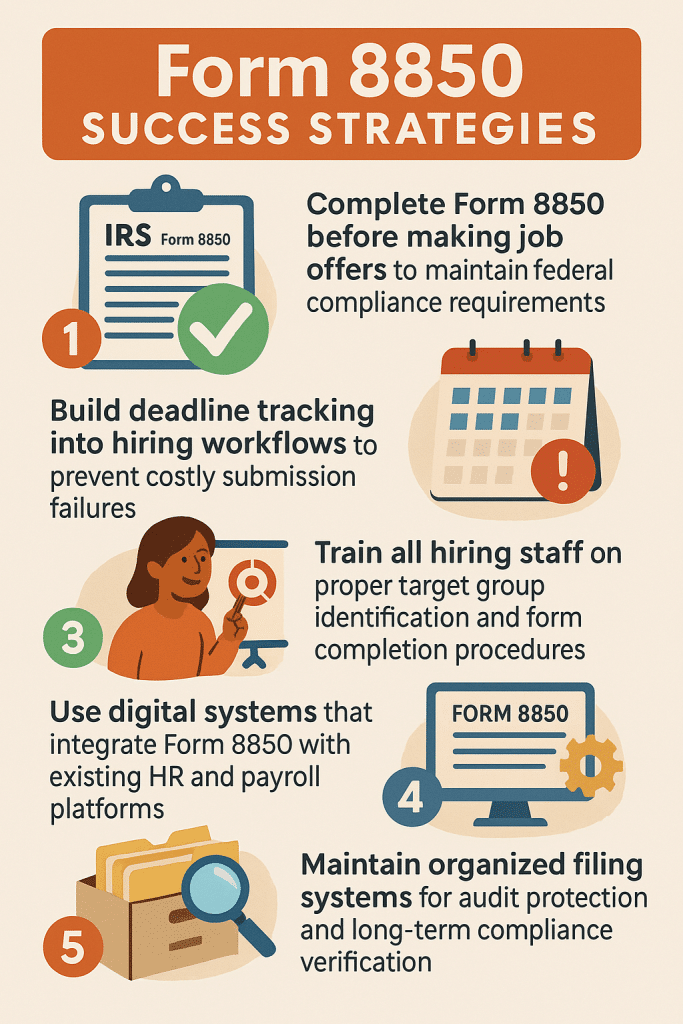
Form 8850 Success Strategies
- Complete Form 8850 before making job offers to maintain federal compliance requirements
- Build deadline tracking into hiring workflows to prevent costly submission failures
- Train all hiring staff on proper target group identification and form completion procedures
- Use digital systems that integrate Form 8850 with existing HR and payroll platforms
- Maintain organized filing systems for audit protection and long-term compliance verification
Advanced Form 8850 Management
Technology has transformed Form 8850 processing from manual paperwork into streamlined digital workflows. But only businesses that understand how to leverage these tools properly see meaningful improvements in their WOTC results.
Digital Submission and Tracking Systems
Electronic Form 8850 submission beats paper processing in every measurable way. Faster processing times, automated deadline tracking, real-time status updates, and reduced error rates all contribute to higher success rates and lower administrative burden.
State workforce agencies increasingly prefer digital submissions through approved platforms that maintain proper authentication and audit trails. These systems often provide confirmation receipts, processing timelines, and status notifications that help businesses manage multiple applications efficiently.
Integration with existing HR systems eliminates duplicate data entry while ensuring consistency across all hiring documentation. When applicant tracking systems communicate directly with WOTC platforms, Form 8850 completion becomes automatic rather than optional.
Quality Control and Error Prevention
Form 8850 errors create expensive delays and potential denials that could have been prevented through basic quality control procedures. Simple verification steps catch most common mistakes before they become problems.
Employee information must match exactly across all related documents. Names, Social Security numbers, addresses, and dates must align perfectly between Form 8850 and supporting materials. Inconsistencies trigger additional review that slows processing and may lead to denials.
Target group selection requires careful verification of actual employee qualifications. Selecting “veteran” without confirming military service can result in denied applications. Choosing “long-term unemployed” without verifying the duration of unemployment leads to similar problems.
| Processing Method | Average Processing Time | Error Rate | Cost per Form |
|---|---|---|---|
| Manual Paper Forms | 4-8 weeks | 25-35% | $15-25 |
| Digital Manual Entry | 2-4 weeks | 15-25% | $8-15 |
| Automated Integration | 1-3 weeks | 5-10% | $3-8 |
Common Form 8850 Mistakes and Solutions
The most expensive Form 8850 mistakes stem from misunderstanding timing requirements and signature procedures. These errors cost businesses thousands in forfeit credits while consuming administrative time that could be spent on growth activities.
Incomplete employer information causes processing delays that can extend beyond useful business timelines. State agencies need complete, accurate employer details to link applications to businesses correctly. Missing EIN numbers, outdated addresses, or incorrect contact information creates problems that take weeks to resolve.
Target group documentation failures occur when forms claim eligibility that can’t be verified through supporting materials. Veterans need DD-214s or similar discharge papers. SNAP recipients need benefit verification letters. Ex-felons need conviction or release documentation. Missing or inadequate proof leads to automatic denials.
A mid-sized restaurant chain avoided $50,000 in lost credits by integrating Form 8850 tracking into their payroll software. The automated system flagged approaching deadlines, validated required information, and maintained digital records that simplified tax filing and audit preparation.
As WOTC compliance specialist Jennifer Torres notes, “Businesses that master Form 8850 as part of a systematic approach to tax credits typically capture 300-400% more credits than those treating it as isolated paperwork.”
State-Specific Variations and Optimization
While Form 8850 is a federal document, state workforce agencies handle processing with variations that affect success rates and timelines. Understanding these differences can significantly improve your results.
Processing times vary dramatically by state. California might take 2-3 weeks while Texas processes applications in 4-6 weeks. New York offers online status tracking, while some states still rely on phone inquiries. Knowing your state’s capabilities helps set realistic expectations and plan accordingly.
Documentation preferences also vary by jurisdiction. Some states accept digital copies of supporting materials, while others require original documents. Electronic signatures work in most states but certain agencies still prefer wet signatures on paper forms.
Multi-state businesses need standardized procedures that accommodate the most restrictive requirements while maintaining efficiency across all locations. Building flexibility into your systems prevents location-specific compliance issues while ensuring consistent results.
Integration with Business Tax Strategy
This WOTC form connects to broader tax planning strategies that extend beyond simple credit claims. Understanding these relationships helps optimize overall business tax positions while maximizing WOTC benefits.
Credit timing considerations become important for businesses with fluctuating tax liabilities. WOTC credits can be carried forward for up to 20 years, providing flexibility for companies that invest heavily in expansion or experience temporary low-profit periods.
Coordination with other employment incentives creates opportunities for compound benefits. State hiring credits, apprenticeship incentives, and research and development credits often complement WOTC without creating conflicts or reducing eligibility.
Record retention requirements extend far beyond Form 8850 submission. IRS audits can occur years after credit claims, making organized documentation essential for protecting your savings. Digital storage with proper backup and security measures has become the standard for serious WOTC programs.
Conclusion
Form 8850 represents the gateway to substantial tax savings through the Work Opportunity Tax Credit program, but only when completed properly and submitted on time. Understanding its purpose as both a screening tool and legal document, mastering the timing requirements, and building systematic completion processes into hiring workflows transforms routine paperwork into strategic financial planning. The difference between treating Form 8850 as an administrative burden versus a business opportunity can mean tens of thousands in annual tax savings while supporting individuals who face employment barriers.
What Is Form 8850 FAQs
What is Form 8850 and when must it be completed?
What is Form 8850 is the IRS Pre-Screening Notice and Certification Request for Work Opportunity Tax Credits, and it must be completed before or on the day of job offer. The completed form must be submitted to state workforce agencies within 28 days of the employee’s start date to maintain eligibility.
Is Form 8850 required for every new hire?
Form 8850 is not required for every new hire, only when employers want to claim WOTC credits for eligible employees from target groups. What is Form 8850 becomes relevant when new hires are veterans, SNAP recipients, ex-felons, or members of other qualifying categories.
What is Form 8850’s relationship to other WOTC documents?
What is Form 8850 serves as the initial application that triggers the entire WOTC process and must be submitted with ETA Forms 9061 or 9062 for complete applications. Form 8850 data eventually flows into Forms 5884 and 3800 when claiming credits on business tax returns.
What happens if Form 8850 is submitted late or incorrectly?
Late Form 8850 submission results in permanent loss of tax credit eligibility with no appeal process available. Incorrect information on Form 8850 can lead to processing delays, application denials, or audit issues that could affect other tax credit claims.
Can Form 8850 be completed electronically or only on paper?
Form 8850 can be completed electronically through approved platforms that maintain proper signature authentication and audit trails. Most states accept digital submissions through online portals, which typically offer faster processing times and better tracking than paper submissions.
Citations
- CountyOffice.org. What Is Form 8850?
- Deskera. Understanding Form 8850
- Walton Management. When is form 8850 due for the WOTC program
- Rockerbox. Form 8850: Top 5 Tips for Perfect Submission
- Pilot Blog. Instructions for Filling Out Form 8850
- ADP. Work Opportunity Tax Credit | What is WOTC?
- Asure Software. How a WOTC Certification Request Works

Paul Kohn MBA is a seasoned business consultant known for helping businesses maximize tax credits and incentives to fuel growth and profitability. He holds a Master’s in Business Administration and has helped numerous companies secure millions in tax credits and implement effective business strategies. He is regarded as a trusted authority for business owners seeking to optimize their savings and growth.