

Work opportunity tax credit funding provides federal tax incentives up to $9,600 per qualifying hire from targeted employment groups, with no cap on total credits businesses can claim annually. The funding mechanism operates through a reduction in direct tax liability, rather than providing upfront grants, making it accessible to any profitable business that hires eligible employees.
Key Takeaways
- Maximum Credit Value: Employers can claim up to $9,600 per eligible new hire with no overall limit on qualifying hires
- Direct Tax Reduction: Credits reduce tax liability dollar-for-dollar, making them more valuable than equivalent deductions
- 28-Day Certification Deadline: Employee eligibility must be certified within 28 days of hire or credits are permanently forfeited
- Ten Target Groups: Veterans, SNAP recipients, ex-felons, and seven other categories qualify for different credit amounts
- Legislative Expansion: Recent proposals seek to increase credit amounts and add new target populations
What Is Work Opportunity Tax Credit Funding?
The federal government created this funding mechanism to address unemployment challenges among specific populations while providing economic incentives for private sector job creation. Unlike grant programs that require competitive applications and limited funding pools, WOTC operates as an open-ended tax credit available to any employer meeting basic requirements.
How WOTC Funding Works
The funding structure operates through the federal tax system rather than direct appropriations, meaning Congress doesn’t need to allocate specific dollar amounts each year. When businesses hire qualifying individuals and complete proper certification, they reduce their tax liability by the credit amount. This mechanism creates unlimited funding potential while ensuring credits only flow to employers who actually create jobs for target populations.
WOTC delivers more financial value than traditional hiring incentives because it reduces tax liability dollar-for-dollar rather than providing taxable income. A $2,400 WOTC credit saves exactly $2,400 in taxes, while a $2,400 grant or deduction might only save $600-$800, depending on tax rates. This difference makes WOTC particularly attractive for profitable businesses seeking to optimize their tax position.
The funding flows through normal tax filing processes, with credits claimed on annual returns or estimated tax payments. Businesses can carry forward unused credits for up to 20 years, providing flexibility for companies with fluctuating tax liabilities or those investing heavily in expansion during low-profit periods.
Who Is Eligible for WOTC Funding
Any U.S. employer can access WOTC funding regardless of business size, structure, or industry. This includes corporations, partnerships, sole proprietorships, and even tax-exempt organizations that pay wages subject to federal income tax withholding. The universal eligibility ensures small businesses compete on equal footing with large corporations for these valuable incentives.
Employee eligibility spans ten federally designated target groups, each facing documented employment barriers. Veterans represent the highest-value category, with disabled veterans generating up to $9,600 credits compared to $2,400 for most other groups. SNAP and TANF recipients often comprise the largest volume of qualifying employees, particularly in retail and food service industries.
Target group diversity creates opportunities across industries and job levels. Manufacturing companies frequently hire veterans and ex-felons, while service industries often employ SNAP recipients and long-term unemployed individuals. Professional services might find opportunities with unemployed veterans or individuals receiving vocational rehabilitation services.
How to Qualify: Navigating Requirements and Certification
Qualification success depends on understanding both employer obligations and employee requirements within strict federal guidelines. The process involves multiple steps with specific timing requirements that can permanently eliminate funding opportunities if missed.
The Certification Process
Prescreening begins during the hiring process with targeted questions about military service, government assistance programs, unemployment duration, and criminal history. These conversations require sensitivity and legal compliance, but they’re essential for identifying potential WOTC opportunities before making hiring decisions.
Form completion must occur at or before job offer acceptance, never after employment begins. IRS Form 8850 captures basic employee information and target group identification, while DOL Forms 9061 or 9062 provide detailed verification supporting the employee’s qualifications. Both forms require employee signatures acknowledging their membership in the target group.
The 28-day submission deadline creates the most critical compliance requirement in the entire WOTC process. This clock starts ticking on the employee’s first day of work, not the application date or orientation completion. Missing this deadline by even one day permanently eliminates all credit eligibility for that employee, regardless of their qualifications or your good intentions.
| Certification Stage | Timeline | Required Actions | Failure Consequences |
|---|---|---|---|
| Pre-screening | During hiring | Identify target groups | Missed opportunities |
| Form completion | Before start date | Complete 8850 & 9061/9062 | Processing delays |
| State submission | Within 28 days | Submit to workforce agency | Permanent disqualification |
| State review | 2-8 weeks | Wait for certification | Delayed credit claims |
Maximizing Hours Worked for Maximum Credit
Hour tracking becomes critical for optimizing credit values, as the system rewards longer employment relationships with higher credit percentages. Employees working 120-399 hours generate 25% credits on qualified wages, while those reaching 400+ hours unlock the full 40% credit rate.
Strategic scheduling can optimize credit values by ensuring qualifying employees cross the 400-hour threshold that unlocks maximum funding benefits. A veteran earning $6,000 in qualified wages generates a $1,500 credit at 25% but a $2,400 credit at 40%—a $900 difference determined entirely by hour tracking and scheduling decisions.
Retention strategies become particularly valuable for WOTC-eligible employees because their departure below minimum hour thresholds renders them ineligible for credit. Some businesses create specific programs to support newly hired target group members, recognizing that their success directly impacts tax credit realization.
Latest Legislative and Funding Developments
Congressional support for WOTC has remained strong across multiple administrations, with recent legislative proposals seeking to expand both credit amounts and eligible populations. These developments suggest that the program will continue to grow as a workforce development tool, rather than facing elimination or reduction.
Recent Enhancements and Proposed Expansions
The HIRE Act of 2021 proposed increasing maximum credits to $15,000 for certain veterans and adding new target groups, including individuals with substance abuse disorders and those aging out of foster care. While this specific legislation didn’t pass, similar proposals continue surfacing, indicating bipartisan support for program expansion.
State-level enhancements have emerged as some states offer supplementary credits that stack with federal WOTC benefits. These programs recognize that employment barriers often require multiple incentives to overcome, creating opportunities for businesses operating in supportive jurisdictions.
Recent regulatory updates have streamlined certification processes in many states while maintaining program integrity. Electronic submission systems and automated tracking have reduced administrative burdens while improving processing times and accuracy.
How WOTC Integrates With Other Funding Initiatives
WOTC stacks effectively with many other employment incentives, creating compound benefits for strategic employers. State hiring credits, workforce development grants, and industry-specific incentives often complement WOTC without reducing eligibility or creating conflicts.
Apprenticeship tax credits, research and development incentives, and empowerment zone benefits can combine with WOTC to create substantial cumulative savings. The key lies in understanding which programs can be layered together and which require choosing between alternatives.
Step-by-Step Guide: Claiming and Maximizing Work Opportunity Tax Credit Funding
Implementation success requires systematic approaches that integrate WOTC considerations into standard hiring and administrative processes. The most successful programs treat WOTC as a core business function rather than an occasional administrative task.
Step 1: Candidate Identification and Prescreening
Building relationships with veteran organizations, workforce development agencies, and re-entry programs creates reliable pipelines for WOTC-eligible candidates. These partnerships often provide pre-screened applicants who meet both job requirements and target group criteria, streamlining the qualification process.
Applicant tracking systems can be configured to flag potential WOTC opportunities during the screening process. Simple questions about military service, government benefits, and employment history help identify candidates worth pursuing through the certification process.
Step 2: Timely Filing and Documentation
Creating documentation calendars with automated reminders prevents missed deadlines that eliminate credit eligibility. Many successful businesses assign specific staff members to monitor WOTC compliance, recognizing that the financial stakes justify dedicated attention.
Digital filing systems have replaced paper processes in most states, reducing processing times and improving accuracy. These systems often provide real-time status updates and automated deadline notifications that help businesses stay compliant.
Step 3: Calculating and Filing Credits
Credit calculations vary by target group and hours worked, requiring careful tracking of both wages paid and time worked during the first year of employment. Most target groups cap qualified wages at $6,000, but veterans can reach $24,000, significantly impacting potential credit amounts.
Tax filing typically occurs on Form 5884, which integrates with standard business tax returns. The process requires maintaining detailed records linking certified employees to their wage and hour information, creating audit trails that support credit claims.
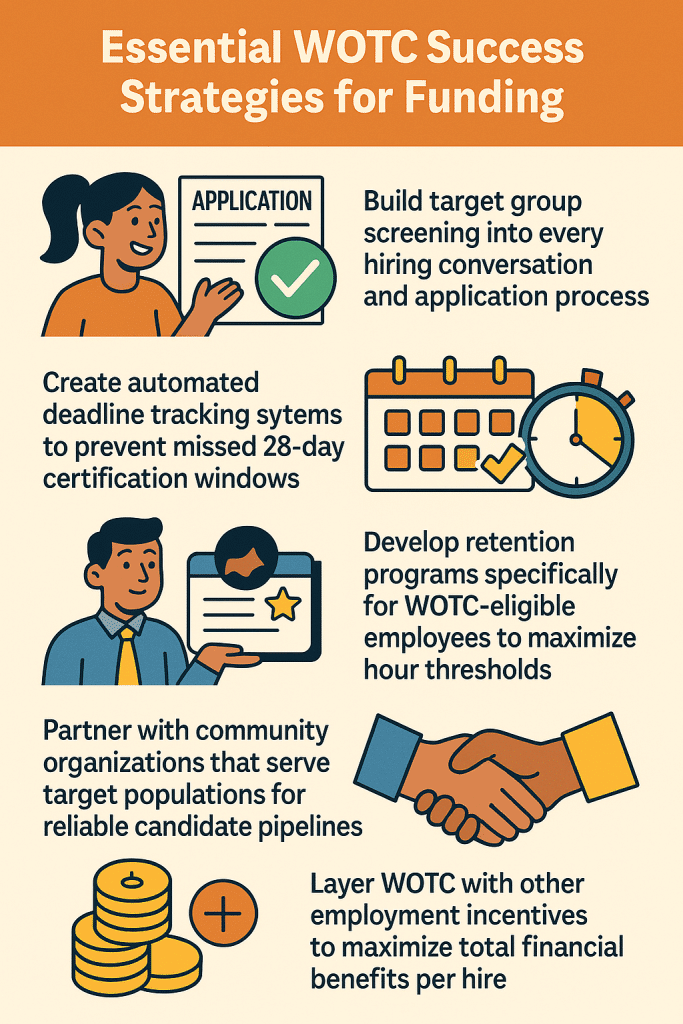
Essential WOTC Success Strategies
- Build target group screening into every hiring conversation and application process
- Create automated deadline tracking systems to prevent missed 28-day certification windows
- Develop retention programs specifically for WOTC-eligible employees to maximize hour thresholds
- Partner with community organizations that serve target populations for reliable candidate pipelines
- Layer WOTC with other employment incentives to maximize total financial benefits per hire
Maximizing Value Beyond Compliance
The most sophisticated WOTC programs extend beyond basic compliance to create comprehensive diversity and inclusion strategies that generate both financial and social returns. These approaches recognize that target group employees often bring unique perspectives, strong motivation, and exceptional loyalty that extends well beyond their credit-generating potential.
Internal policies that prioritize hiring from target groups during recruitment can systematically increase WOTC participation rates. Some businesses set specific targets for veteran hiring or establish partnerships with specific community organizations, creating predictable credit generation alongside workforce diversity goals.
Who Should Use WOTC Funding and Why?
WOTC delivers value across industries and business sizes, but certain sectors and situations create particularly attractive opportunities. High-turnover industries, such as hospitality and retail, often achieve the highest participation rates due to their frequent hiring and demographic alignment with target populations.
Manufacturing companies frequently discover substantial WOTC opportunities through veteran hiring programs, with many veterans possessing technical skills and discipline that translate directly to production environments. A construction company in Arizona implemented WOTC-compliant hiring practices and generated $48,000 in annual tax savings while significantly improving its veteran employment rate.
Healthcare organizations find opportunities across various skill levels, from entry-level positions filled by SNAP recipients to professional roles that attract veterans and long-term unemployed individuals with relevant experience. Seasonal businesses can maximize WOTC benefits by concentrating eligible hiring during peak employment periods.
| Business Factor | High WOTC Potential | Moderate WOTC Potential | Lower WOTC Potential |
|---|---|---|---|
| Hiring Volume | 20+ employees annually | 5-20 employees annually | Under 5 employees annually |
| Industry Type | Retail, Food Service, Manufacturing | Healthcare, Construction | Professional Services |
| Location | Urban areas, military communities | Suburban areas | High-income rural areas |
| Job Skill Level | Entry to mid-level positions | Mixed skill requirements | Senior/executive positions |
Common Pitfalls and Expert Solutions
The most expensive WOTC mistakes involve missed deadlines that permanently eliminate credit eligibility for otherwise qualifying employees. These losses often accumulate over time, with businesses discovering they’ve forfeited tens of thousands in potential credits due to administrative oversights.
Incomplete documentation represents another frequent problem, particularly when employees provide insufficient information to verify target group membership. State agencies cannot approve certifications based on partial information, making thorough initial data collection essential for success.
Employee misclassification issues arise when businesses attempt to claim credits for rehires, transfers, or family members who don’t qualify for WOTC benefits. These mistakes can trigger audits and penalties that far exceed any potential credit value.
Utilizing specialized consultants or technology platforms can effectively address most compliance issues while ensuring maximum credit capture for qualifying hires. The investment in professional guidance typically pays for itself through improved capture rates and avoided penalties.
As tax strategist David Martinez explains, “Businesses that treat WOTC as a strategic hiring tool rather than just a compliance exercise typically see 200-300% higher participation rates and develop stronger, more diverse teams in the process.”
Advanced Optimization Strategies
Multi-location businesses can optimize WOTC benefits by concentrating eligible hiring in jurisdictions with complementary state incentives or higher target population densities. This geographic strategy maximizes credit generation while supporting broader expansion goals.
Timing considerations become important for businesses with fluctuating tax liabilities, as WOTC credits can be strategically claimed or carried forward to optimize overall tax positions. Some businesses coordinate WOTC hiring with major equipment purchases or expansion projects that create temporary high-tax years.
Partnership strategies with temporary staffing agencies can extend WOTC opportunities to contract workers who later become permanent employees. These arrangements require careful documentation but can significantly expand the pool of potential qualifying hires.
Conclusion
WOTC funding represents one of the most accessible and valuable employment incentives available to U.S. businesses, offering direct tax savings up to $9,600 per qualifying hire with no annual caps or competitive application processes. Success requires understanding target group criteria, maintaining strict compliance with certification deadlines, and treating WOTC as a strategic hiring tool rather than an afterthought. Take control of your WOTC potential by implementing systematic screening processes, building community partnerships, and leveraging professional guidance to maximize both financial benefits and positive social impact.
Work Opportunity Tax Credit Funding FAQs
How does work opportunity tax credit funding differ from other employment incentives?
Work opportunity tax credit funding operates as a dollar-for-dollar tax liability reduction rather than taxable income or deductible expenses, making it more valuable than equivalent grant programs. Unlike competitive funding programs, WOTC has no annual caps and is available to any business meeting basic qualification requirements.
Can businesses claim work opportunity tax credit funding for remote workers?
Yes, businesses can claim work opportunity tax credit funding for remote workers who meet target group requirements and work minimum hour thresholds, as work location doesn’t affect eligibility. The same certification and documentation requirements apply regardless of where qualifying employees perform their duties.
What happens to work opportunity tax credit funding if certification is delayed?
Work opportunity tax credit funding remains available even if state certification is delayed, provided Form 8850 was submitted within the 28-day deadline. Businesses can claim credits on amended returns once certification is received, although this may delay the actual realization of the tax benefit.
How do non-profit organizations access WOTC funding benefits?
Non-profit organizations can access WOTC funding benefits if they pay wages subject to federal income tax withholding, though the credits offset payroll taxes rather than income taxes. This makes WOTC particularly valuable for non-profits with significant employment costs and limited revenue diversification.
Can seasonal businesses maximize work opportunity tax credit funding during peak hiring periods?
Seasonal businesses can maximize work opportunity tax credit funding by concentrating WOTC-eligible hiring during peak periods when they need the most workers. The key is ensuring seasonal employees work enough hours to qualify for credits before their employment ends.
Citations
- Oregon Employment Department. Work Opportunity Tax Credit
- Pride Industries. The Work Opportunity Tax Credit for Employees with Disabilities
- Paychex. Work Opportunity Tax Credit (WOTC) Explained
- RockerBox. The Work Opportunity Tax Credit (WOTC) Outlook for 2025
- Paycom. Work Opportunity Tax Credit (WOTC) | A Guide For Employers

Paul Kohn MBA is a seasoned business consultant known for helping businesses maximize tax credits and incentives to fuel growth and profitability. He holds a Master’s in Business Administration and has helped numerous companies secure millions in tax credits and implement effective business strategies. He is regarded as a trusted authority for business owners seeking to optimize their savings and growth.