

Key Takeaways
- Effective work life balance reduces employee burnout by 40% and increases productivity by 25%
- Setting clear boundaries between work and personal time prevents chronic stress and improves job satisfaction
- Flexible work arrangements and time management strategies are more effective than traditional fixed schedules
- Regular breaks, physical activity, and stress management techniques prevent burnout before it starts
- Company culture and leadership support are essential for sustainable work life balance implementation
- Technology tools can either help or hurt work life balance depending on how they’re used
- Personal wellness practices and professional boundaries work together to create lasting balance
Promoting work life balance requires intentional strategies that set clear boundaries, prioritize personal wellness, and create supportive work environments that prevent burnout while maintaining high productivity levels.
Understanding Work Life Balance and Its Impact on Burnout Prevention
Work life balance represents the healthy equilibrium between professional responsibilities and personal well-being that allows people to perform effectively at work while maintaining satisfying personal lives. This balance isn’t about perfect equality between work and personal time, but rather about feeling fulfilled and in control of both areas without one consistently overwhelming the other.
The connection between work life balance and burnout prevention is direct and measurable. When employees feel they have adequate time and energy for both work and personal activities, they’re significantly less likely to experience the chronic exhaustion, cynicism, and reduced performance that characterize burnout syndrome. Research consistently shows that organizations with strong work life balance cultures see lower turnover, higher engagement, and better overall performance.
The Business Case for Work Life Balance
Companies that actively promote work life balance see measurable returns on their investment through reduced healthcare costs, lower absenteeism, and improved employee retention. The financial impact is substantial – replacing a burned-out employee typically costs 50-200% of their annual salary when you factor in recruitment, training, and lost productivity during the transition period.
Beyond cost savings, organizations with strong work life balance cultures often outperform competitors in innovation and customer satisfaction metrics. Employees who aren’t chronically stressed have more mental energy for creative problem-solving and provide better customer service because they’re not operating from a place of exhaustion and frustration.
Signs That Work Life Balance Needs Attention
Recognizing early warning signs of poor work life balance helps prevent more serious burnout issues down the road. Common indicators include consistently working late, difficulty disconnecting from work thoughts during personal time, physical symptoms like headaches or sleep problems, and declining performance in either work or personal areas of life.
Emotional signs are equally important and include feeling overwhelmed by daily responsibilities, irritability with colleagues or family members, loss of interest in previously enjoyable activities, and a sense that there’s never enough time to accomplish important goals. These symptoms often develop gradually, making regular self-assessment crucial for maintaining healthy balance.
| Work Life Balance Strategy | Implementation Difficulty | Time to See Results | Impact on Burnout Prevention |
|---|---|---|---|
| Clear Work Hours Boundaries | Easy | 1-2 weeks | High |
| Regular Exercise Routine | Medium | 2-4 weeks | High |
| Flexible Work Arrangements | Hard (requires approval) | 1-3 months | Very High |
| Stress Management Techniques | Medium | 2-6 weeks | Medium to High |
| Technology Boundaries | Easy | 1 week | Medium |
Creating Effective Work Life Balance Through Boundary Setting
Establishing clear boundaries between work and personal life forms the foundation of a sustainable work life balance. These boundaries help prevent work from gradually consuming all available time and mental energy while ensuring that personal needs receive adequate attention and priority.
Effective boundary setting involves both time-based limits and mental separation techniques that allow for complete disengagement from work during personal time. This separation is crucial for stress recovery and maintaining the energy needed for long-term professional success without sacrificing personal well-being.

Physical and Temporal Boundaries
Physical boundaries involve creating dedicated spaces for work and personal activities, even when working from home. Having a specific work area that can be “closed” at the end of the day helps signal the transition between professional and personal time, making it easier to mentally disconnect from work responsibilities.
Temporal boundaries include setting specific start and stop times for work activities and protecting personal time from work intrusions. This means avoiding email checking during family dinner, refraining from taking work calls during personal activities, and establishing “no work” zones during evenings and weekends, unless true emergencies arise.
Digital and Communication Boundaries
Modern technology makes it easier than ever for work to intrude on personal time, making digital boundaries essential for work life balance. This includes turning off work notifications during non-work hours, using separate devices or accounts for work and personal communication, and setting clear expectations about response times for non-urgent communication.
Effective digital boundaries also involve using technology intentionally rather than reactively. Instead of constantly checking email throughout the day, establish specific times for reviewing and responding to communication. A marketing executive reduced her after-hours work stress by 60% after implementing a policy of checking email only three times per day and turning off all work notifications after 7 PM.
Implementing Flexible Work Arrangements for Better Work Life Balance
Flexible work arrangements represent one of the most effective strategies for improving work life balance while maintaining or even increasing productivity. These arrangements recognize that different individuals work most effectively at different times and in various environments, enabling customization that supports both personal needs and professional performance.
The key to successful flexible work arrangements is focusing on results rather than hours worked or physical presence in a specific location. This outcome-based approach enables employees to structure their work in a way that complements their personal lives while still meeting all professional obligations and performance standards.
Remote Work and Hybrid Schedules
Remote work and hybrid arrangements eliminate commute time while providing greater control over the work environment and schedule. These arrangements work particularly well for employees with family responsibilities, long commutes, or personal situations that benefit from location flexibility.
Successful remote work requires strong communication protocols, clear performance expectations, and regular check-ins to maintain team cohesion and accountability. The flexibility to work from home during a child’s illness or to avoid a lengthy commute during bad weather can significantly reduce stress while maintaining productivity levels.
Flexible Scheduling and Compressed Work Weeks
Flexible scheduling allows employees to adjust their work hours to accommodate personal needs while still meeting team collaboration and customer service requirements. This might involve starting earlier to leave in time for family activities or working longer days, four days a week, to have three-day weekends.
Compressed work weeks, where employees work longer days for fewer days per week, can provide substantial work life balance benefits by creating dedicated personal time blocks. These arrangements work well for employees who prefer longer, uninterrupted work periods and value extended personal time more than daily flexibility.
Stress Management Techniques That Support Work Life Balance
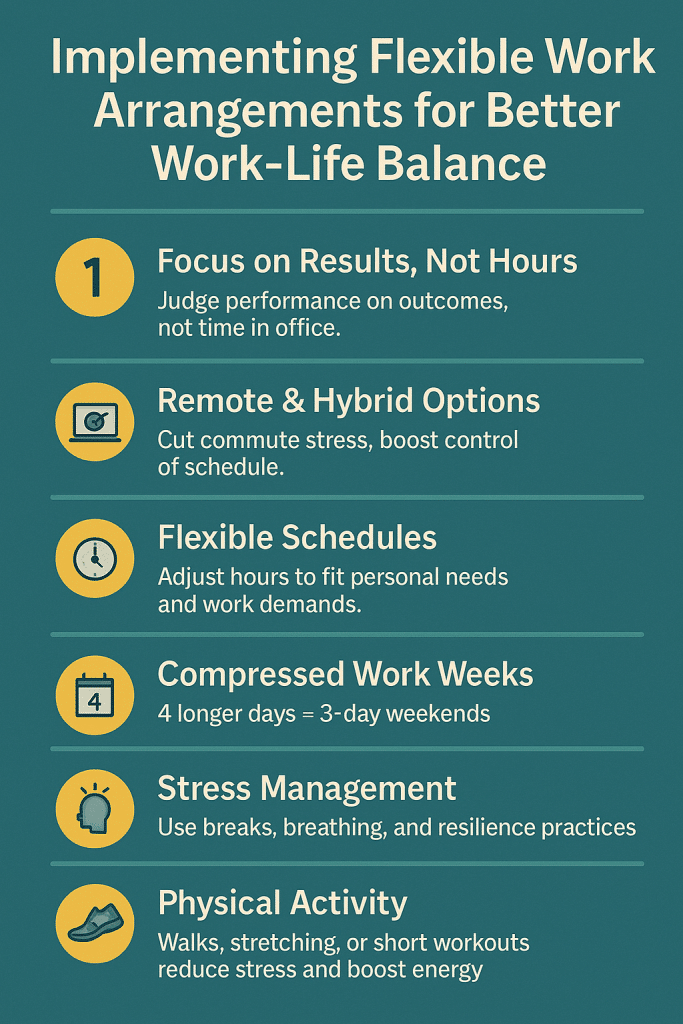
Effective stress management forms a crucial component of sustainable work life balance by providing tools for handling work pressures without letting them spill over into personal life. These techniques help maintain emotional equilibrium and prevent the accumulation of chronic stress, which can lead to burnout.
The most effective stress management approaches combine immediate stress relief techniques for acute situations with longer-term practices that build overall resilience and stress tolerance. This dual approach ensures that you can handle both daily stressors and larger challenges without compromising your work life balance.
Mindfulness and Relaxation Practices
Mindfulness practices such as meditation, deep breathing exercises, and progressive muscle relaxation provide immediate stress relief while building long-term emotional regulation skills. These techniques can be used during work breaks, commute time, or transition periods between work and personal activities to help maintain mental clarity and emotional balance.
Regular mindfulness practice, even just 10-15 minutes daily, has been shown to reduce cortisol levels, improve focus, and increase emotional resilience. The key is consistency rather than duration – short daily practices are more effective than occasional longer sessions for building stress management skills that support work life balance.
Physical Activity and Movement
Regular physical activity is one of the most effective tools for managing stress, while also improving overall health and energy levels. Exercise doesn’t need to be intensive or time-consuming to be beneficial – even short walks, stretching breaks, or brief workout sessions can significantly impact stress levels and mental clarity.
The timing of physical activity can enhance its work life balance benefits. Morning exercise can provide energy and stress resilience for the day ahead, while evening workouts can help process work stress and facilitate a smooth transition into personal time. A software developer reduced his work-related anxiety by 45% after implementing daily 20-minute walks during lunch breaks and brief stretching sessions between meetings.
Building Company Culture That Promotes Work Life Balance
Organizational culture plays a fundamental role in determining whether work life balance initiatives succeed or fail. Companies that truly support work life balance create environments where taking vacation time, leaving at reasonable hours, and prioritizing personal well-being are not just tolerated but actively encouraged and modeled by leadership.
Building a culture that promotes work life balance requires consistent actions that align with stated values, not just policy statements or occasional wellness initiatives. Employees quickly recognize whether leadership genuinely supports balance or merely pays lip service to the concept while rewarding overwork and availability.
Leadership Modeling and Support
Leaders who model healthy work life balance by taking vacations, maintaining reasonable work hours, and openly discussing their own balance strategies give employees permission to do the same. This modeling is more powerful than any policy statement because it demonstrates that balance is valued and safe to pursue.
Supportive leadership also involves actively protecting employees from unreasonable demands, helping redistribute workloads when necessary, and recognizing that sustainable performance requires adequate rest and recovery time. Leaders should regularly ask about workload balance and be prepared to make adjustments when employees indicate they’re struggling to maintain healthy boundaries.
Policy and Practice Alignment
Companies with effective work life balance cultures ensure that their formal policies align with informal expectations and practices. This means that vacation policies are actually utilized without guilt, flexible work arrangements are genuinely available to those who need them, and performance evaluations prioritize work quality over just hours worked.
Policy alignment also requires addressing systemic issues that undermine work life balance, such as unrealistic deadlines, inadequate staffing, or communication expectations that extend beyond normal work hours. As workplace wellness expert Dr. Michael Rodriguez notes, “Organizations that achieve lasting work life balance improvements focus on changing systems and processes, not just individual behaviors.”
Technology’s Role in Work Life Balance Management
Technology can either enhance or undermine work life balance depending on how it’s implemented and used. When used strategically, technology tools can enhance efficiency, facilitate flexible work arrangements, and promote better work-life balance. However, poorly managed technology can create constant connectivity pressures that make true work life balance nearly impossible.
The key to leveraging technology for better work life balance lies in intentional use that supports your balance goals rather than reactive use that responds to every notification and communication immediately. This requires setting up systems and boundaries that make technology work for you rather than against your balance objectives.
Productivity Tools and Time Management Apps
Productivity applications and time management tools can help optimize work hours by improving focus, reducing time waste, and helping identify patterns in how time is actually spent. These tools are most effective when they facilitate more efficient work processes that free up time for personal activities, rather than simply enabling more work to be packed into the same hours.
Effective productivity tools include time-tracking applications that reveal where time is actually spent, task management systems that prevent important items from being forgotten, and calendar applications that help protect personal time from work intrusions. The goal is using technology to work smarter rather than longer, creating space for better work life balance.
Communication Management and Notification Control
Managing digital communication is crucial for maintaining work life balance in an always-connected world. This involves setting up notification systems that distinguish between urgent and non-urgent communications, utilizing autoresponders to establish expectations about response times, and creating separate communication channels for work and personal use.
Effective communication management also includes training colleagues and clients about your availability and response expectations. By proactively communicating your work hours and emergency contact procedures, you can reduce pressure to be constantly available while ensuring that truly urgent matters can still reach you when necessary.
| Aspect | Poor Work Life Balance | Healthy Work Life Balance |
|---|---|---|
| Work Hours | Regularly working 60+ hours per week | Consistent 40-50 hour work weeks |
| Personal Time | Constantly interrupted by work demands | Protected time for family, hobbies, rest |
| Stress Levels | Chronic stress, anxiety, exhaustion | Manageable stress with recovery periods |
| Health | Sleep problems, physical symptoms | Regular exercise, adequate sleep, good health |
| Relationships | Strain on family and friendships | Strong personal relationships, social connection |
Personal Wellness Strategies That Enhance Work Life Balance
Personal wellness practices form the foundation of sustainable work life balance by ensuring that you have the physical and mental resources needed to handle both work and personal responsibilities effectively. These practices focus on building resilience, maintaining health, and cultivating positive habits that support long-term balance, rather than just providing temporary stress relief.
Effective wellness strategies are integrated into daily routines rather than treated as additional obligations that compete with work and personal time. The goal is to create sustainable practices that enhance rather than complicate your overall life balance while providing the energy and clarity needed for both professional success and personal fulfillment.
Sleep Hygiene and Recovery
Quality sleep represents one of the most important factors in maintaining work life balance because it affects every other aspect of physical and mental performance. Good sleep hygiene involves maintaining a consistent sleep schedule, creating a restful sleep environment, and developing a pre-sleep routine that helps transition from the day’s activities to restful rest.
Sleep quality significantly impacts work performance, emotional regulation, and physical health, ultimately affecting your ability to maintain healthy boundaries and manage stress effectively. Poor sleep creates a cycle where work stress interferes with rest, leading to reduced performance that in turn creates more stress and exacerbates further sleep problems.
Nutrition and Energy Management
Consistent energy levels throughout the day support work life balance by preventing the fatigue that leads to poor decision-making about boundaries and priorities. This involves eating regular, balanced meals that provide steady energy rather than relying on caffeine and sugar for temporary boosts that lead to crashes later.
Energy management also includes timing meals and snacks to support your work schedule and personal activities. Planning ahead prevents the decision fatigue that leads to poor food choices and ensures that you have adequate fuel for both professional and personal responsibilities throughout the day.
Measuring and Maintaining Your Work Life Balance Progress
Sustainable work life balance requires ongoing assessment and adjustment as circumstances change and new challenges arise. Regular evaluation helps identify what’s working well and what needs modification before small problems become major balance disruptions that lead to burnout or decreased performance.
Effective measurement combines objective indicators such as work hours and stress symptoms with subjective assessments of satisfaction and fulfillment in both work and personal areas. This comprehensive approach ensures that improvements in one area don’t come at the expense of others and that your overall quality of life continues to improve over time.
Self-Assessment Tools and Metrics
Regular self-assessment using simple rating scales for work satisfaction, personal fulfillment, stress levels, and overall energy can help track your work life balance over time. These assessments should be conducted weekly or monthly to identify trends and patterns that may not be apparent from day-to-day experience.
Objective metrics, such as hours worked per week, the number of work emails sent after hours, the frequency of working weekends, and the amount of time spent on personal activities, provide concrete data about your actual balance rather than just your perception of balance. A consulting manager discovered she was working 20% more hours than she realized by tracking her time for two weeks, leading to important boundary adjustments.
Adjusting Strategies Based on Life Changes
Work life balance strategies that work well during one life phase may need adjustment as circumstances change. New job responsibilities, family changes, health issues, or personal goals may require modifications to your approach while maintaining the core principles of healthy boundaries and personal wellness.
Regular strategy review ensures that your work life balance approach evolves with your changing needs rather than becoming a rigid system that no longer serves your current situation. This flexibility prevents frustration and helps maintain long-term success with balance goals even as life circumstances shift and develop.
Achieving sustainable work life balance requires commitment to both personal boundaries and wellness practices that support long-term success rather than just temporary stress relief. Remember that work life balance is not a destination but an ongoing process of adjustment and refinement based on changing circumstances and priorities. Start by implementing one or two strategies that address your biggest current challenges, then gradually build a comprehensive approach that supports both your professional success and personal well-being. The investment in work life balance pays dividends through improved performance, better relationships, and greater overall life satisfaction.
Work Life Balance FAQs
What are the most effective work life balance strategies for preventing burnout?
The most effective work life balance strategies for preventing burnout include setting clear boundaries between work and personal time, taking regular breaks throughout the day, and maintaining consistent sleep schedules. Additionally, regular physical activity, stress management techniques such as mindfulness, and having supportive relationships both at work and in personal life significantly reduce the risk of burnout.
How can employers promote better work life balance for their employees?
Employers can promote work life balance by offering flexible work arrangements, modeling healthy boundaries themselves, and creating policies that truly support personal time without penalty. This includes respecting after-hours boundaries, providing adequate staffing to prevent overwork, and measuring performance based on results rather than hours worked.
What role does technology play in maintaining work life balance?
Technology can either help or hurt work life balance depending on how it’s used – productivity tools and flexible work platforms can improve efficiency and create more personal time, while constant connectivity and notifications can erode boundaries. The key is using technology intentionally with clear rules about when and how to engage with work-related communications.
How long does it take to see improvements after implementing work life balance changes?
Most people begin to see improvements in stress levels and energy within 2-4 weeks of implementing work life balance strategies, with more significant changes in overall well-being and job satisfaction appearing after 2-3 months. The timeline depends on which strategies are implemented and how consistently they’re followed.
Can work life balance actually improve job performance and productivity?
Yes, proper work life balance typically improves job performance and productivity by reducing stress, improving focus, and preventing the mental fatigue that leads to mistakes and decreased efficiency. Studies show that employees with good work life balance are 25% more productive and take fewer sick days compared to those experiencing chronic work stress.

Paul Kohn MBA is a seasoned business consultant known for helping businesses maximize tax credits and incentives to fuel growth and profitability. He holds a Master’s in Business Administration and has helped numerous companies secure millions in tax credits and implement effective business strategies. He is regarded as a trusted authority for business owners seeking to optimize their savings and growth.