
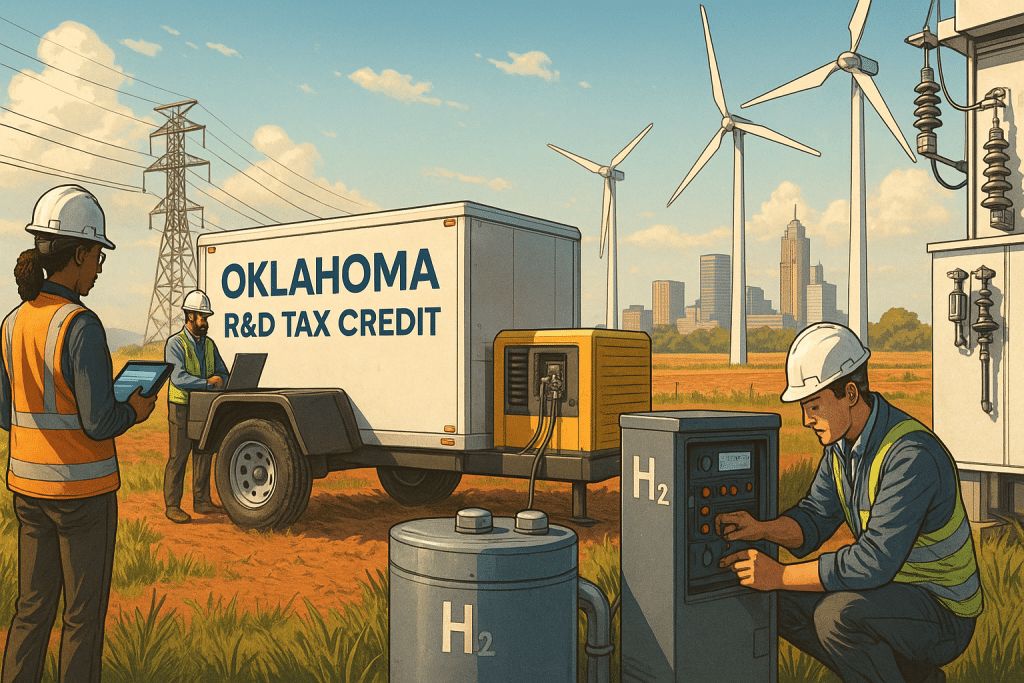
Oklahoma now offers a 5% research and development rebate through Senate Bill 324 (signed into law May 29, 2025), but the Oklahoma Research and Development Rebate Program has not yet received funding from the legislature. Until appropriations happen, Oklahoma businesses can claim the federal R&D tax credit which applies to qualified research expenses and offers payroll tax offsets for startups—a powerful cash flow tool for the state’s aerospace, energy, and manufacturing sectors.
Key Takeaways
- Senate Bill 324 created Oklahoma’s first-ever R&D rebate program in May 2025—a 5% rebate on qualified research expenditures conducted in-state
- The program exists on paper but cannot pay out until the Oklahoma Legislature appropriates funds to the Research and Development Rebate Fund (status: not yet funded as of November 2025)
- Oklahoma businesses can immediately claim federal R&D tax credits worth 6-14% of qualifying research expenses regardless of state program funding
- Startups under $5 million in revenue can use R&D credits to offset up to $500,000 in annual payroll taxes starting in 2023—getting quarterly cash refunds even without taxable income
- The federal One Big Beautiful Bill Act (2025) restored immediate expensing for domestic R&D costs, eliminating the five-year capitalization requirement
- When Oklahoma’s rebate program gets funded, companies can stack state rebates with federal credits on the same qualifying expenses
What Actually Happened with Oklahoma’s R&D Rebate Program
Let me give you the straight story because there’s confusion out there. On May 29, 2025, Governor Kevin Stitt signed Senate Bill 324 into law. That bill created the Oklahoma Research and Development Rebate Program. Big news. Oklahoma went from being one of 12 states with zero R&D incentives to having a formal program on the books.
Senator Kristen Thompson from Edmond championed this legislation. She co-chairs the LEAD Committee and watched Oklahoma lose tech companies to Texas, Colorado, and other states offering R&D credits. Boeing and Phillips 66 backed the bill. The aerospace and energy sectors need this.
Here’s the catch nobody’s talking about loud enough. The Oklahoma Legislature created the program but didn’t put money in it. Zero dollars appropriated to the Research and Development Rebate Fund as of right now. The Oklahoma Department of Commerce runs the program. They’ve got the attestation forms ready. They’re set up to process applications. But until the legislature appropriates funds, they can’t write checks.
The program is real. The program is law. The program just needs funding to actually pay rebates to companies doing research in Oklahoma.
How the 5% Rebate Will Work Once Funded
When money flows into the fund—and it will eventually—here’s what kicks in. You submit an application to the Oklahoma Department of Commerce. You document your qualified research expenditures that happened in Oklahoma. The same expenses that qualify for the federal R&D credit qualify here.
The rebate equals 5% of those qualifying costs. If you spent $1 million on eligible R&D in Oklahoma, you get a $50,000 rebate check. Not a tax credit that reduces future liability. An actual rebate payment.
The program caps total rebates at $20 million per fiscal year. Claims get processed first-come, first-served. If applications exceed $20 million in a year, late applications get prorated or pushed to the next year. You need to have filed all your Oklahoma tax returns to qualify. And you need proof the R&D work actually occurred within state borders.
Senator Thompson designed this carefully. It rewards innovation without creating runaway costs. The first-come basis encourages companies to file early and document properly. The $20 million cap protects state revenue while supporting enough research activity to make a difference.
| Program Feature | Oklahoma State Rebate (SB 324) | Federal R&D Tax Credit |
|---|---|---|
| Current availability | Law passed but awaiting legislative funding | Fully available now to all qualifying companies |
| Benefit rate | 5% cash rebate on QREs | 6-14% credit on qualifying expenses |
| Annual cap | $20 million statewide cap | No cap per company |
| Processing method | First-come, first-served rebate applications | Filed with federal tax return, processed by IRS |
| Payroll tax offset | Not offered | Yes, up to $500K annually for qualified startups |
| Can both be claimed? | Yes, when funded | Yes, independent of state rebate |
Oklahoma’s Industries That Qualify for R&D Benefits
Oklahoma has three massive sectors driving qualified research activity. Aerospace leads the pack. Boeing operates major facilities in Oklahoma City. Tinker Air Force Base handles aircraft maintenance, repair, and overhaul for the entire Department of Defense fleet. That’s not just fixing planes—that’s developing new maintenance techniques, testing improved repair processes, solving technical problems nobody’s solved before.
The Oklahoma Department of Aerospace and Aeronautics merged with the space industry office this year. Lieutenant Governor Matt Pinnell said they’re not just competing in space—they’re planning to lead. Oklahoma State University just installed a cold spray additive manufacturing system funded by the National Science Foundation. This technology builds metal parts without melting them. Faster production. Fewer defects. Perfect for aerospace applications.
Dr. Pranjal Nautiyal from OSU explained it to me this way: “We shoot tiny powder particles faster than the speed of sound so they stick together. Unlike traditional 3D printing which melts metals, cold spray builds parts in solid state.” That research qualifies for R&D credits. The companies partnering with OSU on this technology qualify. Tinker Air Force Base is already working with them on aircraft sustainment applications.
Energy comes second. Oklahoma produces oil and natural gas. But the research happening now focuses on carbon capture, geothermal energy, hydrogen production and storage. The University of Oklahoma’s Mewbourne College of Earth and Energy leads DOE-sponsored geothermal projects. They’re involved in Utah FORGE and the Newberry superhot EGS demonstration.
Dr. Mileva Radonjic from OSU said something that stuck with me: “Due to large oil and gas infrastructure and vast amount of subsurface data, energy transition requiring carbon storage and geothermal energy can have successful implementation in Oklahoma.” Translation: Oklahoma’s existing energy knowledge base positions the state perfectly for next-generation energy research.
Manufacturing rounds out the top three. Advanced manufacturing. Precision components. Process improvements that reduce waste or increase efficiency. A glass fabrication company in Tulsa worked with an R&D advisory firm and claimed $87,000 in federal credits over four years. They were developing new glass products, testing different materials, consulting with industry professionals about feasibility.
The Four-Part Test Explained for Oklahoma Companies
Your research activities need to meet four criteria to qualify for federal R&D credits (and the future Oklahoma rebate once funded). These come straight from IRC Section 41. Every activity must pass all four tests.
First test: Business component purpose. You’re developing or improving a product, process, software, technique, formula, or invention that will be used in your business. An aerospace manufacturer creating lighter-weight components qualifies. An energy company testing new drilling techniques qualifies. A software developer building custom automation tools qualifies.
Second test: Technical uncertainty. You face questions about capability, methodology, or appropriate design. You don’t know if what you’re trying will work. You don’t know how to achieve the result. You don’t know which approach works best. That uncertainty must be technical—not market uncertainty about whether customers want the product.
Third test: Process of experimentation. You systematically evaluate alternatives to eliminate uncertainty. Testing. Modeling. Simulation. Trial and error. Prototyping. You’re not guessing. You’re following a methodical approach to find answers.
Fourth test: Hard science. Your work relies on engineering, physics, chemistry, biology, computer science. Marketing studies don’t qualify. Aesthetic improvements without functional changes don’t qualify. Management surveys don’t qualify.

The Federal R&D Credit Oklahoma Companies Can Claim Right Now
Don’t wait for Oklahoma’s rebate program to get funded. The federal credit works today. You file Form 6765 with your federal tax return. The credit typically ranges from 6% to 14% of your qualified research expenses depending on which calculation method you use.
You’ve got two calculation options. The regular research credit compares your current expenses to a base amount from your historical spending patterns. Or you use the alternative simplified credit—14% of QREs exceeding 50% of your average over the prior three years. Most companies find simplified easier and more beneficial.
The 2025 One Big Beautiful Bill Act changed everything for domestic research. Before this year, you had to capitalize R&D expenses and amortize them over five years. Spend $500,000 on R&D, deduct $100,000 annually for five years. Starting in 2025, you deduct the full amount immediately. All $500,000 hits your tax return in the year you spend it.
This combines with the R&D credit to create double benefits—immediate expense deduction plus a tax credit on those same costs.
The Payroll Tax Offset for Oklahoma Startups
If your company started in the last five years and your revenue stays under $5 million, you can use R&D credits against payroll taxes instead of income taxes. This matters tremendously for startups losing money while developing their first products.
Calculate your R&D credit normally. Then instead of applying it against income tax you don’t owe yet, apply it against your employer portion of Social Security and Medicare taxes. The IRS refunds you every quarter. Up to $500,000 annually for five years. That’s potentially $2.5 million in cash for a pre-revenue company.
An Oklahoma software startup in Norman with eight employees claimed $92,000 in federal R&D credits for 2024. They had no taxable income—burning cash while building their platform. Using the payroll tax offset, they received $92,000 in quarterly refunds throughout the year. That money kept developers on payroll while waiting for their first customer contracts.
Five Critical Actions Oklahoma Businesses Should Take
- Start documenting qualifying R&D activities immediately – Don’t wait until tax time. Track project plans, technical challenges, test results, meeting notes, and iteration records as work happens. Contemporary documentation survives IRS audits. Reconstructed documentation often doesn’t.
- Track employee time on research projects – You need to prove which employees worked on qualifying activities and how much time they spent. Timesheets, project codes, or detailed job descriptions combined with project logs all work. Guessing percentages doesn’t work.
- Monitor Oklahoma’s rebate program funding status – Check the Oklahoma Department of Commerce website quarterly for appropriation updates. When funds get allocated, file immediately since the $20 million cap gets distributed first-come, first-served.
- Consider amending prior year returns if you qualify – You can go back and claim federal R&D credits for open tax years (typically three years, four years for refund claims). Small businesses under $31 million can also amend 2022-2024 returns to switch capitalized R&D costs to immediate expensing.
- Coordinate state rebate and federal credit strategies – Once Oklahoma’s rebate program gets funded, you can claim both benefits on the same qualified expenses. Plan your documentation to satisfy both programs’ requirements from the start.
What Makes Oklahoma’s Approach Different
Most states offer R&D tax credits. Oklahoma chose a rebate instead. That difference matters. Tax credits reduce your tax liability. You need taxable income to benefit. Rebates provide cash payments regardless of tax position. A company losing money during heavy R&D phases still gets a rebate check.
The first-come, first-served structure creates urgency. States with unlimited R&D credits sometimes see claims balloon beyond budget projections. Oklahoma capped total annual rebates at $20 million. That protects state revenue while ensuring the program remains politically sustainable long-term.
Senator Thompson studied programs in other states. She saw credits get eliminated when costs exceeded projections. She designed Oklahoma’s program to avoid that fate. Companies get meaningful support. The state maintains fiscal control. Both sides win if the legislature actually funds it.
The requirement for in-state research matters too. Some state credits allow companies to claim credits for R&D happening anywhere. Oklahoma requires proof the work occurred within state borders. This incentivizes companies to locate research facilities here rather than conducting R&D elsewhere and just claiming Oklahoma credits.
Industries Getting Maximum Benefit
Aerospace and defense contractors in Oklahoma can claim substantial federal credits now and position for state rebates once funded. Boeing’s Oklahoma City operations qualify. Suppliers to Tinker Air Force Base qualify. Companies working on advanced manufacturing techniques for aerospace components qualify.
Energy sector research spans traditional oil and gas plus emerging technologies. Testing enhanced recovery techniques qualifies. Developing carbon capture systems qualifies. Improving geothermal energy extraction qualifies. Building hydrogen production facilities involves qualifying research. Companies working on these projects often spend millions annually on qualifying activities.
Software and technology companies frequently underestimate R&D credit eligibility. Building custom software solutions involves systematic experimentation to eliminate technical uncertainty. Developing new algorithms qualifies. Creating innovative database structures qualifies. Solving integration challenges between complex systems qualifies.
Agriculture and food processing deserve mention. Oklahoma has strong agricultural roots. Companies developing improved crop varieties, testing new irrigation systems, creating better food preservation methods, or optimizing production processes all conduct qualifying research. These industries often overlook R&D credits because they don’t think of themselves as “research companies.”
| Factor | Traditional State R&D Tax Credit | Oklahoma’s Rebate Program (SB 324) |
|---|---|---|
| Benefit type | Reduces state tax liability | Cash rebate payment |
| Requires taxable income | Yes, to claim immediately | No, rebate paid regardless of tax position |
| Annual limit | Often no statewide cap | $20 million total per fiscal year |
| Application process | Filed with state tax return | Separate application to Commerce Department |
| Distribution method | First to file gets full credit | First-come, first-served until cap reached |
| Carryforward option | Typically 10-20 years | Excess claims may carry to next fiscal year |
Documentation Requirements That Protect Your Claims
The IRS audits R&D credit claims more frequently than average returns. When they audit, they want contemporaneous documentation proving your activities qualify. “Contemporaneous” means created at the time the work happened—not reconstructed later when you decide to claim the credit.
Start with project documentation. What problem were you trying to solve? What technical uncertainty did you face? What alternatives did you evaluate? Document this at project kickoff. Write it down before you know the outcome.
Track your experimentation process. What tests did you run? What were the results? What did you learn? What adjustments did you make? Keep lab notebooks, test logs, simulation results, prototype iterations. This proves you followed a systematic approach rather than randomly trying things.
Maintain detailed payroll records. Which employees worked on qualifying projects? How much time did each person spend? Time tracking systems work perfectly. Project codes on timesheets work. Detailed job descriptions combined with project logs work. Percentages estimated at year-end don’t work.
Save supply and equipment documentation. What materials did you consume during R&D? What equipment did you purchase specifically for research? Keep purchase orders, invoices, and internal requisitions that connect specific supplies to specific qualifying projects.
An energy company in Tulsa lost $240,000 in R&D credits during an IRS audit. They had legitimate qualifying activities. They had the expenses. They couldn’t prove which employees worked on which projects or show their supply costs related to qualifying research. The documentation gap killed their claim. Learn from their mistake.
Why Professional R&D Tax Credit Firms Matter
Your regular CPA probably doesn’t specialize in R&D credits. This isn’t a criticism—it’s recognition that R&D credits sit at the intersection of engineering and tax law. Most general practice accountants lack the technical expertise to identify all qualifying activities or build audit-proof documentation.
Professional R&D firms employ both engineers and tax specialists. The engineer interviews your technical staff, reviews your projects, and identifies qualifying activities your team doesn’t recognize as R&D. The tax specialist calculates the credit and prepares documentation structured to survive IRS scrutiny.
This combination matters. An engineer understands whether your manufacturing process improvement eliminates technical uncertainty. A tax specialist understands how to document that work for IRS Form 6765. You need both skill sets working together.
R&D firms typically work on contingency—you pay a percentage of credits they identify. You risk nothing if they find nothing. This makes professional help accessible even to smaller companies worried about upfront costs.
When Oklahoma’s rebate program gets funded, you’ll need help navigating both the state rebate application and federal credit filing. Professional firms already know both processes. They’ll coordinate your documentation to satisfy both programs and maximize your total benefit.
What Oklahoma Business Owners Should Do This Month
File your federal R&D credit for 2024 if you haven’t already. Don’t wait for Oklahoma’s rebate program funding. The federal credit is real money available now. If you’re past the deadline, consider amended returns for prior years where you conducted qualifying research but didn’t claim credits.
Set up documentation systems for ongoing R&D work. Create project files. Implement time tracking. Save technical records contemporaneously. When Oklahoma’s rebate program gets funded, you’ll have documentation ready to file immediately and beat the first-come rush.
Monitor the Oklahoma Legislature’s appropriation process. The program exists. The framework works. It just needs funding. Stay connected with your state representatives. Let them know your company conducts R&D in Oklahoma and would benefit from program funding.
Review your 2022-2024 tax returns if you’re under $31 million in revenue. The 2025 changes allow you to amend those years and switch from capitalizing R&D costs to immediate expensing. This could generate refunds for taxes already paid.
Consider scheduling a no-cost assessment with an R&D tax credit specialist. Many firms offer free preliminary reviews. They’ll look at your activities and give you a ballpark estimate of potential federal credits and future state rebates. That information helps you decide whether pursuing credits makes financial sense.
Oklahoma took a major step forward creating this rebate program. Senator Thompson and the Oklahoma Legislature recognized that innovation drives economic growth. They designed a program that rewards companies investing in research while protecting state finances through the $20 million annual cap.
The federal R&D credit remains your immediate opportunity. With the 2025 changes allowing immediate expensing of domestic R&D costs, companies conducting qualifying research in Oklahoma can reduce taxes substantially right now. When state rebate funding comes through—and based on the bipartisan support, it likely will—Oklahoma businesses can stack state and federal benefits on the same qualifying expenses.
That’s real money supporting real innovation in a state with deep expertise in aerospace, energy, and advanced manufacturing. Take advantage of what’s available today. Position yourself for what’s coming tomorrow.
Oklahoma R&D Tax Credit FAQs
Does Oklahoma currently have an R&D tax credit or rebate program?
Oklahoma created the Research and Development Rebate Program through Senate Bill 324, which Governor Stitt signed on May 29, 2025. The program offers a 5% rebate on qualified research expenditures conducted in Oklahoma. While the program exists in law, the Oklahoma Legislature has not yet appropriated funds to the Research and Development Rebate Fund, so rebates cannot be paid out until funding is allocated.
Can Oklahoma businesses claim the federal R&D tax credit even without a state program?
Yes, Oklahoma businesses can claim the federal R&D tax credit regardless of state program status. The federal credit applies to qualified research expenses and typically provides 6-14% of qualifying costs. The 2025 One Big Beautiful Bill Act also restored immediate expensing for domestic R&D expenditures, making the federal credit more valuable than in previous years.
How much is the Oklahoma R&D rebate once the program gets funded?
Once the Oklahoma Legislature appropriates funds, qualifying businesses will receive a 5% cash rebate on qualified research expenditures conducted within Oklahoma. Total rebates are capped at $20 million annually on a first-come, first-served basis. Applications are processed through the Oklahoma Department of Commerce, and companies must prove their research occurred in-state and that all Oklahoma tax returns have been filed.
Can Oklahoma startups use R&D credits if they don’t have taxable income?
Yes, qualified small businesses can use the federal R&D credit to offset payroll taxes rather than income taxes. Startups under five years old with less than $5 million in annual gross receipts can claim up to $500,000 per year against their employer portion of Social Security and Medicare taxes for five years, receiving quarterly refunds even without profits.
What industries in Oklahoma typically qualify for R&D tax benefits?
Oklahoma’s aerospace and defense sector (including Boeing operations and Tinker Air Force Base contractors), energy companies working on traditional and renewable technologies, advanced manufacturing facilities, software developers, and agricultural/food processing operations commonly qualify. Any Oklahoma business conducting systematic experimentation to eliminate technical uncertainty in developing or improving products, processes, or software may qualify for federal R&D credits and future state rebates.
R&D Tax Credits by State
Alaska
Arizona
Arkansas
California
Colorado
Connecticut
Delaware
Florida
Georgia
Hawaii
Idaho
Illinois
Indiana
Iowa
Kansas
Kentucky
Louisiana
Maine
Maryland
Massachusetts
Michigan
Minnesota
Missouri
Mississippi
Montana
Nebraska
Nevada
New Hampshire
New Jersey
New Mexico
New York
North Carolina
North Dakota
Ohio
Oklahoma
Oregon
Pennsylvania
Rhode Island
South Carolina
South Dakota
Tennessee
Texas
Utah
Vermont
Virginia
Washington
West Virginia
Wisconsin
Wyoming
Citations
- Oklahoma Department of Commerce – Research and Development Rebate Program
- Oklahoma Legislature – Senate Bill 324 (Enrolled)
- Oklahoma Senate – Senator Kristen Thompson Applauds Passage of Landmark Research and Development Rebate
- Oklahoma House of Representatives – House Advances Hill’s Workforce and Economic Development Bills
- LegiScan – Oklahoma SB324 Bill Text
- Aprio – State R&D Tax Credits: Recent Updates and Impacts
- Oklahoma State University – Cold Spray System Positions Oklahoma at Forefront of Advanced Manufacturing
- Oklahoma State University – Fueling the Future: Using Geological Science to Drive Energy Innovation
- Oklahoma Business Voice – Oklahoma Space Industry Merges with Aerospace Department
- University of Oklahoma – MPGE Research
- OKC Innovation District – Aero Week 2025
- Oklahoma Department of Aerospace and Aeronautics – October Commission Meeting
- Power Technology – 2025 Oklahoma Aerospace Forum