

- Immediate Relief Available: The One Big Beautiful Bill Act restores full R&D expensing starting in 2025
- Small Business Benefits: Companies under $31M can file amended returns for 2022-2024 to claim full deductions
- Large Business Options: Bigger companies can accelerate remaining deductions over 2025-2026
- Catch-Up Deduction: Claim previously delayed tax benefits from the 5-year amortization period
- Deadline Alert: Small businesses have one year from enactment to elect retroactive relief
- Combined Benefits: Maximize both R&D deductions and Section 41 research tax credits
Looking to leverage R&D amortization and claim your “catch-up” deduction? The One Big Beautiful Bill Act (OBBB) brings great news for businesses that have been forced to spread their research costs over five years since 2022. Now you can claim back those delayed tax benefits through special catch-up rules that could put thousands of dollars back in your company’s pocket.
What Is R&D Amortization and the Catch-Up Deduction?
Starting in 2022, businesses were required to spread their research and development costs over five years instead of deducting them all at once. This change negatively impacted the cash flow of many companies and made it more difficult for them to invest in new ideas. The catch-up deduction is a special rule that allows you to claim back the tax benefits you lost during this period.
Think of it like this: if you spent $100,000 on research in 2023, you could only deduct $20,000 that year. The other $80,000 had to wait. Now, with the catch-up deduction, you can claim that remaining $80,000 much sooner than expected.
How R&D Amortization Rules Changed in 2025
Thanks to the One Big Beautiful Bill Act, domestic research costs are now fully deductible under the new Section 174A, effective starting in 2025. This means companies can revert to the old way of doing things – deducting research costs immediately when they spend the money.
The new law establishes two primary paths for recovering your money. Small businesses can file amended tax returns for 2022, 2023, and 2024 to claim full deductions. Larger companies can utilize the catch-up deduction to accelerate their remaining tax benefits.
| Year | Old Rule (5-Year Spread) | New Rule (Full Deduction) | Extra Benefit |
|---|---|---|---|
| 2025 | $20,000 | $100,000 | $80,000 |
| 2026 | $20,000 | $0 (already claimed) | $20,000 earlier |
| Total First Year | $20,000 | $100,000 | $80,000 faster |
Small Business R&D Amortization Relief Options
Small businesses with annual receipts of less than $31 million can apply the new rules, effective as of 2022. This means they can file amended returns to claim the full research deductions they should have gotten in those years. The deadline to make this choice is one year after the law takes effect.
For small companies, this option often makes the most sense because it can create immediate tax refunds. If your business paid too much in taxes during 2022-2024 because of the amortization rules, you can get that money back now instead of waiting.
Benefits of Filing Amended Returns
Filing amended returns offers small businesses several advantages beyond simply receiving a refund more quickly. Companies can restate their financial records to show higher net income and better shareholder equity. This can be helpful when applying for loans or attracting investors, as it demonstrates the true strength of your business.
The process requires careful planning, though. You need to gather all your research cost records from 2022-2024 and work with a tax professional to file the paperwork correctly. The one-year deadline means you cannot wait too long to make a decision.
See if your business qualifies for tax credits HERE.
Large Business Catch-Up Deduction Strategy
Larger businesses that do not qualify for the retroactive relief can still accelerate their remaining research deductions from 2022-2024. They can choose to claim all the leftover deductions in 2025 or spread them over 2025 and 2026.
This choice depends on your company’s specific tax situation. If you expect to have high income in 2025, claiming all the deductions at once might save more money. If your income will be spread out, taking the deductions over two years might work better.
| Deduction Method | 2025 Deduction | 2026 Deduction | Tax Savings (21% rate) |
|---|---|---|---|
| All at once | $400,000 | $0 | $84,000 in 2025 |
| Split over two years | $200,000 | $200,000 | $42,000 each year |
Making the Right Choice for Your Business
The decision between taking all your catch-up deductions at once or spreading them out requires careful planning. Consider your expected income levels, cash flow needs, and other tax planning strategies to optimize your financial situation. Some businesses may benefit from the immediate large deduction if they are expecting a particularly profitable year.
Remember that this choice affects your research and development tax credit calculations too. The Section 41 research credit can be worth up to 20% of qualified research costs, so timing your deductions properly can maximize both benefits.
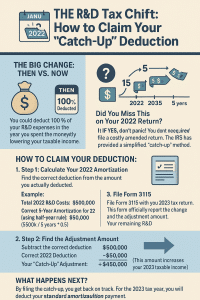
Required Steps to Claim Your R&D Amortization Catch-Up
Getting your catch-up deduction requires specific steps that must be done correctly and on time. First, identify all your domestic research costs from 2022-2024 that were subject to the five-year amortization rules. The types of costs that qualify include compensation, travel expenses, overhead costs such as rent and utilities, and various other research-related expenses.
Next, calculate how much of those costs you have not yet deducted. For costs from 2022, you have already claimed two years of deductions. For 2023 costs, you have claimed one year. For 2024 costs, you have not claimed any deductions yet under the old rules.
Documentation and Filing Requirements
Proper documentation is critical for claiming your catch-up deduction successfully. You need detailed records showing which costs qualify as research expenses under Section 174. This includes employee time sheets, project descriptions, cost allocation methods, and documentation proving that the work was performed in the United States.
The filing process may require an accounting method change form to be included with your tax return. This tells the IRS that you are switching from the five-year amortization method to immediate expensing for future costs and claiming the catch-up for past expenses.
Tax Planning Opportunities with R&D Amortization Changes
The restoration of immediate research expensing creates new tax planning opportunities that smart businesses should consider. Companies can now coordinate their research deductions with their Section 41 research credit claims for maximum benefit. This coordination can be worth hundreds of thousands of dollars for companies with significant research activities.
Consider timing new research projects to take advantage of the restored immediate expensing. If you have been delaying research investments because of the amortization rules, 2025 might be the perfect time to move forward with those projects.
| R&D Investment | Immediate Deduction | Research Credit (20%) | Total Tax Benefit |
|---|---|---|---|
| $1,000,000 | $210,000 | $200,000 | $410,000 |
| $500,000 | $105,000 | $100,000 | $205,000 |
| $250,000 | $52,500 | $50,000 | $102,500 |
Cash Flow Impact and Business Investment
The immediate cash flow improvement from catch-up deductions can help fund additional research projects or other business investments. Many companies found that the five-year amortization rules made it harder to justify research spending because the tax benefits were delayed.
Now that immediate expensing is back, companies can make research investment decisions based on the true economic cost after considering immediate tax savings. This should encourage more innovation and business growth across all industries that depend on research and development.
Common Mistakes to Avoid with R&D Amortization
Several common mistakes can cost you money or create problems with the IRS when claiming your catch-up deduction. The biggest mistake is failing to properly identify which costs qualify as research expenses under the tax law. Not all development work qualifies – the activities must meet specific technical requirements.
Another mistake is missing the deadline for making elections. Small businesses have only one year from the effective date of the law to choose the retroactive option. Missing this deadline means you will be subject to the catch-up deduction approach instead of receiving immediate refunds.
Working with Foreign Research Costs
Foreign research expenses must still be amortized over 15 years, even under the new law. This creates complexity for companies that conduct research both in the United States and overseas. You need to carefully track which costs relate to domestic versus foreign research activities.
The allocation between domestic and foreign research can significantly impact your R&D tax benefits. Domestic research is eligible for immediate expensing and qualifies for the research credit, whereas foreign research receives neither benefit. Proper documentation of where research activities occur is essential for maximizing your tax savings.
See if your business qualifies for tax credits HERE.

Industry-Specific R&D Amortization Considerations
Different industries face unique challenges and opportunities with the restored research expensing rules. Software companies, for example, need to understand how the rules apply to software development activities. The IRS guidance distinguishes between software development (which qualifies) and data entry or database maintenance (which does not qualify).
Manufacturing companies often have research costs spread across multiple facilities and product lines. They need systems to track which costs relate to qualifying research activities versus routine production or quality control work. Biotechnology and pharmaceutical companies typically have clear research activities but must also manage the complexity of long-term clinical trials.
Service Industry Applications
Even service industries can benefit from research expensing if they develop new processes, software, or methods of delivering services. The key is showing that the activities involve experimentation to eliminate uncertainty about developing new or improved business components.
Professional service firms developing new service delivery methods, financial companies creating new trading algorithms, and retail companies testing new customer engagement technologies may all qualify for research benefits if their activities meet the technical requirements.
The restoration of immediate research expensing represents a major opportunity for businesses that invest in innovation. Whether you qualify for retroactive relief as a small business or need to use the catch-up deduction as a larger company, proper planning and execution can generate significant tax savings. The key is acting quickly to understand your options, gather the necessary documentation, and make the right elections before the deadlines pass. With immediate expensing back in place, now is the perfect time to review your research activities and ensure you are capturing every available tax benefit.
R&D Amortization FAQs
Can I claim the catch-up deduction if I never filed for R&D expenses before 2022?
Can you claim the catch-up deduction if you never filed for R&D expenses before 2022? Yes, you can still claim the catch-up deduction for qualified research expenses you incurred during 2022-2024, even if you did not properly claim them on your original returns. However, you may need to file amended returns for those years to establish the basis for your catch-up deduction, and you should work with a tax professional to ensure compliance with all requirements.
What happens if I choose the wrong election method for my catch-up deduction?
What happens if you choose the wrong election method for your catch-up deduction? Once you make an election regarding your R&D amortization method (either retroactive relief for small businesses or the catch-up deduction timing), it is generally difficult to change without IRS permission. This is why careful planning with a qualified tax advisor is essential before making your election to ensure you choose the method that provides the maximum benefit for your specific situation.
Do state taxes follow the same rules as federal taxes for R&D amortization changes?
Do state taxes follow the same rules as federal taxes for R&D amortization changes? State tax treatment varies significantly because not all states automatically conform to federal tax law changes. Some states may continue requiring five-year amortization even though federal law now allows immediate expensing, while others may adopt the federal changes with different effective dates or modifications, so you need to check each state’s specific rules where your business operates.

Paul Kohn MBA is a seasoned business consultant known for helping businesses maximize tax credits and incentives to fuel growth and profitability. He holds a Master’s in Business Administration and has helped numerous companies secure millions in tax credits and implement effective business strategies. He is regarded as a trusted authority for business owners seeking to optimize their savings and growth.