

Key Takeaways
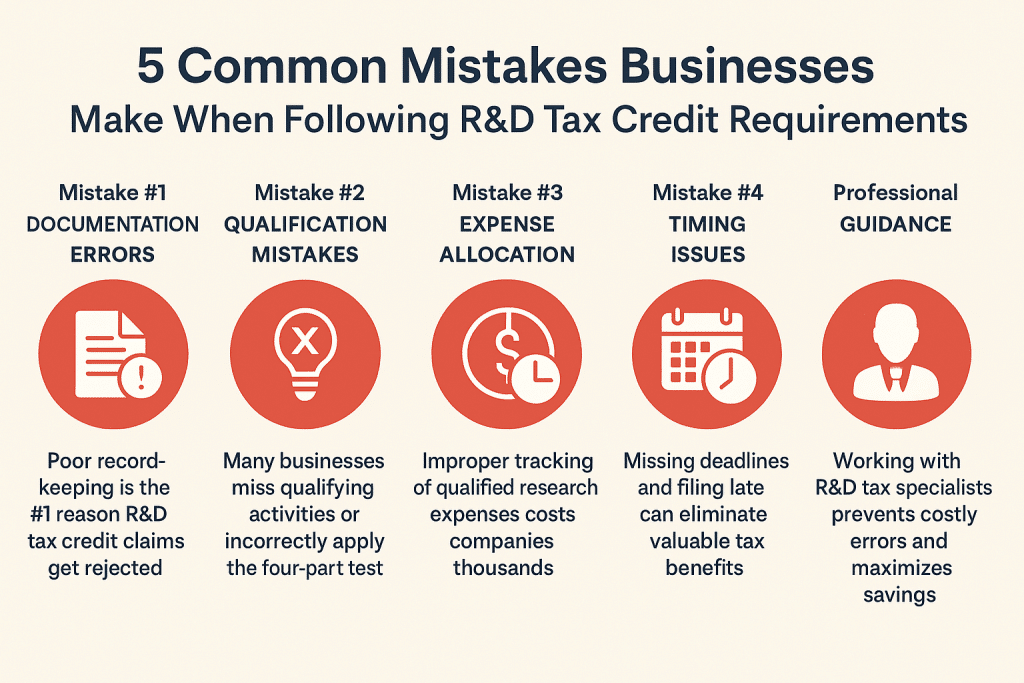
- Documentation Errors: Poor record-keeping is the #1 reason R&D tax credit claims get rejected
- Qualification Mistakes: Many businesses miss qualifying activities or incorrectly apply the four-part test
- Expense Allocation: Improper tracking of qualified research expenses costs companies thousands
- Timing Issues: Missing deadlines and filing late can eliminate valuable tax benefits
- Professional Guidance: Working with R&D tax specialists prevents costly errors and maximizes savings
- Compliance Focus: Following IRS requirements exactly protects against audits and penalties
Understanding R&D tax credit requirements can save your business thousands of dollars each year, but many companies make costly mistakes that reduce their benefits or trigger IRS problems. The Research and Development tax credit offers dollar-for-dollar savings against your tax bill, but following the requirements properly is essential for maximizing these valuable benefits while staying compliant with federal regulations.
Understanding R&D Tax Credit Requirements for Maximum Benefit
The R&D tax credit offers businesses substantial tax benefits for qualifying research activities. However, the R&D tax credit requirements are complex and specific. Companies must meet the IRS four-part test, maintain proper documentation, and track qualified expenses correctly. Understanding these requirements helps businesses avoid common pitfalls that can result in thousands of dollars in lost savings or create compliance issues.
Many businesses think they do not qualify for R&D tax credits because they associate research with laboratories or high-tech companies. The reality is much broader. Manufacturing companies that improve their processes, software developers creating new applications, and even restaurants testing new recipes can qualify under the right circumstances. The key is understanding how your activities match the specific requirements set by the IRS.
| Requirement | What It Means | Common Example |
|---|---|---|
| Permitted Purpose | Creating new or improved business components | Developing faster software features |
| Elimination of Uncertainty | Resolving technical unknowns | Testing which material works best |
| Process of Experimentation | Systematic testing and evaluation | Running multiple prototypes |
| Technological in Nature | Based on hard sciences | Using engineering principles |
Mistake #1: Poor Documentation of R&D Tax Credit Requirements
The biggest mistake businesses make with R&D tax credit requirements is failing to maintain proper documentation. The IRS requires detailed records that prove your activities qualify for the credit. Many companies try to recreate documentation after the fact, but this approach often fails during audits because the records lack the detail and authenticity that contemporaneous documentation provides.
Proper documentation should include project descriptions, technical challenges faced, methods used to overcome uncertainties, and detailed time tracking for employees working on qualifying activities. The records must clearly show how each activity meets the four-part test required by the IRS. Companies that maintain these records from the beginning of their projects have much stronger claims and face fewer challenges during IRS reviews.
Essential Documentation Components
Successful R&D tax credit claims require specific types of documentation that demonstrate compliance with R&D tax credit requirements. Project files should include initial problem statements, technical approaches considered, experimental results, and conclusions reached. Employee time records must show the percentage of time spent on qualifying activities versus routine work. Financial records must separate qualifying expenses from general business costs.
The documentation should convey the story of your research process. Start with the business problem you were trying to solve, explain the technical uncertainties you faced, describe the experiments you conducted, and document the results you achieved. This narrative approach helps IRS examiners understand why your activities qualify for the credit and demonstrates that you followed a systematic research process.
Mistake #2: Misunderstanding Qualifying Activities Under R&D Tax Credit Requirements
Many businesses incorrectly assume that all development work qualifies for R&D tax credits. The R&D tax credit requirements are very specific about which activities qualify for the credit. Routine data collection, market research, quality control testing, and regular maintenance activities typically do not qualify as research. The activities must involve eliminating technical uncertainty through systematic experimentation based on hard sciences.
A common error is including activities that adapt existing technology without significant modification. Simply customizing software for a client or making minor improvements to existing products usually does not meet the qualification standards. The work must involve substantial technical challenges that require experimentation to resolve. Understanding this distinction helps businesses focus their claims on truly qualifying activities.
Identifying True Research Activities
Qualifying research activities under R&D tax credit requirements must involve the development of new knowledge or capabilities that did not previously exist. This includes creating new products, significantly improving existing ones, developing new manufacturing processes, or creating new software applications. The key is showing that the work involved technical uncertainty that required systematic investigation to resolve.
Consider a manufacturing company developing a new production line. If they are simply installing known technology, this would not qualify. However, suppose they are experimenting with new combinations of existing technologies to achieve better performance or modifying equipment in ways that have not been tried before. In that case, these activities may qualify for the credit.
Mistake #3: Incorrect Expense Allocation for R&D Tax Credit Requirements
Properly tracking and allocating expenses is crucial for meeting R&D tax credit requirements, but many businesses make serious errors in this area. Companies often fail to distinguish between qualifying research expenses and general business costs, resulting in either inflated claims that trigger audits or missed opportunities for legitimate deductions. The IRS requires precise allocation of costs to qualifying activities.
Common expense allocation mistakes include claiming 100% of an employee’s salary when they only spend part of their time on qualifying research, including overhead costs that do not directly support research activities, and failing to exclude costs for activities that do not meet the four-part test. Accurate expense tracking from the project’s inception prevents these problems and maximizes legitimate credit claims.
| Expense Type | Qualifying Example | Non-Qualifying Example |
|---|---|---|
| Employee Wages | Engineers designing new products | Sales staff demonstrating products |
| Materials | Components for testing prototypes | Materials for final production |
| Software | Development tools for new applications | General business software licenses |
| Contractor Costs | Specialists hired for research projects | General consulting services |
Best Practices for Expense Tracking
Successful expense allocation for R&D tax credit requirements requires detailed tracking systems that capture both direct and indirect costs related to qualifying activities. Direct costs include wages for employees working specifically on research projects, materials consumed in experiments, and contractor fees for research services. Indirect costs may include a portion of facility costs, utilities, and equipment depreciation that support research activities.
The allocation methodology must be reasonable and consistently applied. Many companies use time-based allocation for employee costs, where the percentage of time spent on qualifying activities determines the percentage of wages that can be claimed. For shared resources, such as facilities or equipment, companies may allocate costs based on usage or the square footage dedicated to research activities. The key is to document the allocation method and apply it consistently across all projects.
Mistake #4: Timing and Filing Errors with R&D Tax Credit Requirements
Meeting the timing requirements for R&D tax credits is essential, but many businesses make costly mistakes with deadlines and filing procedures. The R&D tax credit requirements include specific deadlines for making elections, filing claims, and responding to IRS requests. Missing these deadlines can eliminate valuable tax benefits or create compliance problems that are expensive to resolve.
One common timing error involves the payroll tax election for small businesses. Companies that qualify can use up to $250,000 of their R&D credit to offset payroll taxes, rather than income taxes. However, this election must be made by the due date of the tax return, and the credit can only be applied starting with the quarter following the election. Companies that miss this deadline lose the opportunity to use their credits against payroll taxes.
Critical Filing Requirements and Deadlines
Understanding the filing requirements for R&D tax credit helps businesses avoid costly timing mistakes. The basic credit claim must be filed with Form 6765 attached to the company’s tax return. For amended returns claiming previously unclaimed credits, businesses generally have three years from the original filing date to do so. However, some situations may extend or limit this timeframe based on specific circumstances.
Small businesses making the payroll tax election face additional timing requirements. The election must be made on the originally filed return or the first amended return filed before the due date. Once created, the election applies to the credit year and the four subsequent tax years. Companies cannot revoke the election once it has been made, so careful consideration is essential before choosing this option.
Mistake #5: Failing to Work with R&D Tax Credit Requirements Specialists
The complexity of R&D tax credit requirements makes professional guidance essential; however, many businesses attempt to handle claims internally without adequate expertise. This approach often leads to missed opportunities, compliance errors, and audit problems that cost far more than professional fees. R&D tax specialists understand the nuances of the law and can help businesses maximize their benefits while minimizing compliance risks.
Working with specialists becomes even more crucial as the IRS intensifies its scrutiny of R&D credit claims. Recent changes to Form 6765 require more detailed information about research activities, and the IRS has strengthened its review procedures. Companies that work with experienced professionals are better positioned to navigate these requirements and defend their claims if selected for examination.
Benefits of Professional R&D Tax Credit Guidance
R&D tax credit specialists bring valuable expertise that helps businesses comply with R&D tax credit requirements while maximizing their benefits. They understand the industry-specific applications of the credit, stay current with changing regulations, and know how to present claims in a way that minimizes audit risk. This expertise often results in larger credit amounts and stronger documentation than companies achieve on their own.
Professional guidance also provides valuable audit support if the IRS examines your R&D credit claims. Specialists can help prepare for audits, respond to IRS requests, and negotiate with examiners to resolve issues efficiently. This support can be crucial for protecting your tax benefits and avoiding penalties that could far exceed the cost of professional assistance.
Additional R&D Tax Credit Requirements Compliance Strategies
Beyond avoiding common mistakes, businesses should implement proactive strategies to ensure ongoing compliance with R&D tax credit requirements. Regular training for project managers and finance staff helps maintain proper documentation practices throughout the year. Quarterly reviews of potential qualifying activities ensure that businesses capture all eligible expenses and identify issues before they become problems.
Technology solutions can also support compliance efforts. Time tracking software, project management systems, and specialized R&D credit software help automate documentation and expense allocation processes. These tools reduce the administrative burden of compliance while improving accuracy and completeness of claims.
| Compliance Area | Action Required | Frequency |
|---|---|---|
| Documentation | Maintain contemporaneous project records | Ongoing |
| Expense Tracking | Allocate costs to qualifying activities | Monthly |
| Activity Review | Assess projects against four-part test | Quarterly |
| Professional Review | Specialist evaluation of claims | Annually |
Building Long-Term R&D Tax Credit Success
Success with R&D tax credit requirements requires building systems and processes that support consistent compliance over time. Companies should establish clear procedures for identifying qualifying activities, documenting research processes, and tracking related expenses. Training programs help ensure that all relevant staff understand their roles in supporting R&D credit claims.
Regular review and improvement of these processes help companies adapt to changing requirements and business conditions. As companies grow or change their business models, their R&D activities often change accordingly. Periodic assessment ensures that compliance procedures remain effective and that businesses continue to capture all available tax benefits while meeting IRS requirements.
Avoiding common mistakes with R&D tax credit requirements helps protect your business from costly compliance issues while maximizing valuable tax benefits. The key is understanding the specific requirements, maintaining proper documentation, working with qualified professionals, and building systems that support ongoing compliance. Companies that take these steps can confidently claim R&D tax credits while minimizing audit risk and maximizing their tax savings. Remember that the complexity of these requirements makes professional guidance essential for most businesses, and the investment in proper compliance typically pays for itself many times over through increased tax benefits and reduced compliance risks.
R&D Tax Credit Requirements FAQs
What documentation is required to prove R&D tax credit requirements are met?
What documentation is required to prove R&D tax credit requirements are met? You must maintain contemporaneous records including project descriptions, technical challenges, experimental methods, employee time tracking, and financial records that clearly separate qualifying expenses from routine business costs. The documentation should demonstrate how each activity meets the four-part test and show the systematic research process used to eliminate technical uncertainty.
Can software development activities qualify under R&D tax credit requirements?
Can software development activities qualify under R&D tax credit requirements? Yes, software development can qualify if it involves creating new functionality, improving performance, or solving technical challenges through systematic experimentation, but routine programming, maintenance, and customization of existing software typically do not meet the qualification standards. The development must involve eliminating technical uncertainty about how to achieve specific capabilities or performance improvements.
How do small businesses meet R&D tax credit requirements for payroll tax offsets?
How do small businesses meet R&D tax credit requirements for payroll tax offsets? Small businesses with less than $31 million in gross receipts and no more than five years of revenue generation can elect to use up to $250,000 of R&D credits annually against payroll taxes by making the election on their tax return. The election must be made by the return due date and applies for five consecutive years once selected.
What expenses do not qualify under R&D tax credit requirements?
What expenses do not qualify under R&D tax credit requirements? Non-qualifying expenses include market research, routine quality control, general business operations, foreign research activities (which have separate rules), and activities after commercial production begins. Only expenses directly related to eliminating technical uncertainty through systematic experimentation qualify for the credit.
How often should businesses review their compliance with R&D tax credit requirements?
How often should businesses review their compliance with R&D tax credit requirements? Businesses should conduct quarterly reviews of potential qualifying activities and maintain ongoing documentation practices, with annual professional reviews to ensure claims are properly prepared and supported. Regular review helps identify qualifying activities promptly and maintains the contemporaneous documentation that the IRS requires for valid claims.

Paul Kohn MBA is a seasoned business consultant known for helping businesses maximize tax credits and incentives to fuel growth and profitability. He holds a Master’s in Business Administration and has helped numerous companies secure millions in tax credits and implement effective business strategies. He is regarded as a trusted authority for business owners seeking to optimize their savings and growth.