
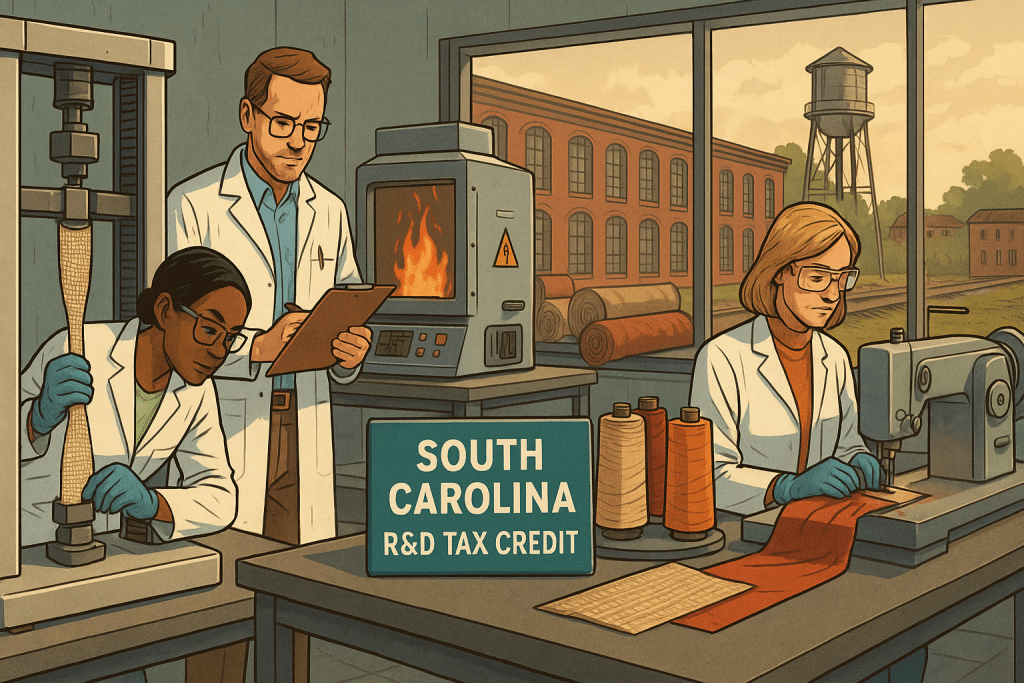
The South Carolina R&D tax credit offers businesses a 5% credit on qualified research expenses conducted within the state, with unused credits carrying forward for 10 years. When combined with recent federal tax law changes that now allow immediate expensing of domestic R&D costs, South Carolina companies can see dramatic improvements in cash flow and tax savings.
Key Takeaways
- South Carolina businesses can claim a 5% state credit on top of the federal R&D tax credit, creating a double benefit that many companies overlook.
- The One Big Beautiful Bill Act signed in July 2025 restored permanent immediate expensing for domestic R&D expenses, making the combined federal and state credits significantly more valuable.
- Your business must claim the federal R&D credit first to qualify for South Carolina’s state credit – they work together, not separately.
- The credit can offset up to 50% of your tax liability each year, with unused amounts carrying forward for a decade.
- South Carolina’s aerospace, automotive, manufacturing, and biotech industries are perfectly positioned to benefit from these combined incentives.
What Makes South Carolina’s R&D Credit Different
Here’s something most business owners don’t realize: South Carolina doesn’t calculate its own version of the R&D credit from scratch. Instead, the state piggybacks directly on your federal credit calculation under IRC Section 41.
Think about what this means for you. If you’re already claiming the federal credit (and you should be), adding South Carolina’s state credit is straightforward. The state doesn’t make you jump through completely different hoops or hire additional consultants to figure out a separate calculation method.
Under S.C. Code Section 12-6-3415, South Carolina gives you 5% of your qualified research expenses that happen within state lines. That’s in addition to the federal credit you’re claiming. A manufacturing company in Greenville developing new aerospace components doesn’t just get federal tax relief – they stack the state credit on top.
One catch exists: you absolutely must claim your federal R&D credit first. South Carolina requires that federal claim as proof that your activities qualify. Miss the federal credit, and you’ve locked yourself out of the state benefit too.
Recent Federal Changes That Turbocharged the R&D Credit
Something happened in July 2025 that changed everything for companies doing R&D. President Trump signed the One Big Beautiful Bill Act, and buried in that massive piece of legislation was a game-changing provision for businesses investing in innovation.
Before this law, companies had to capitalize and amortize their domestic R&D expenses over five years starting in 2022. That meant if you spent $500,000 on research and development, you could only deduct $100,000 per year for five years. Your cash was tied up, and your tax benefit was spread thin.
The new law flipped that completely. Starting with tax years after December 31, 2024, you can immediately expense all domestic R&D costs again. That $500,000? You deduct it all in year one. For businesses in South Carolina’s aerospace sector developing new manufacturing processes or biotech companies working on breakthrough treatments, this creates immediate cash flow that can fund the next phase of research.
Small businesses got an even better deal. If your company has less than $31 million in gross receipts and you incurred R&D expenses between December 31, 2021 and January 1, 2025, you can go back and amend those returns. That’s potentially three years of retroactive deductions you can claim right now.
Here’s what this means when combined with South Carolina’s state credit: You’re not just getting a federal tax credit and a state tax credit anymore. You’re also getting immediate deductions that boost your current year’s cash position. A company spending $1 million on qualified research in South Carolina could see the federal credit, the state credit, and full current-year expensing all working together.
Who Qualifies for South Carolina’s R&D Credit
Walk into any BMW facility in the Upstate, any Boeing plant in Charleston, any pharmaceutical manufacturer in Columbia, and you’ll find companies doing work that qualifies. But here’s where businesses trip up: they think R&D means guys in white lab coats mixing chemicals.
The federal four-part test that South Carolina relies on is broader than most people realize. Your activities need to:
First, they must develop or improve a business component – a product, process, software, formula, or technique. When Volvo’s engineers in Ridgeville work on improving their manufacturing line to produce electric vehicles more efficiently, that counts. When a software company in Greenville writes code to solve technical challenges in their platform, that counts too.
Second, you need to be eliminating uncertainty. You’re trying to figure out how to make something work, what design approach achieves the best result, or which method solves a specific technical problem. An automotive supplier in Spartanburg testing different materials to improve component durability is eliminating uncertainty about which material performs best under stress.
Third, your process needs to involve experimentation. You’re testing, modeling, simulating, or prototyping to evaluate alternatives. This doesn’t mean formal scientific method with control groups. It means you tried multiple approaches to see what worked.
Fourth, it must rely on hard sciences – engineering, physics, chemistry, computer science, biology. Marketing research and consumer surveys don’t qualify, even if they involve testing.
The research must physically happen in South Carolina. If you have operations in multiple states, only the work performed by South Carolina employees or contractors working within the state counts toward your state credit calculation.
Breaking Down the Numbers
| Business Scenario | Qualified SC Research Expenses | State Credit (5%) | Tax Liability Cap Impact |
|---|---|---|---|
| Small Manufacturing Firm | $200,000 | $10,000 | Can use immediately if liability exceeds $20,000 |
| Mid-Size Tech Company | $800,000 | $40,000 | Can use immediately if liability exceeds $80,000 |
| Large Aerospace Supplier | $2,500,000 | $125,000 | Can use immediately if liability exceeds $250,000 |
| Biotech Startup | $400,000 | $20,000 | Carries forward if insufficient current liability |
That 50% limitation trips up companies every year. You calculate your total state tax liability, subtract all other credits you’re claiming, and whatever’s left is your baseline. The R&D credit can only reduce that remaining amount by half.
Let’s say your company has a $100,000 South Carolina tax liability. After claiming other credits, you’re down to $60,000. Your R&D credit calculation shows you earned $45,000 in credits this year. You can only use $30,000 this year (50% of the $60,000 remaining liability). The extra $15,000 carries forward to next year.
That 10-year carryforward becomes crucial for growing companies. Your R&D spending often outpaces your profit growth in the early years. Those banked credits sit there waiting, ready to offset taxes as your company scales. A biotech firm spending heavily on R&D today might have minimal tax liability for the first few years, but as they commercialize their products and profits increase, those carried-forward credits can dramatically reduce their tax burden.
South Carolina’s Innovation Economy
South Carolina isn’t randomly offering this credit. The state has deliberately built an economy where innovation thrives, and the numbers back it up.
The aerospace sector alone contributes $38.3 billion annually to South Carolina’s economy and supports 143,581 jobs. Since Boeing selected North Charleston for its final assembly facility in 2009, the state’s aerospace industry has grown faster than any other state – 21.7% employment growth since 2019. Companies like Lockheed Martin opened F-16 production lines in Greenville. Woodward invested nearly $200 million in a new Spartanburg facility. These aren’t just assembly operations – they’re doing real R&D work on advanced materials, manufacturing processes, and aerospace technologies.
The automotive sector tells a similar story. BMW’s Spartanburg plant has grown from that first vehicle rolling off the line in 1994 to becoming a $27 billion economic driver. Volvo invested over $1 billion in their Ridgeville facility. Mercedes produces electric vans in North Charleston. South Carolina became the nation’s top exporter of both completed passenger vehicles and tires, not through cheap labor but through continuous innovation in manufacturing processes and product development.
The life sciences industry might be South Carolina’s fastest-growing sector, with an annual economic impact of $25.7 billion. Companies like Nephron Pharmaceuticals, Ritedose Corporation, and dozens of biotech startups are conducting drug development, developing medical devices, and researching new treatments. The state has built infrastructure specifically to support this – from wet lab space in Charleston’s Blue Sky Labs to research partnerships with the Medical University of South Carolina.

What Counts as Qualified Research Expenses
The expenses that generate your 5% credit break down into three main buckets, and understanding each one helps you capture the full value available.
Wages for Research Activities
This is often your biggest category. Any employee substantially engaged in qualified research activities generates qualified wage expenses. That aerospace engineer spending 80% of her time designing new components? 80% of her wages count. The software developers writing code to solve technical challenges? Their time counts. Even the technicians running experiments and tests contribute to qualified wages.
The key word is “substantially.” Part-time involvement counts. Your engineering manager who splits time between R&D projects and other duties can allocate their wages accordingly. Companies often undercount here because they don’t realize that support personnel directly supervising or directly supporting R&D activities can qualify too.
Supply Costs
Materials consumed in your research process count. An automotive parts manufacturer testing different metal alloys can include the cost of those materials. A pharmaceutical company running drug trials can include the compounds and materials used in testing. The software company? Their cloud computing costs for development and testing environments qualify.
Supplies must be consumed in the research process – you can’t count equipment that has a useful life beyond the project. That testing equipment you purchased might not count as a supply, but the materials you run through that equipment do.
Contract Research
When you pay someone else to conduct research on your behalf, 65% of those payments can count as qualified expenses. A company hiring Clemson University to conduct materials research for a new manufacturing process can include 65% of what they pay Clemson. A biotech firm contracting with an independent lab for testing work captures 65% of those costs.
The research must still meet all the qualifications – it needs to be your research project, eliminating your technical uncertainty, even if someone else is performing the work under contract.
Industries Taking Full Advantage in South Carolina
Key Sectors Claiming Maximum R&D Benefits:
- Aerospace Manufacturing: Companies developing advanced composites, precision components, and aerospace systems. Boeing’s work on commercial aircraft, Lockheed Martin’s F-16 production involving continuous improvement processes, and suppliers creating specialized parts all generate substantial qualified expenses.
- Automotive Engineering: BMW testing new electric vehicle technologies, Volvo improving manufacturing efficiency, suppliers developing components with better performance characteristics. The automotive sector’s $27 billion impact includes massive R&D investment.
- Pharmaceutical and Biotech: Nephron Pharmaceuticals developing new drug delivery systems, Ritedose Corporation working on blow-fill-seal technology improvements, smaller biotech firms researching disease treatments. The state’s $25.7 billion life sciences sector runs on innovation.
- Advanced Manufacturing: Companies across multiple sectors improving production processes, developing automation solutions, testing new materials, and solving technical challenges in their manufacturing operations.
- Software Development: Tech companies building applications that solve technical problems, improving algorithms, developing new features that required experimentation and testing to achieve functionality.
Federal vs. State Credit: How They Work Together
| Feature | Federal R&D Credit | South Carolina R&D Credit |
|---|---|---|
| Credit Rate | Varies by calculation method (typically 6-10% of incremental spending) | Flat 5% of all SC qualified expenses |
| Calculation Method | Complex formulas comparing current to historical spending | Simple: 5% of total qualified SC expenses |
| Annual Limit | Can offset entire federal tax liability (with payroll option for startups) | Cannot exceed 50% of state tax liability after other credits |
| Carryforward Period | 20 years | 10 years |
| Refundability | No, but startups can apply against payroll taxes | No |
| Location Requirement | Research can occur anywhere in the U.S. | Research must physically occur in South Carolina |
| Prerequisite | None | Must claim federal credit first |
The relationship between these credits matters. You’re not choosing one or the other – you’re stacking them. A company with $1 million in qualified South Carolina research expenses might see a federal credit of $70,000 to $100,000 (depending on their calculation method and history) plus a guaranteed South Carolina credit of $50,000. That’s $120,000 to $150,000 in combined tax relief from the same research spending.
Filing Your South Carolina R&D Credit
South Carolina keeps the paperwork straightforward compared to some states. You’ll use Schedule TC-18, which gets attached to your state corporate income tax return.
The form asks for pretty basic information. You report your total qualified research expenses made in South Carolina during the tax year. You multiply that by 5% to get your current year credit. If you have credits carried forward from previous years, you add those in. Then the form walks you through the 50% limitation calculation to figure out how much you can actually use this year.
For pass-through entities like S corporations and partnerships, the credit flows through to the owners. The entity claims the credit on Schedule TC-18, then the individual shareholders or partners include their share on their personal returns. You’ll need to track which entity generated the credit and provide the entity’s FEIN on the form.
Filing deadlines follow your regular South Carolina corporate income tax return deadlines. Most calendar-year corporations file by April 15th, with a six-month extension available. Don’t miss that window – you need to claim the credit in the year the research expenses occurred, not when you discover you qualified.
Documentation You Actually Need
South Carolina doesn’t require you to submit detailed documentation with your initial filing, but don’t let that fool you. The state can audit your credit claim, and when they do, you’ll need solid documentation backing up every dollar.
Keep contemporaneous records. “Contemporaneous” means created at or near the time the activities occurred, not reconstructed years later when the auditor shows up. Project plans, engineering notebooks, test results, emails discussing technical challenges, meeting notes about design decisions – these all matter.
Track time carefully. If you’re claiming wages, you need some way to substantiate that employees actually worked on qualified activities. Time sheets, project codes, or even reasonable estimates based on project assignments work, but you can’t just guess after the fact.
Document your technical uncertainty. What problem were you trying to solve? What alternatives did you consider? Why wasn’t the solution obvious? Capture this while you’re doing the work, not years later.
According to tax credit specialists, “The companies that maximize their R&D credits aren’t necessarily doing more research – they’re just better at identifying and documenting the qualified work they’re already doing. Most businesses leave money on the table because they don’t realize their day-to-day innovation qualifies.”
Real-World Impact: How South Carolina Companies Benefit
Manufacturing Success: A South Carolina automotive parts manufacturer developing specialized components for the aerospace industry claimed the state R&D credit for a multi-year prototype project. The work involved designing highly specialized parts that required extensive testing and iteration. Over two tax years, the company qualified for $116,263 in South Carolina state credits on top of their $213,867 in federal credits. Those combined savings helped fund the next generation of product development.
Pharmaceutical Innovation: A mid-sized pharmaceutical manufacturer in Columbia spent $2.3 million on qualified research activities developing new drug delivery mechanisms. The company claimed $115,000 in South Carolina credits, which they used partially in the current year and carried forward $40,000 to future years as their tax liability grew. The immediate cash flow from the current-year credit covered equipment purchases for their next research phase.
Why Professional Help Matters
Let’s be honest about something: calculating R&D tax credits correctly is technical work that most in-house accounting teams aren’t equipped to handle. That’s not a knock on your team – it’s just reality. These credits require understanding tax law, engineering principles, and documentation requirements that most generalist CPAs don’t deal with regularly.
A specialized R&D tax credit firm brings three things your regular accountant usually can’t: First, they know how to identify qualified activities you didn’t realize counted. Your engineers probably aren’t thinking about tax credits when they’re solving technical problems. A good R&D specialist interviews your technical team, reviews your projects, and finds qualifying work you overlooked.
Second, they handle the documentation properly. They know what the IRS and South Carolina Department of Revenue expect to see during an audit. They help you create the contemporaneous records that protect your credit claim years down the road.
Third, they usually work on contingency or for a percentage of the credits they identify. That means no upfront cost – you only pay when you actually receive tax savings. For many businesses, the additional credits a specialist finds more than covers their fee.
The recent changes to R&D expensing under the One Big Beautiful Bill Act add another layer of complexity. Deciding whether to take immediate expensing or amortize expenses, figuring out retroactive opportunities for small businesses, coordinating the R&D credit with bonus depreciation – these decisions have real cash flow implications that require modeling and expertise.
Looking Ahead: South Carolina’s R&D Investment
South Carolina isn’t sitting still. The state continues investing in research infrastructure through institutions like the South Carolina Research Authority (SCRA), which provides funding and support for academic startups, facilitates partnerships between industry and universities, and helps technology companies relocate to the state.
The University of South Carolina’s McNair Center for Aerospace Innovation and Research brings in $30 million annually in research grants. Clemson’s Center for Advanced Engineering Fibers and Films pushes boundaries in materials science. The Medical University of South Carolina drives innovation in medical devices and treatments. These aren’t just academic exercises – they’re creating commercial opportunities and qualified research activities for businesses partnering with these institutions.
Organizations like SC Commerce actively recruit companies doing innovative work, and they understand that tax incentives like the R&D credit play a role in location decisions. When aerospace companies choose between sites in different states, South Carolina’s combination of skilled workforce, research partnerships, and tax incentives makes a difference.
The state’s cluster approach – deliberately building concentrations of related industries – creates ecosystems where innovation happens naturally. Aerospace suppliers locate near Boeing and Lockheed Martin. Automotive suppliers cluster around BMW and Volvo. Biotech companies gravitate toward medical research institutions. That concentration means more qualified research activities, more cross-pollination of ideas, and more opportunities to claim R&D credits.
Conclusion
The South Carolina R&D tax credit represents real money for companies doing innovative work in the state. When you combine the 5% state credit with recent federal changes allowing immediate R&D expensing, the total benefit creates meaningful cash flow that can fund your next round of innovation.
The credit isn’t limited to big corporations or traditional research labs. If you’re solving technical problems, improving products or processes, or developing new capabilities through experimentation, there’s a good chance your activities qualify. The question isn’t whether the credit exists – it’s whether you’re capturing it.
Start by evaluating your current research activities against the four-part test. Look at your engineering work, product development, process improvements, and software development. Then talk to a specialized R&D tax credit firm about quantifying your opportunity and ensuring proper documentation. With the federal law changes making these credits more valuable than ever, now’s the time to make sure you’re not leaving money on the table.
South Carolina R&D Tax Credit FAQs
Can startups with no tax liability benefit from the South Carolina R&D tax credit?
Startups can claim the South Carolina R&D tax credit, but since it’s non-refundable, they won’t receive a cash payment if they have zero state tax liability. The benefit comes through the 10-year carryforward period – as the startup grows and begins generating taxable income, those accumulated credits reduce future tax bills substantially.
Do software companies qualify for South Carolina’s R&D tax credit?
Software companies frequently qualify for the South Carolina R&D tax credit when they’re developing new features, improving algorithms, or solving technical challenges through experimentation. The key is showing that the work involved technical uncertainty that required a process of evaluation and testing, not just routine coding or applying existing knowledge.
How does the South Carolina R&D tax credit interact with the federal credit?
The South Carolina R&D tax credit requires businesses to first claim the federal R&D credit under IRC Section 41, then the state provides an additional 5% credit on qualified expenses occurring within South Carolina. These credits stack together, providing combined federal and state tax relief on the same research spending.
What happens to my South Carolina R&D tax credit if I have more credit than tax liability?
When your South Carolina R&D tax credit exceeds the 50% limitation on your current year’s tax liability, the unused portion carries forward for up to 10 years. These carryforward credits can be used in future years when you have sufficient tax liability, making them valuable for growing companies whose R&D spending currently exceeds their profitability.
Does contract research performed outside South Carolina count toward the state credit?
Contract research only generates South Carolina R&D tax credits when the actual research activities occur within South Carolina. If you’re contracting with an out-of-state university or research firm, those costs may qualify for your federal credit but won’t count toward your South Carolina state credit calculation.
R&D Tax Credits by State
Alaska
Arizona
Arkansas
California
Colorado
Connecticut
Delaware
Florida
Georgia
Hawaii
Idaho
Illinois
Indiana
Iowa
Kansas
Kentucky
Louisiana
Maine
Maryland
Massachusetts
Michigan
Minnesota
Missouri
Mississippi
Montana
Nebraska
Nevada
New Hampshire
New Jersey
New Mexico
New York
North Carolina
North Dakota
Ohio
Oklahoma
Oregon
Pennsylvania
Rhode Island
South Carolina
South Dakota
Tennessee
Texas
Utah
Vermont
Virginia
Washington
West Virginia
Wisconsin
Wyoming
Citations
- South Carolina Code Section 12-6-3415 – Tax credit for research and development expenditures, Justia
- Schedule TC-18: Research Expenses Credit, South Carolina Department of Revenue
- SC Aerospace – South Carolina Council on Competitiveness
- Aerospace Industry Company Relocation, South Carolina Department of Commerce
- Automotive Manufacturing & Industry Growth in South Carolina, South Carolina Department of Commerce
- Life Sciences – Research & Manufacturing Industry, South Carolina Department of Commerce
- South Carolina Aerospace Cluster Soars to New Heights, Columbia Business Monthly
- Life Sciences Hub in Upstate SC, Upstate SC Alliance